


- Bitcoin remains above $60,000 but still lacks the momentum to rebound despite the stock market rally.
- Strategy has sold another 1,683 Bitcoins.
- Capital inflows into spot Bitcoin ETFs are gradually increasing.
- BlackRock continues to expand its tokenization initiatives and experiment with blockchain-based fund infrastructure.

- Bitcoin remains above $60,000 but still lacks the momentum to rebound despite the stock market rally.
- Strategy has sold another 1,683 Bitcoins.
- Capital inflows into spot Bitcoin ETFs are gradually increasing.
- BlackRock continues to expand its tokenization initiatives and experiment with blockchain-based fund infrastructure.
That catalyst, however, has yet to materialize in either direction. While the S&P 500 continues to reach fresh all-time highs and the U.S. dollar has weakened noticeably, Bitcoin has still failed to gather enough momentum to break convincingly above the psychologically important $70,000 level.
When Could the Crypto Bull Market Return?
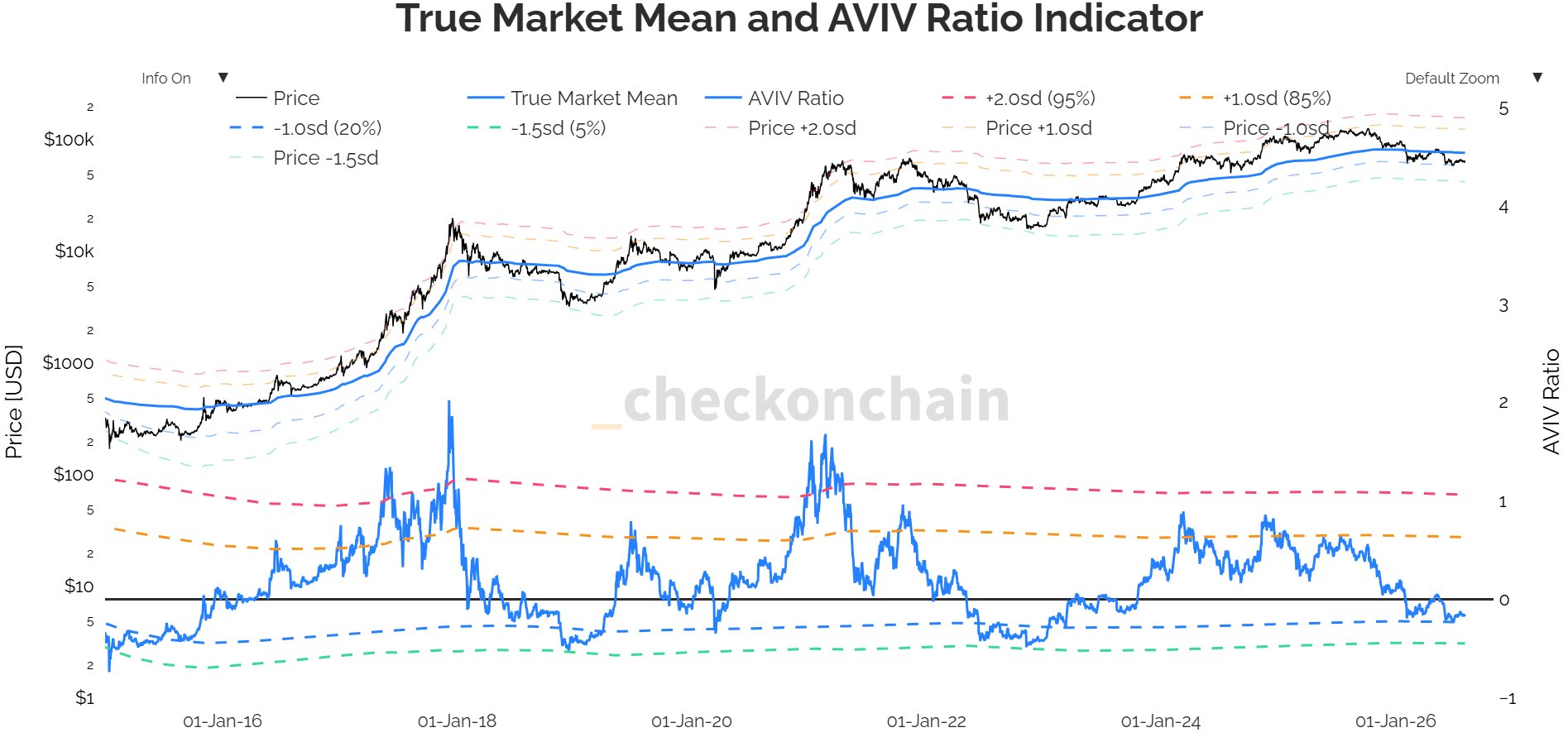
From a cyclical perspective, the cryptocurrency market currently finds itself in a fairly familiar position. If previous Bitcoin market cycles continue to serve as a useful guide, the first meaningful phase of a new recovery could begin around November or December this year. Until then, another and perhaps final capitulation phase cannot be ruled out. Such a move could drive Bitcoin toward the $45,000 area, where the price would approach approximately -1.5 standard deviations from its long-term average. Historically, this level has often marked the lower boundary of Bitcoin bear markets and served as an attractive accumulation zone during previous cycles.
Although Bitcoin has successfully defended the $60,000 area in recent months, market participation remains relatively subdued. ETF inflows have improved only recently, while spot market activity still lacks the strength typically associated with a sustainable bullish reversal. Investors currently appear more attracted to equities and even precious metals than to digital assets. As long as Bitcoin remains below $70,000, it is difficult to argue that a decisive trend reversal has begun.
Source: Checkonchain
Strategy Sells More Bitcoin While Coinbase Results Weigh on Sentiment
The largest corporate Bitcoin holder, Strategy, disclosed the sale of another 1,683 BTC, worth approximately $105 million. This marked the company's third sale in recent weeks and came shortly after it reported weaker-than-expected quarterly earnings, largely driven by unrealized losses on its Bitcoin holdings.
Sentiment across the cryptocurrency sector was also hurt by disappointing earnings from Coinbase, reminding investors that digital asset companies remain highly sensitive to fluctuations in crypto prices and trading activity. Despite these transactions, Strategy continues to hold by far the largest corporate Bitcoin treasury. However, if the current bear market were to extend until 2028 and break the historical four-year cycle that has defined Bitcoin for more than a decade, Strategy could eventually be forced to liquidate additional holdings. In an environment characterized by limited liquidity and subdued investor demand, further large-scale sales could amplify volatility and place additional downward pressure on Bitcoin prices.
BlackRock Continues Tokenization Push as Traditional Finance Moves On-Chain
One of the more constructive developments for the industry comes from BlackRock's continued expansion into tokenized financial assets. The asset manager has launched tokenized share classes for selected European money market funds managing more than $300 billion in combined assets.
Developed in partnership with JPMorgan's Kinexys blockchain platform, the solution allows qualified investors to transfer fund ownership around the clock using blockchain technology while preserving the traditional shareholder registry. The initiative represents another important milestone in the gradual convergence of traditional finance and distributed ledger technology. At the same time, this structural trend continues to develop largely independently from the short-term performance of cryptocurrencies themselves.
Bitcoin ETF Inflows Turn Positive Again
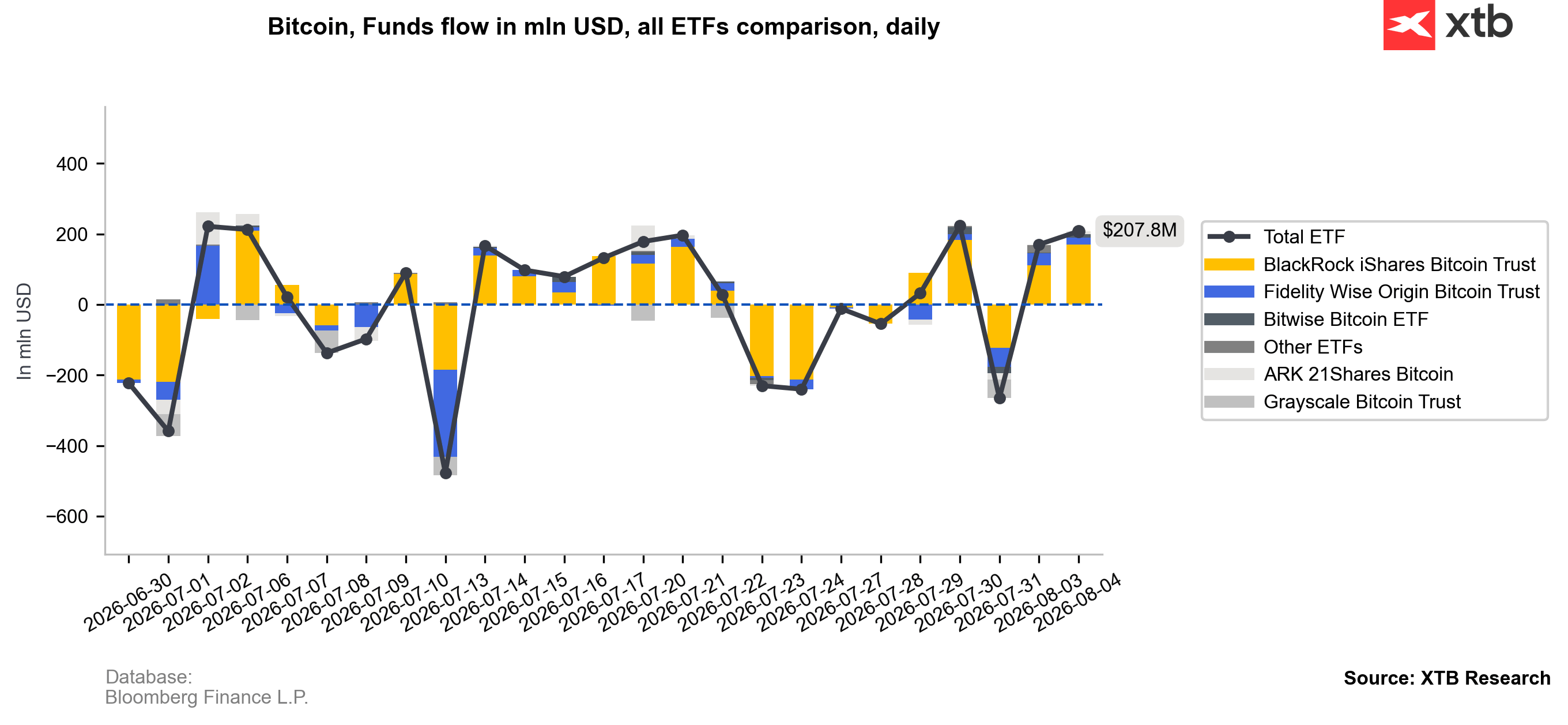
Capital flows into U.S. spot Bitcoin ETFs have returned to positive territory, with daily inflows exceeding $200 million during recent trading sessions. BlackRock's iShares Bitcoin Trust (IBIT) continues to account for the largest share of new institutional allocations, reinforcing its position as the dominant vehicle for institutional Bitcoin exposure.
The improvement in fund flows suggests institutional investors are gradually rebuilding positions following several weeks of outflows. Historically, sustained ETF inflows have often provided an important foundation for medium-term price appreciation. As a result, ETF demand remains one of the most closely watched indicators of institutional sentiment and may currently offer a more meaningful signal than short-term retail trading activity.
Source: XTB Research, Bloomberg Finance L.P.
Capital Rotates Toward Selected Altcoins
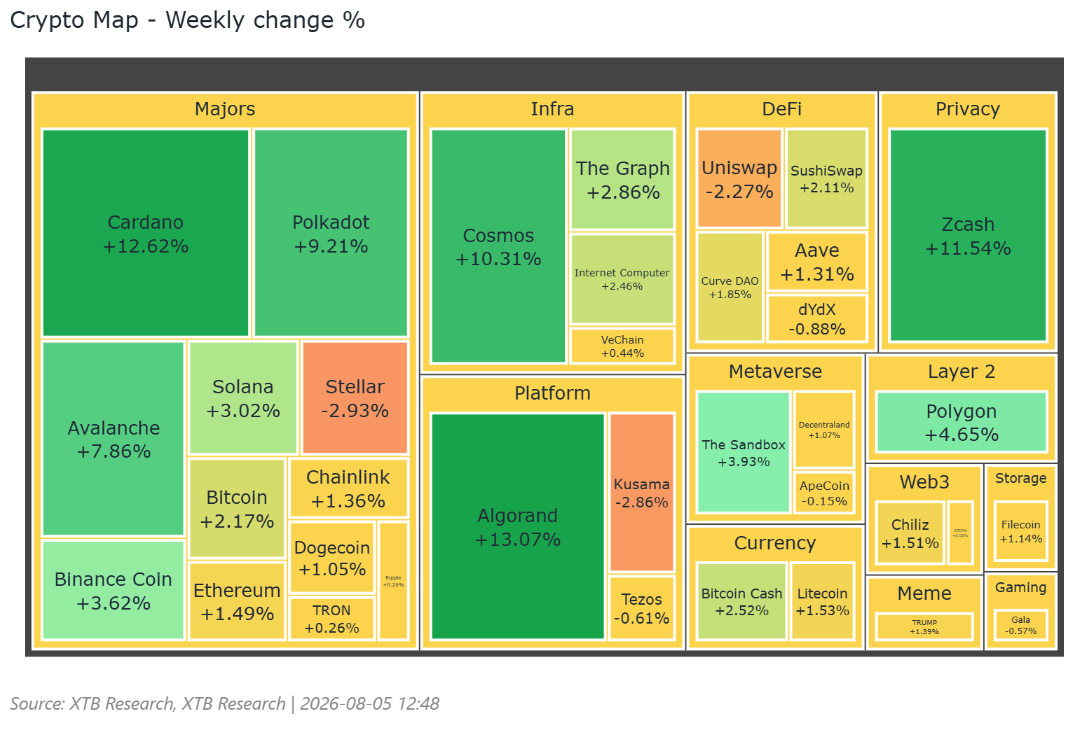
The weekly performance heat map highlights an increasingly selective rotation of capital into higher-beta cryptocurrencies. While Bitcoin and Ethereum continue to post relatively modest gains, stronger momentum has emerged in projects such as Algorand, Cardano, Zcash, Cosmos and Polkadot, suggesting investors are becoming more willing to increase exposure to higher-risk segments of the market.
At the same time, weaker performance across parts of the DeFi ecosystem and selected infrastructure tokens indicates that the rally remains uneven rather than broad-based. This type of market structure is typical during recovery phases, when capital gradually rotates away from the largest cryptocurrencies toward altcoins with greater short-term upside potential.
Source: XTB Research
Most Cryptocurrencies Still Trade Below Their Long-Term Average
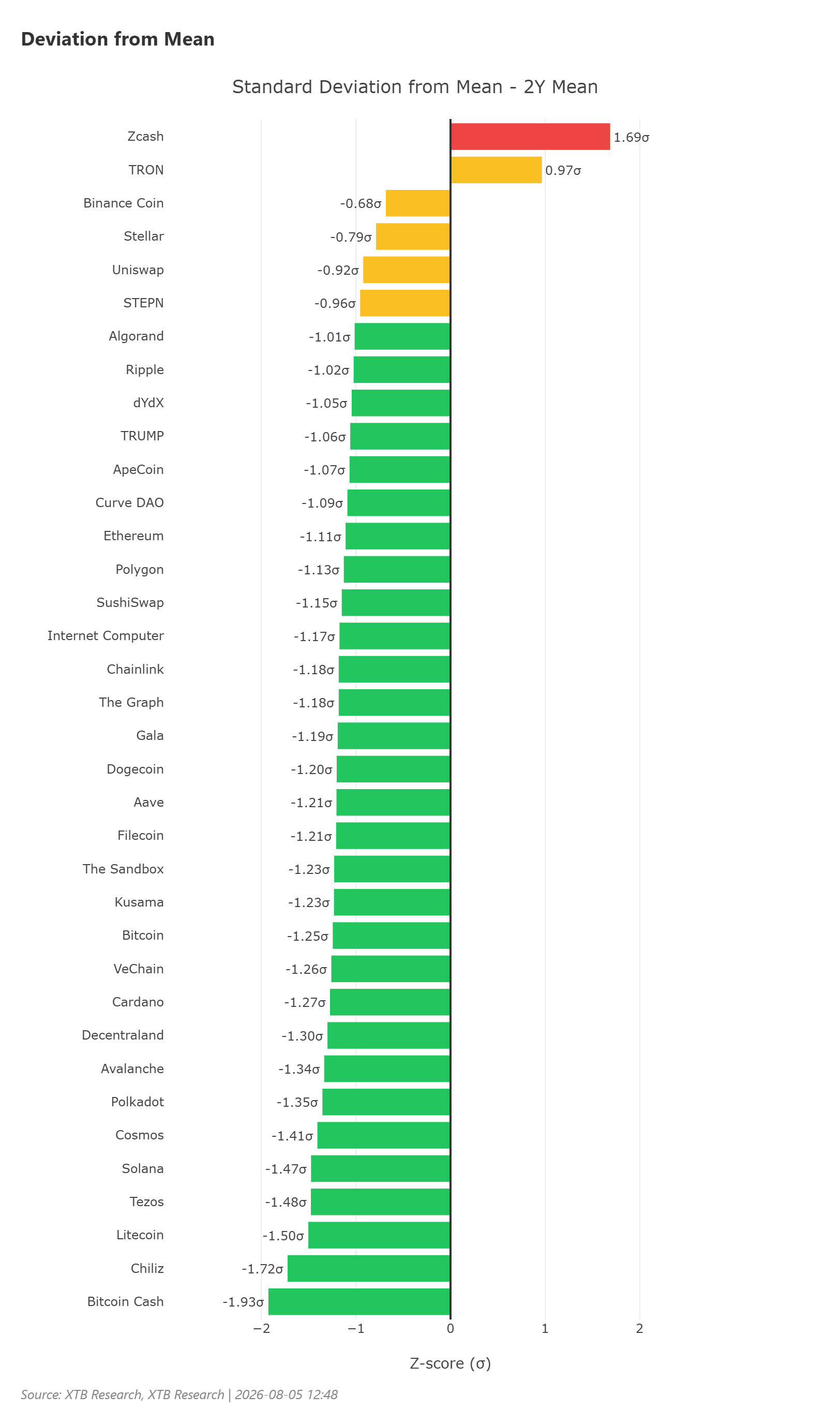
The two-year standard deviation analysis shows that the overwhelming majority of major cryptocurrencies continue to trade below their historical equilibrium levels despite recent price gains. The most notable exception is Zcash, which currently trades significantly above its long-term average, potentially reflecting either short-term overextension or unusually strong project-specific fundamentals.
Meanwhile, assets such as Bitcoin Cash, Chiliz, Litecoin and Solana remain well below their two-year mean, indicating continued relative weakness compared with the broader market. From a quantitative perspective, this type of analysis helps identify both potentially overextended assets and cryptocurrencies that may still be in the early stages of recovery following prolonged declines.
 Source: XTB Research
Bitcoin Technical Outlook (D1 Chart)
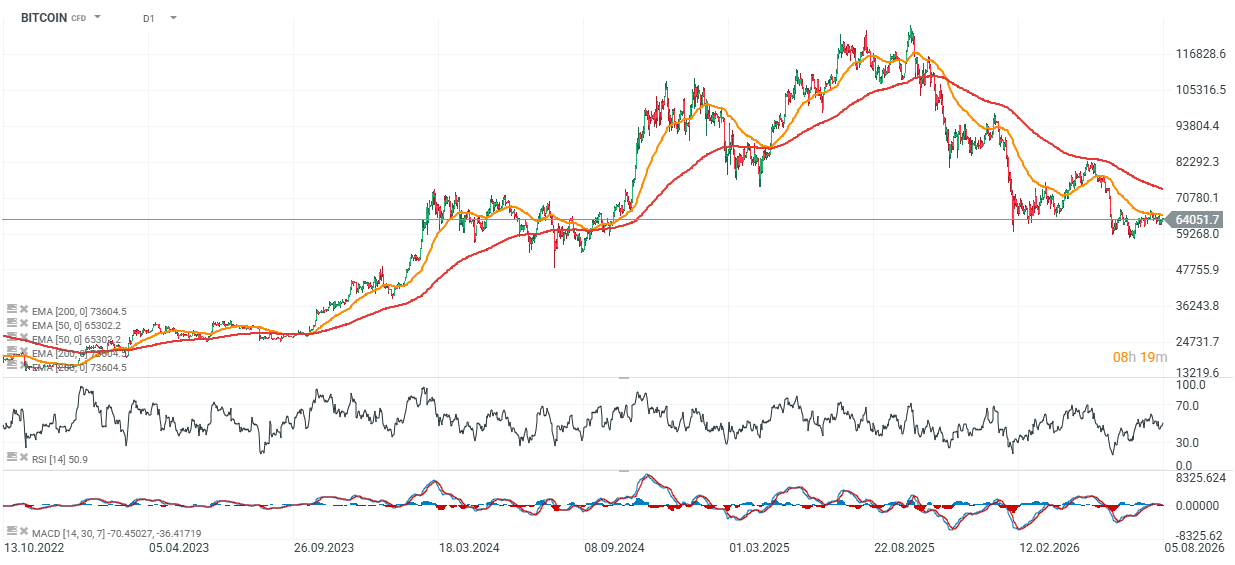
From a technical perspective, Bitcoin's first important challenge is reclaiming the 50-day Exponential Moving Average (EMA50), currently located near $65,300. A successful breakout above this level would represent the first meaningful improvement in short-term momentum. The next major resistance levels are found around $70,000 and $73,500, both of which previously acted as important reversal zones.
On the downside, the psychologically important $60,000 level continues to provide the first line of support, followed by the recent swing lows around $58,000. If Bitcoin were to reject once again from the $70,000 region, the resulting decline could closely resemble the three previous corrective waves seen over recent quarters, potentially driving prices back toward the $45,000 to $47,000 area, given the price action analysis and historical True Market Mean deviation levels during the bear markets.
Source: xStation5
Eryk Szmyd Financial Markets Analyst, XTB



Daily Summary: New Records on Wall Street. Markets Await the New Earnings Season



Market Wrap: France’s Budget, Spain’s Elections. Politics Returns to the Markets



Daily Summary: Wall Street Recovers as Micron Shines and Oil Prices Rise Again


Bitcoin weakens under pressure from the dollar. What’s next for crypto prices?