



Daily Summary: Oil at five-month highs, indices under pressure (23.10.2026)
Friday's trading session was dominated by a sharp surge in crude oil prices, with Brent approaching $112 per barrel, its highest level since May, following another escalation of attacks on Saudi Arabia. It was oil, rather than the sell-off in AI stocks, that acted as the main drag on equities and bonds today, though a separate narrative is building in the background: corporate bond spreads have widened to their highest levels since May 2025, reflecting growing investor concern over the volume of debt required to finance AI infrastructure.
🛢️ Energy commodities
At its peak today, Brent exceeded $112 per barrel, whilst WTI remained above $100. Gains were driven by Iran-backed Houthi rebels who launched further missile and drone strikes on Saudi Arabia, hitting targets including the port of Yanbu, oil infrastructure, and an airport. Saudi Aramco once again ordered the evacuation of its Dhahran headquarters and moved personnel to remote work following a security alert.
Tensions were further heightened by reports that the US and Israel are drawing up plans to resume strikes against Iran following November's congressional elections. President Trump told reporters at the White House that the US had already "knocked out" Iran and threatened to go "a bit further", without specifying details. Simultaneously, he accused Tehran of fabricating incidents in the Strait of Hormuz to drive up oil prices ahead of the election.
Although flows through Hormuz have formally returned close to pre-war levels, Kpler data shows the seven-day average remains approximately 26% below baseline levels prior to the conflict, maintaining a high geopolitical risk premium. Brent has gained more than 85% this year since the outbreak of the US-Iran war, which is nearing its ninth month.
📈 Equity market
Wall Street experienced another mixed session: the S&P 500 slipped 0.4%, the Dow Jones tumbled over 1% weighed down by the financial sector, whilst the Nasdaq 100 managed a modest gain (+0.2%) as selling pressure on technology firms finally eased somewhat. This offered slight relief after the Nasdaq 100's worst session since June; on a weekly basis, the semiconductor index remains down over 5% and is heading for its longest losing streak since November last year.
In Europe, the week ended markedly lower, with the DAX and CAC 40 suffering under the weight of dismal results from luxury goods and automotive companies. Kering, the owner of Gucci, saw its shares plummet more than 16% following disappointing brand sales data, dragging down Richemont (-5%). Volvo Cars suffered an even harsher blow, with its shares falling by up to 25% to record lows after reporting a third-quarter net loss attributed to US tariffs and intensifying competition from Chinese EV manufacturers; the company announced a 5bn SEK cost-cutting programme and 2,500 redundancies.
Asian markets closed the week without a clear direction, as the Nikkei declined on fears of BoJ rate hikes, whilst Shanghai and Hong Kong edged higher due to selective buying in discounted technology shares.
Regarding specific companies:
- General Motors shares are heading for their worst week since January 2025 (-8%) following cautious management commentary regarding "external headwinds".
- Markets are also monitoring reports that SpaceX seeks to secure at least 80,000 base stations for its proprietary cellular network, sparking enthusiasm for tower companies (Crown Castle +11%, American Tower +8%) at the expense of traditional operators (AT&T -4%, T-Mobile -5%).
- Lockheed Martin gained 7.8% after raising its full-year earnings per share forecast to $30.35–$30.75.
🪙 Precious metals
Gold, defying its typical safe-haven role, fell below the $4,000 per ounce threshold, marking a weekly decline of roughly 4%, its steepest since early June. This paradox is explained by a combination of factors: elevated oil prices and rising US inflation expectations are strengthening anticipation of further Fed rate hikes. Intriguingly, a divergence remains between price action and long-term demand, with gold-backed ETFs recording capital inflows for a fourteenth consecutive week.
🌍 Macroeconomic data and monetary policy
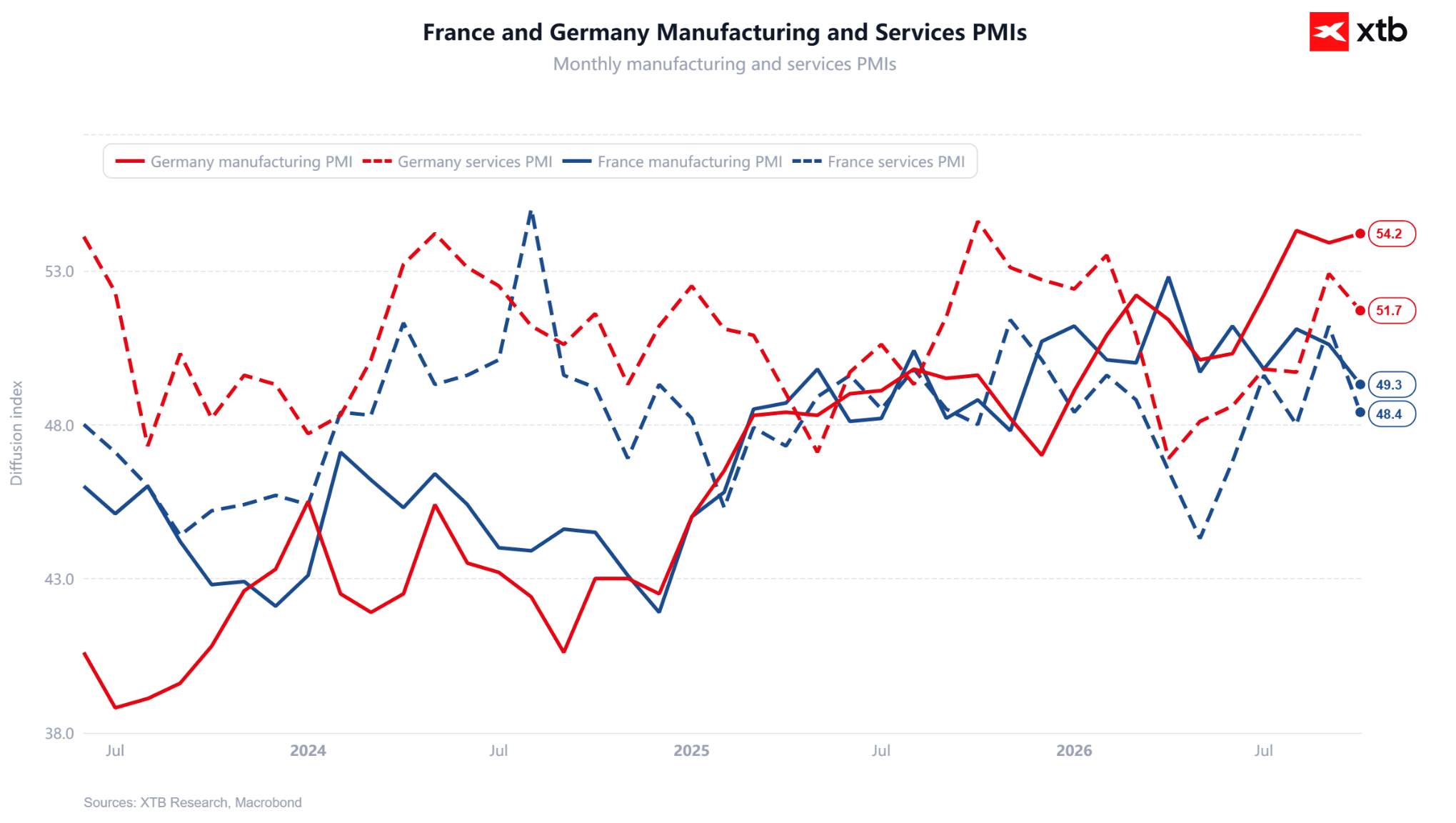
European PMI prints disappointed as the Eurozone composite index fell to 51.9, largely driven by weakness in France where the composite indicator dropped to 48.4.
Figure 1: Germany and France Manufacturing and Services PMIs (2024 - 2026)
Source: XTB Research, 23.10.2026
- Excluding the pandemic period, French business confidence fell to its lowest level since the 2012 debt crisis.
- Employment in France contracted, whereas it expanded in Germany and the rest of the Eurozone.
- The growth rate of raw material purchasing rose to a 4.5-year high (inventory rebuilding, similar to April).
- Input prices reached their highest since May, whilst output prices fell compared to September (suggesting margin compression).
- Data remains consistent with further tightening, though economic headwinds in France may present an obstacle.
In the United Kingdom, the reading proved unexpectedly resilient at 53.1 points.
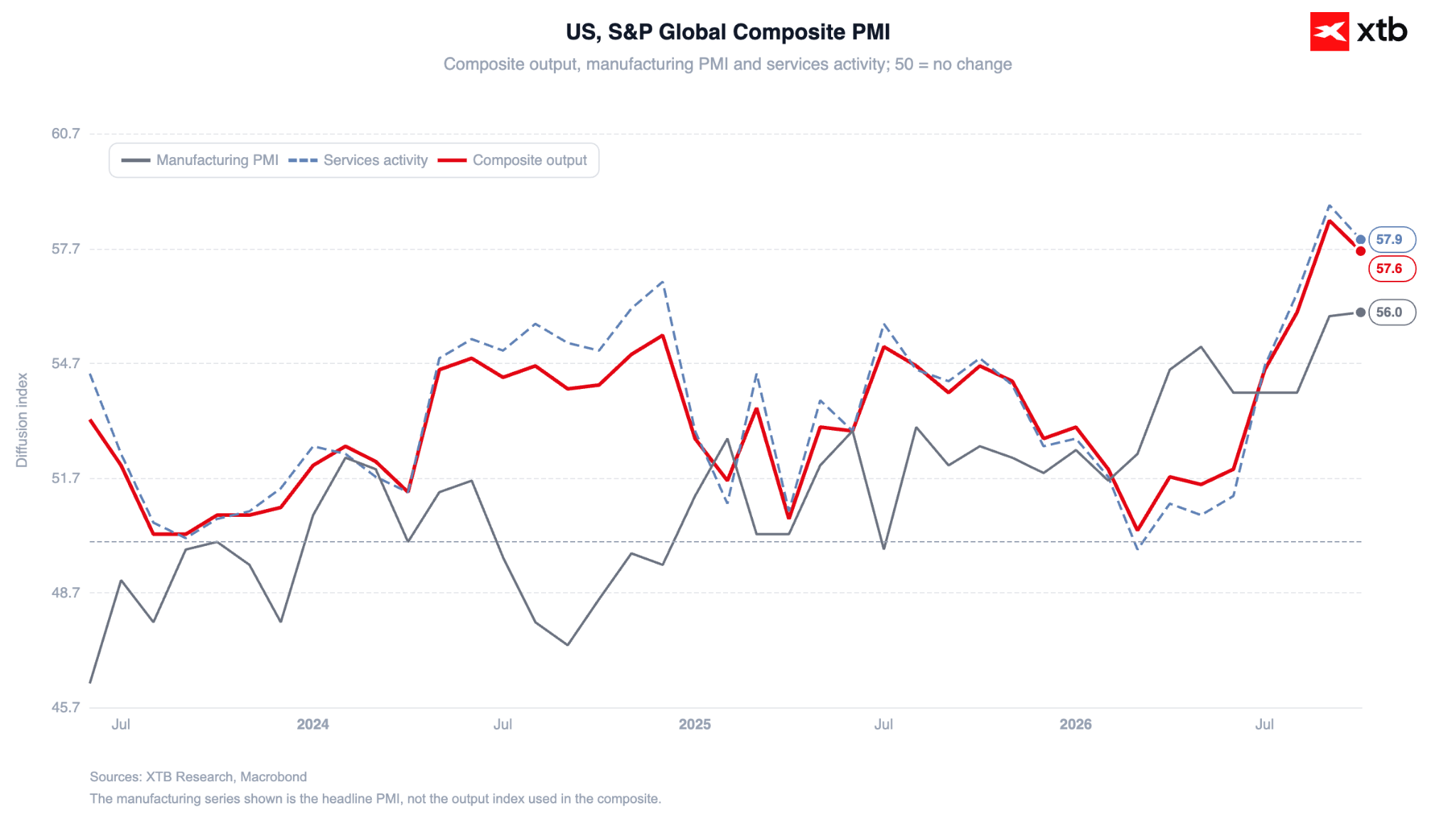
US data slowed but continues to point towards GDP growth of around 4% (Q3 Nowcast stands at 3.5%). Manufacturing (56.0) underperformed services (57.9).
Figure 2: US S&P Global Composite PMI (2024 - 2026)
Source: XTB Research, 23.10.2026
- However, looking ahead to the 12-month outlook, the trend reverses. Furthermore, manufacturing employment is expanding at its fastest rate since March 2012.
- Prices are increasing more rapidly in manufacturing than in services, which aligns with the substantial rise in crude oil prices.
- New export orders for goods expanded for the first time since June last year, whilst service exports grew at their strongest pace since July 2023.
US consumer sentiment according to the University of Michigan index fell to a five-month low in October, reflecting pressure from high living costs and elevated interest rates. Short-term inflation expectations shifted upwards once more, complicating matters for the Federal Reserve ahead of its meeting scheduled for 28 October. Markets currently price in just a 10% probability of a rate hike at the upcoming meeting, though amid rising energy prices, the chances of policy tightening in December have risen to nearly 80%.
📊 Debt market
The decline in 10-year US Treasury yields stalled near the psychological 5% level, closing the day at 4.99% under the impact of renewed crude oil price gains and rising inflation uncertainty. In European markets, 10-year German Bund yields rose to 3.35%, whilst UK benchmarks reached 5.36%.
Global investment-grade corporate credit spreads widened to 129 basis points, reaching their highest level since May 2025 due to concerns over debt funding requirements for artificial intelligence projects. Mounting investor doubts were fueled by Meta Platforms' plans to raise hundreds of billions of dollars for infrastructure expenditure, which has expanded to $825bn, casting doubt on project returns given elevated capital costs.
💱 Foreign exchange
The Polish złoty came under severe pressure owing to rising crude oil prices and a deterioration in the global trade balance for energy importers, pushing USD/PLN above the 3.92 level and sending EUR/PLN towards 4.40.
EUR/USD dipped below the 1.12 handle, reacting to a sharp downturn in French manufacturing data and sustained strength in the US economy.
🪙 Cryptocurrencies
Major digital assets displayed relative stability amidst Friday's turmoil in traditional markets, with Bitcoin holding near $81,400.
On the regulatory front, US Senator Richard Blumenthal demanded clarification from Tether, the issuer of the stablecoin, regarding multi-million-dollar payments made to an entity linked to a former White House advisor, refocusing market attention on transparency across the digital asset sector.
—
Michał Jóźwiak, Financial Markets Analyst at XTB


BREAKING: France slows down, Germany holds on. Euro falls below 1.12



Daily Summary: Valuations Under Pressure, Capital Moves Away From Technology

Market Wrap: "Decent" results are not enough – tech stocks fall further; oil highest since May (22.10.2026)


Daily Summary: SpaceX and the tech sector drive Wall Street, oil retreats sharply below $97