



DoorDash (DASH.US) stock dropped 2.8% on Friday after RBC Capital Markets downgraded the food delivery platform to “sector perform” from “outperform” and cut the price target to $60 from $70 per share.
“DASH's execution & management are widely considered the class of the sector but approaching '23, we are uncomfortable with a potentially unfavorable risk/reward given likely hypersensitivity to order deceleration,” RBC analysts in a client note.
Company yesterday announced lay-off plans which may affect 1,250 positions which equals 7% of the current employee workforce. Also DoorDash expects that it will incur approximately $85 million in restructuring charges.
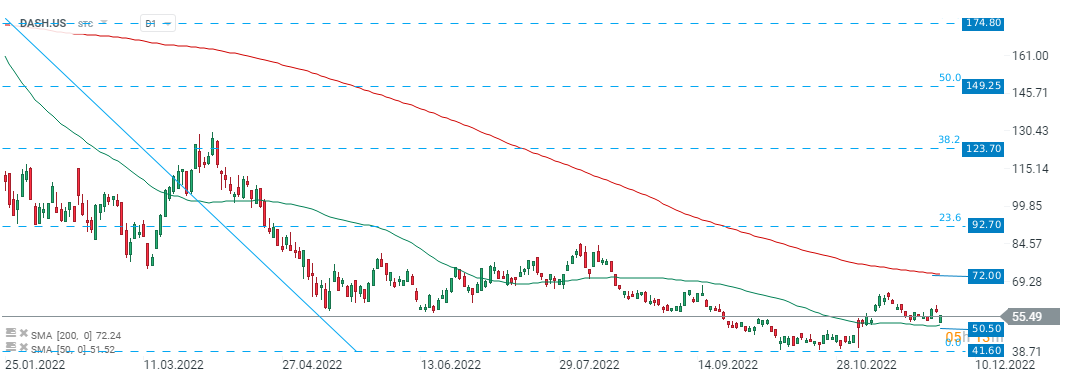 DoorDash (DASH.US) stock launched today's session sharply lower, however buyers managed to erase some losses after sellers failed to break below 50 SMA (green line). As long as price sits above upward correction towards 200 SMA (red line) may be launched. The nearest support to watch is located around recent lows at $41.60. Source: xStation5

Morning wrap: Strong Wall Street, weak Europe and Asia 🚩 NFP to test equity strength



Daily Summary: Wall Street Recovers as Micron Shines and Oil Prices Rise Again
Stock of the Week: Micron. The Memory Cycle in the Age of Artificial Intelligence


US Open: Micron restores faith in the never-ending AI boom