


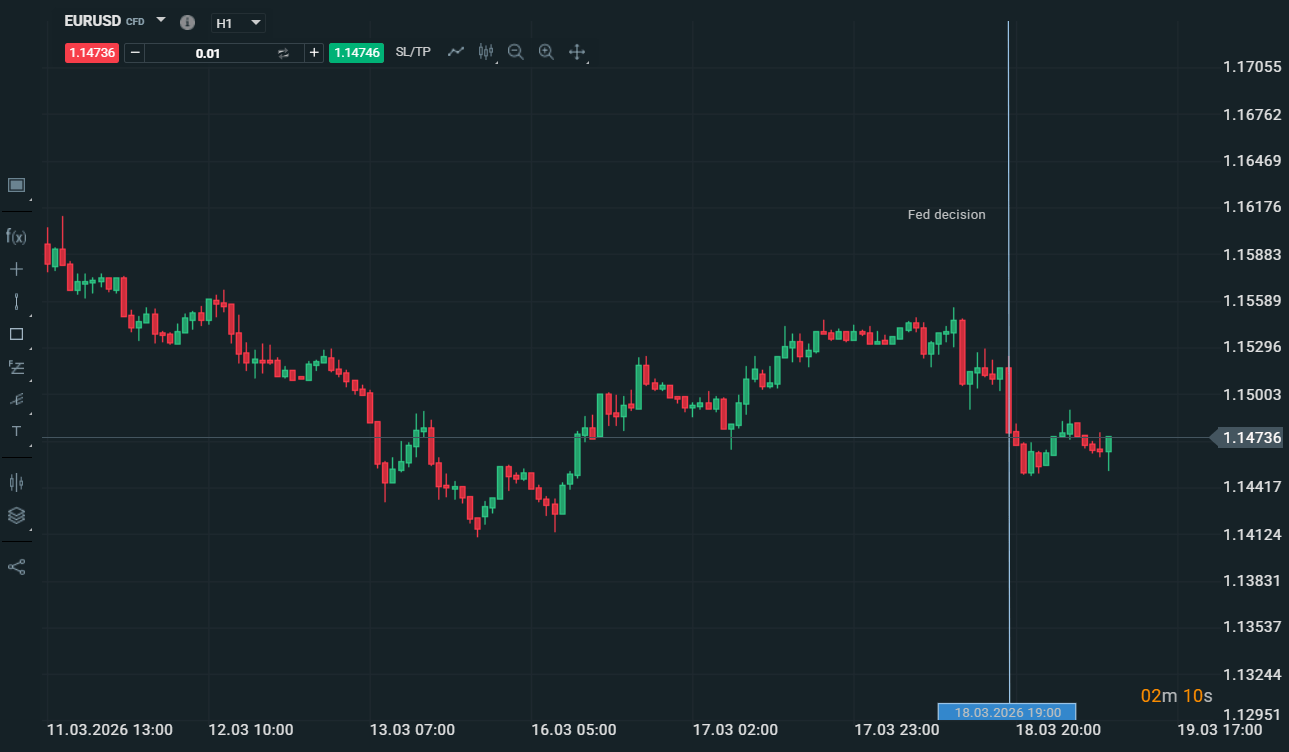
EURUSD is currently under renewed downward pressure, approaching the 1.1450–1.1500 area. A stronger US dollar and rising geopolitical uncertainty are dominating the macro environment. The key driver of recent moves is the energy shock related to the conflict with Iran, which has significantly altered expectations for both the Fed and European central banks.
As for the Federal Reserve, yesterday’s decision was in line with expectations – interest rates remained at 3.50%–3.75%. However, the overall message was more hawkish than the market had initially assumed. The Fed maintained its forecast for rate cuts in 2026–2027, but fewer FOMC members now support easing, and inflation risks have clearly increased. Jerome Powell emphasized that higher oil prices could push inflation back above 3% in the short term, while also noting that policy remains data-dependent and moderately restrictive.
The market reaction reflected this mixed but hawkish message:
- the initial weakening of the dollar was quickly reversed
- EURUSD briefly moved higher but then fell below 1.1500 and has remained in that zone since
Overall, the Fed remains in a “wait-and-see” mode, but with a more cautious and slightly hawkish bias, which supports the dollar in the short term.
On the European side, the situation has shifted much more dynamically. The conflict with Iran has once again highlighted stagflation risks, which are more significant for the euro area than for the US. Although Europe is better prepared than in 2022 (stronger euro, more diversified energy sources, improved supply chains), it remains much more sensitive to an oil market shock. Oil prices in the 100–120 USD range would have a clearly negative impact on both growth and inflation in Europe.
This has already led to a significant shift in ECB communication and market expectations:
- a transition from a “wait-and-see” narrative to a slightly hawkish tone (Lagarde, Nagel)
- upward revisions of inflation forecasts (e.g., Nomura: 2.1% → 2.7%)
- a shift in market pricing from rate cuts toward potential rate hikes
Despite this shift, the ECB is expected to keep rates unchanged today at around 2.0%. The lack of hard data and the desire to avoid signaling panic argue against immediate action, but the medium-term policy path is becoming increasingly dependent on energy prices. If oil prices remain elevated, a rate hike later this year becomes a realistic scenario.
Today is particularly important for EURUSD, as several European central banks are announcing decisions in quick succession. The SNB is likely to keep rates at 0.00%, balancing between deflation risks and a strong franc. The Bank of England is also expected to leave rates at 3.75%, with the vote split being key. The Riksbank is likely to remain at 1.75%.
Across Europe, a common trend is visible: expectations for rate cuts have been pushed back, and central banks are shifting toward a more cautious or even hawkish stance due to geopolitical and inflation risks. However, this is not yet fully reflected in actual policy decisions.
EURUSD stands between a hawkish Fed and rapidly shifting expectations for the ECB. However, the energy shock and Europe’s greater sensitivity to oil prices tilt the short-term balance in favor of the dollar, leaving the pair with a slightly bearish bias ahead of today’s central bank decisions. The market will closely monitor upcoming events.


RBA turns increasingly hawkish as markets reprice November rate hike expectations ⚔️



Daily Summary: Buyers Refuse to Give In

US Natural gas extends declines 🔥📉



US OPEN: The wave of AI concerns is building again, oil returns near highs