



The pre-holiday closure of equity markets allows investors to catch their breath and step away from the relentless shifts in sentiment, currently rattled by the latest twists in the Iranian war. U.S. index futures are seeing a slight correction following yesterday’s highly volatile session, which—despite the panic triggered by Donald Trump’s address—ended with modest gains.
Paradoxically, despite the "holiday" on the stock market, volatility will not be in short supply. At 2:30 PM CET, the most critical report from the U.S. labour market, the Non-Farm Payrolls (NFP), will be released. This will be the "dot over the i" for the sentiment Federal Reserve members carry into their month-end interest rate meeting. With Wall Street closed, investor focus on the data will be heightened, potentially leading to significant swings in major, currently dormant currency pairs like EURUSD.
Source: XTB Research
What can we expect from today’s NFP report?
-
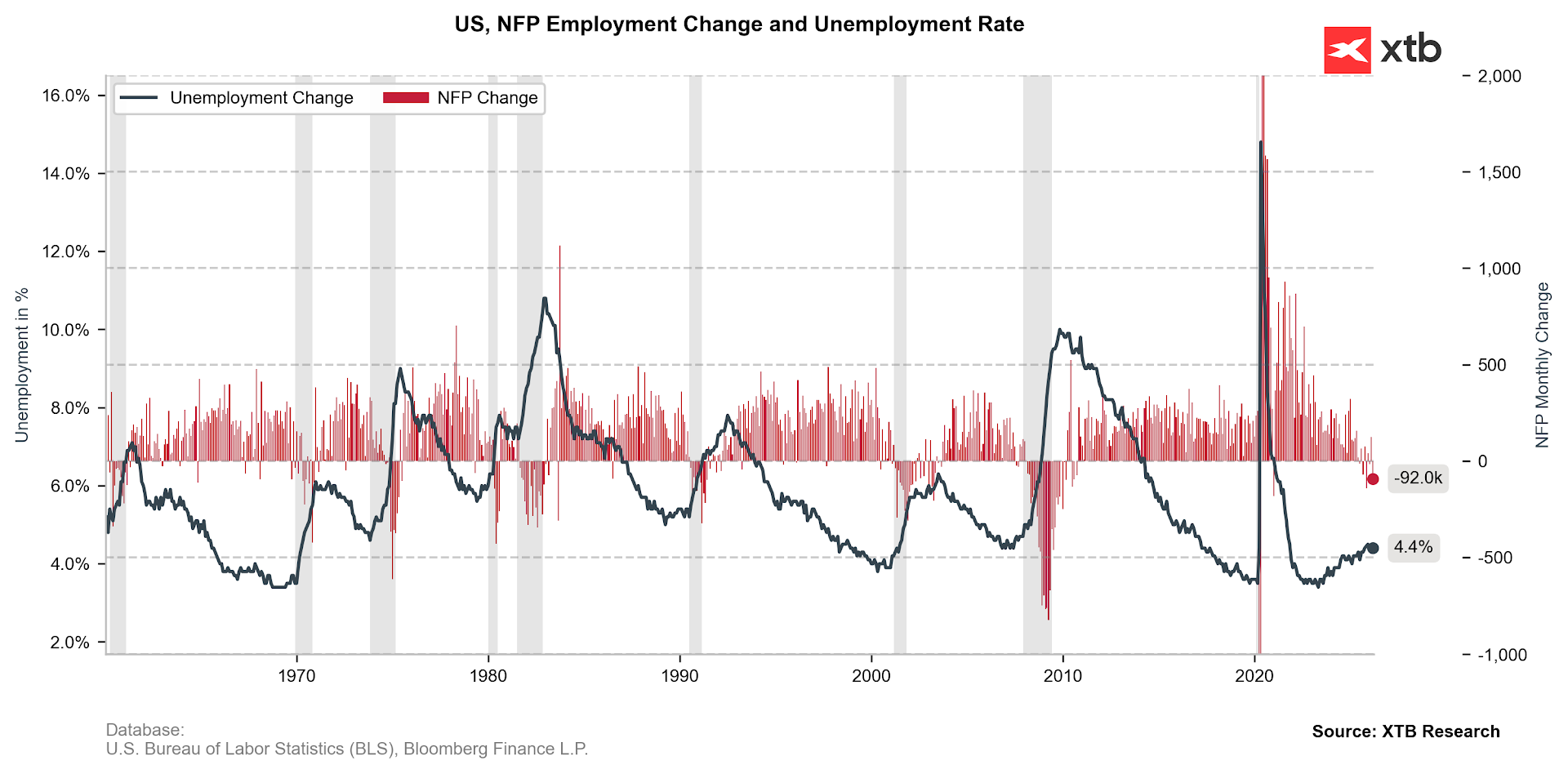
Payrolls: According to the Bloomberg consensus, U.S. payrolls are expected to increase by 65k in March, marking a rebound from the 92k decline in the previous month. In the private sector alone, employment is projected to bounce back by 70k, nearly erasing February’s 86k drop.
-
Unemployment Rate: Expected to remain unchanged at 4.4% following a surprise jump from 4.3%.
-
Average Hourly Earnings: Growth is expected to slow marginally from 0.3% to 0.2% (m/m) and from 3.8% to 3.7% (y/y).
The best surprise is no surprise
While the recent data was among the worst since the 2007-2008 crisis, it did not trigger panic due to its "one-off" nature. The correction primarily affected sectors that had previously seen massive gains (healthcare, education, construction), and the net effect in many categories remained positive. Mass strikes in healthcare also weighed on the numbers. Furthermore, unemployment remains at a historically low 4.4%, supported by stable jobless claims and steady ISM Employment readings despite surging price pressures.
Labour market stability highlights price concerns
Today’s data is particularly vital given the war in Iran and materializing fears of a long-term inflationary shock driven by energy prices. Following Donald Trump’s hawkish address, thin hopes for a quick de-escalation have evaporated. Risks of significant damage to energy infrastructure in the Persian Gulf and the murky status of the Strait of Hormuz have risen once again.
Labour stability will sharpen the Fed's focus on inflation. While U.S. CPI is certain to spike in the near term, the question remains whether the shock will be a one-time event or a persistent pressure that "eats into" food and service prices.
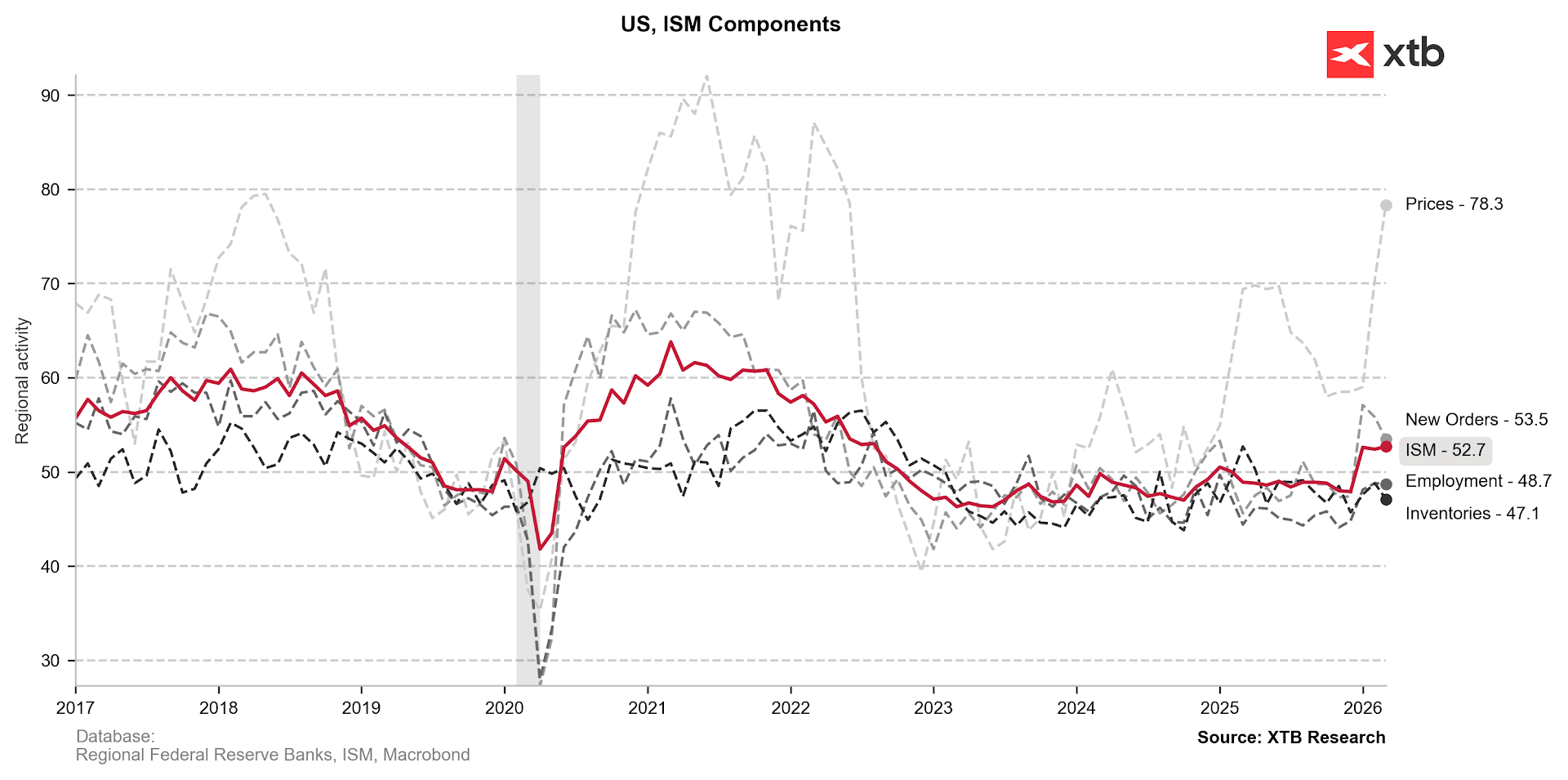
Recent ISM data primarily showed a drastic increase in price pressure. Source: XTB Research
Several FOMC members have already signaled heightened vigilance:
-
Alberto Musalem (St. Louis Fed): Sees potential for both cuts and hikes, suggesting the current policy is well-balanced (hinting at a prolonged pause).
-
Lorie Logan (Dallas Fed): Believes U.S. oil majors won't sacrifice margins to save consumers, and Iranian risks could force the Fed to pivot in the opposite direction (hinting at readiness for hikes).
-
Michelle Bowman (Governor): Remains dovish, still eyeing three cuts by the end of 2026. However, her argument relies on labour market concerns. If NFP aligns with the recently strong ADP report, labour worries may take a backseat during the April FOMC meeting.
EURUSD (H4)
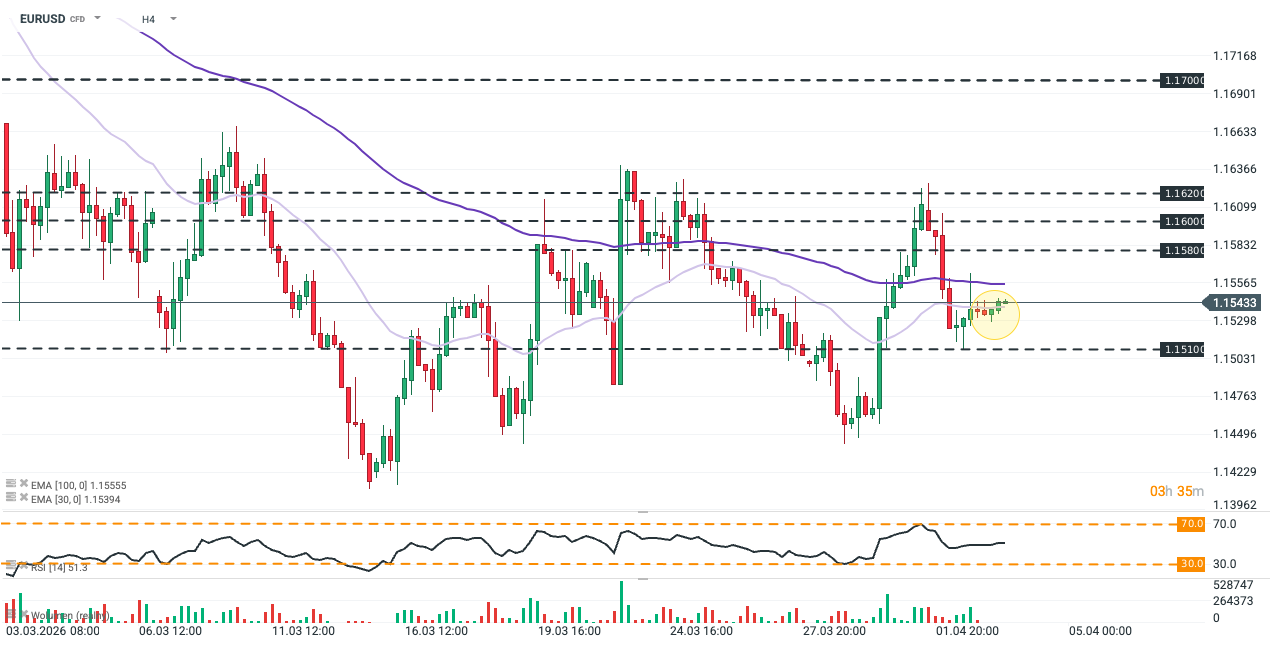
Since the outbreak of the war in Iran, EURUSD has remained clearly capped at the 1.162 level. Friday’s calm is helping the pair recover some ground lost after Trump’s speech, but a return to local highs is unlikely given NFP expectations. Only significantly weaker data could lead to a test of 1.1580, though a breach of the broader consolidation remains improbable.
Source: xStation5


Three markets to watch next week (23.10.2026)



Daily Summary: Oil at five-month highs, indices under pressure (23.10.2026)

US Open: Further declines on Wall Street, Brent above 111 USD, AI correction continues (14.10.2026)

BREAKING: France slows down, Germany holds on. Euro falls below 1.12