



The private credit market is off to a weak start to the year. After Blue Owl restricted withdrawals from one of its private credit funds a few weeks ago, the market began openly questioning the solvency and valuations of many funds.
This weekend, BlackRock joins the list of firms fueling investors’ concerns.
Source: Bloomberg Finance LP
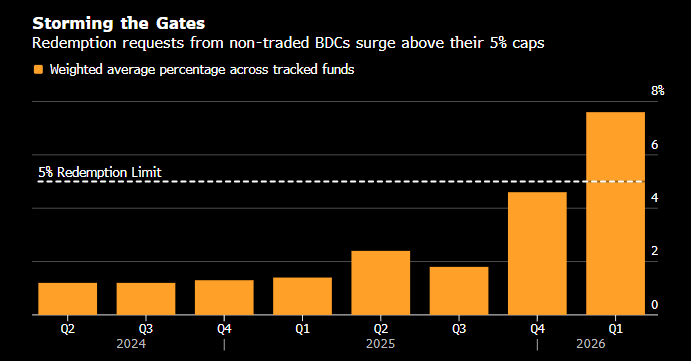
Capital outflows from the private credit market are reaching unprecedented levels. Given the nature of this market and its lack of liquidity, this puts funds in a difficult position.
Source: Bloomberg Finance LP
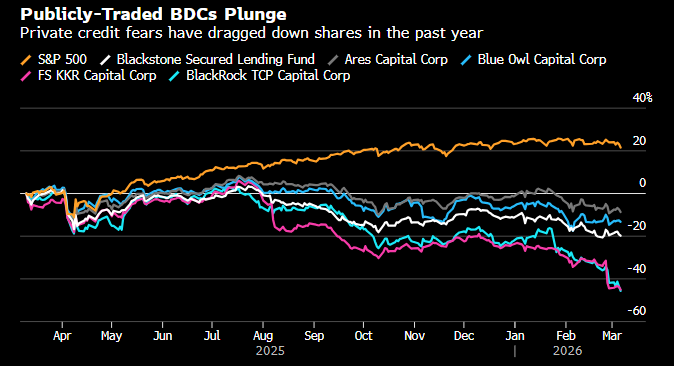
This difficult situation is also clearly reflected in valuations.
Companies such as BlackRock and Blue Owl are now paying the price for flaws in their own strategy. The idea behind the growth of private credit was to expand the offering to retail investors, but they have a very different risk profile and a much lower tolerance for having their capital locked up for the long term. Investors’ concerns are not unfounded either: the private credit market plays a fundamental role in financing the build-out of AI infrastructure, an area whose promised returns are increasingly being called into question.
What are funds hiding?
The lack of liquidity in the private credit market is not, in itself, a reason to panic. Illiquidity is a fundamental feature of this market, not something extraordinary. What could be a major problem, evoking memories of 2007, is that, according to a Bloomberg investigation, many funds and positions in the private credit market have greater exposure to the software sector than they report.
In practice, this means that many funds may be masking their full exposure to software in order to obtain financing without paying the appropriate risk premium. The very existence of such a premium—and evidence of attempts to conceal exposure to avoid it, suggests that the situation of tech companies and the private credit market may be worse than the financial metrics of many of these firms would imply.
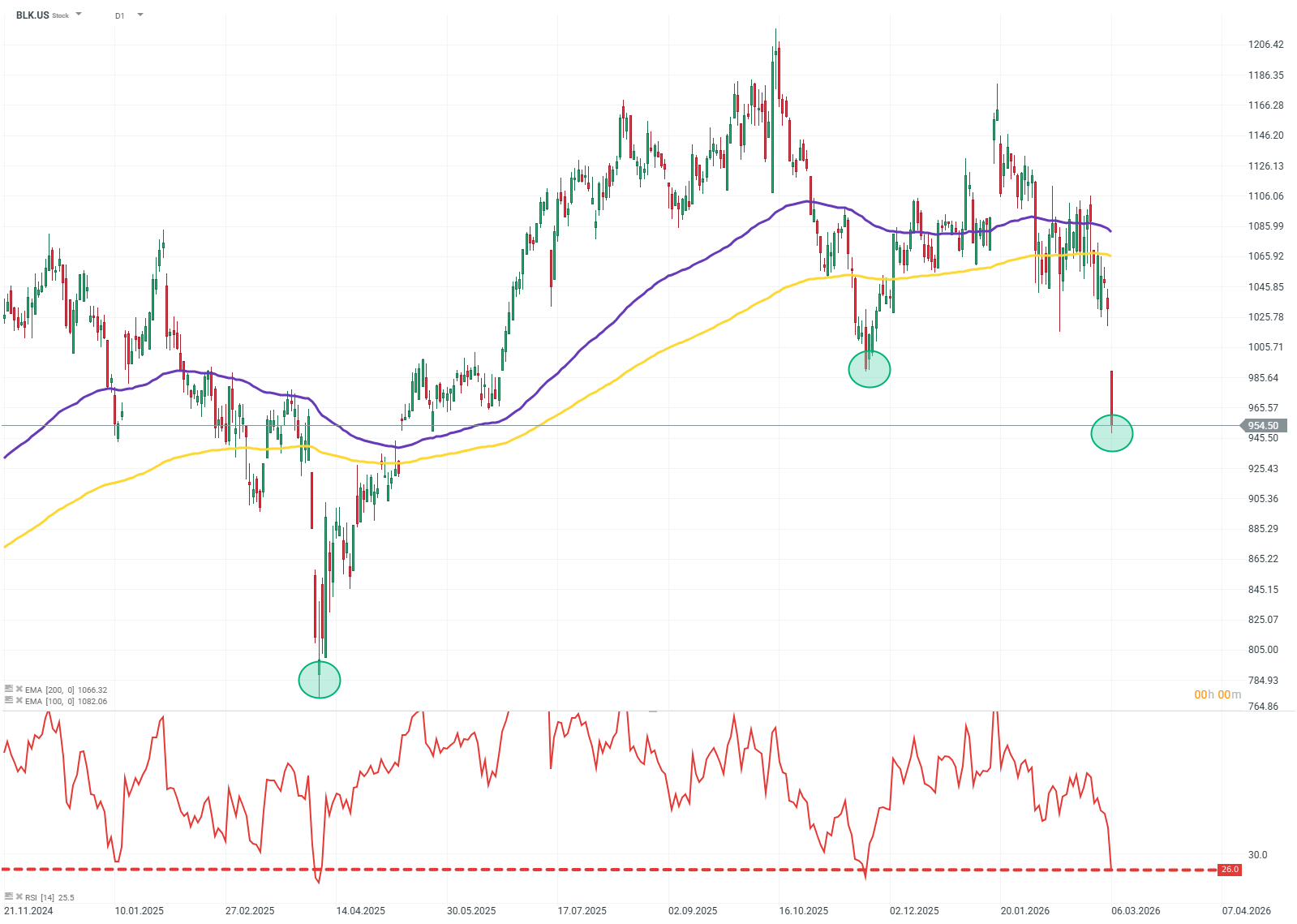
BLK.US (D1)
Source: xStation5
While the problems in the private credit market will not disappear overnight, and may, over time, prove worse than expected, this does not change the fact that, as of today, the chart action looks more like an emotionally driven, temporary correction. An RSI around ~25 signaled a “bottom” in previous sell-off episodes.



Three markets to watch next week (23.10.2026)



Daily Summary: Oil at five-month highs, indices under pressure (23.10.2026)

US Open: Further declines on Wall Street, Brent above 111 USD, AI correction continues (14.10.2026)

Chart of the Day: Is USDJPY running out of road? Inflation forces the BoJ to act, but the Fed could spoil the Yen’s rally