



Despite decades of stagnation, the Japanese economy remains one of the largest in the world, and the Japanese yen remains one of the most important currencies. An indispensable element of this financial landscape is the so-called "Carry Trade." What is it, why is it so important, and why is it threatened?
"Carry Trade" is a method used by institutional investors to profit from interest rate differentials. In this case — between the USA and Japan. By taking advantage of ultra-low interest rates in Japan, investors borrow yen, buy dollars with them, and then purchase U.S. bonds, whose interest rates are higher than the cost of borrowing in Japan. This strategy is burdened with significant interest rate and currency risk.
"Carry trade" works as long as there is a significant difference in interest rates and bond yields — this difference between the USA and Japan is systematically decreasing. Mounting negative phenomena and pressure on the Bank of Japan (BoJ) have forced the end of the yield control program and the start of unprecedented interest rate hikes.
The yen is trapped in the structural problems of the Japanese economy. The yen cannot weaken too much, as the country will no longer be able to afford imports, on which it is critically dependent — however, even a small interest rate hike by developed country standards could lead to the collapse of the Japanese financial system due to Japan's gigantic debt — which is mostly held by Japanese banks.
What does this mean for the currency market, and what is the most likely scenario? The interest rate difference between the USA and Japan is still as much as 3.5%, which makes profits from "carry trade" easier, but exerts continuous pressure on the yen, which has already lost half of its value since 2020.
An unacceptable level for Japan is above 160 yen per dollar, due to unacceptable increases in fuel and food prices.
Why did the yen break the upward trend at 160 and has been consolidating for a year? The Bank of Japan is a heavyweight champion in the field of currency interventions, even verbal intervention by the bank can bring the rate down by several yen within minutes. The Bank of Japan has the largest foreign exchange reserves in the world and will not hesitate to use them; any speculative attack on the yen is doomed to failure. However, the BoJ cannot maintain the yen's rate so high with such low interest rates; sooner or later, the bank will be forced to raise them.
The market currently prices a 0.75-1% interest rate hike by the BoJ by March next year, while at the same time, the market expects the FED to cut rates by over 1.5%. This means a reduction in the interest rate differential from 3.5% to even 1%. This is too little to compensate investors for transaction costs and risk, and this scenario will lead to massive position closures and significant yen appreciation.
USDJPY (D1)
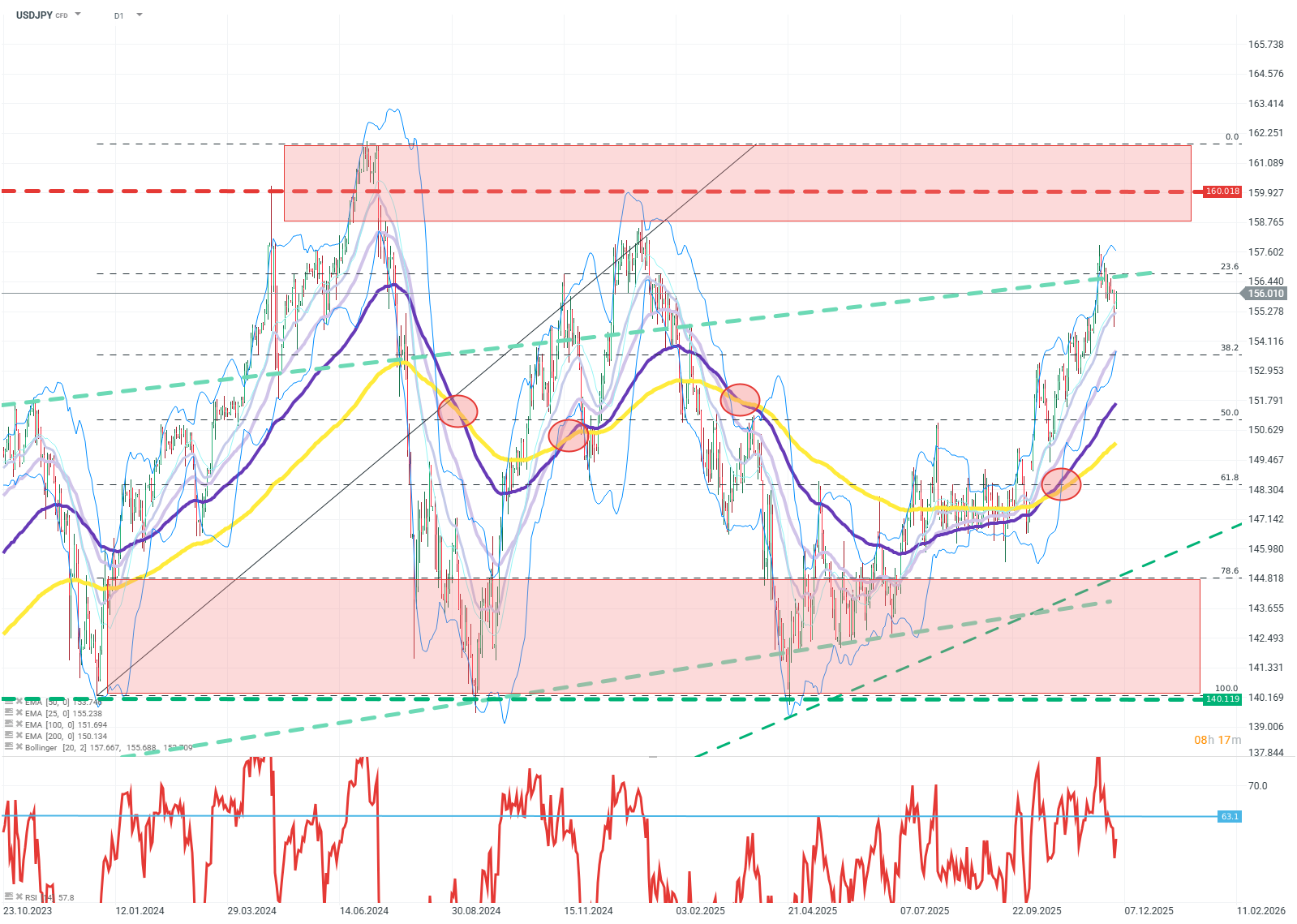
Source: xStation5


BREAKING: France slows down, Germany holds on. Euro falls below 1.12


Chart of the Day: Is USDJPY running out of road? Inflation forces the BoJ to act, but the Fed could spoil the Yen’s rally



Macro Calendar: Preliminary PMI Readings and Earnings Ahead



Morning Wrap: AI profitability concerns spark market Sell-Off