



Macro is back in focus: is AI moving to the background?
Microsoft has long been viewed as one of the primary beneficiaries of the AI trend, but it has also become one of its most sensitive barometers. The company is investing tens of billions of dollars into data centers, expanding Azure, and integrating tools such as Copilot across its product ecosystem.
The issue is that the market is no longer rewarding investment and growth alone—it now expects visible monetization. At the same time, Microsoft’s significant exposure to OpenAI, which competes with players such as Anthropic (Claude), Google, and Perplexity, raises questions about whether capital has been optimally allocated from a strategic standpoint.
This marks a fundamental shift. Over the past two years, investors were buying the “promise of AI”. Now, they increasingly demand tangible outcomes: margins, revenues, and real business applications. Any slowdown in Azure growth or weaker-than-expected adoption of AI tools may be interpreted as a warning signal rather than a temporary fluctuation. It is worth noting, however, that Microsoft’s recent results have remained solid and do not yet indicate a clear slowdown in cloud computing.
Oil, yields, and recession risk: the macro overlay intensifies
This shift in perception is further reinforced by a much more challenging macroeconomic backdrop. The rise in oil prices above $100 per barrel, driven by escalating tensions in the Middle East, is not just a consumer issue—it may act as a catalyst for broader financial tightening.
Historically, strong oil shocks have often preceded recessions. The mechanism is straightforward: higher energy prices fuel inflation, reduce real incomes, and force central banks to maintain elevated interest rates for longer. As a result, bond yields rise and the cost of capital increases across the economy, including for technology companies.
For firms like Microsoft, this has a dual impact. On one hand, higher rates compress valuations of growth assets, which are particularly sensitive to the discounting of future cash flows. On the other, a potential economic slowdown may weaken demand for cloud services and AI solutions. A prolonged conflict involving the US, Israel, and Iran represents a material risk for the technology sector.
AI as an investment cycle, not just a technological shift
One critical aspect often overlooked in market narratives is that AI represents one of the most capital-intensive investment cycles in the history of the technology sector. Building infrastructure—from chips to data centers—requires enormous capital outlays that must ultimately be justified by future demand.
However, this demand is not independent of the economic cycle. On the contrary, it is highly cyclical. The majority of AI spending is funded through corporate budgets, which are among the first areas to be optimized during periods of uncertainty.
In a weaker macro environment, companies may:
- delay cloud migration,
- limit experimentation with AI tools,
- reduce spending on IT infrastructure.
This implies that even if the technology itself remains transformative, its adoption curve may be significantly more cyclical than previously assumed. It is also important to note that large technology firms have already committed substantial capital to AI, increasing the stakes of the cycle. It is no coincidence that the strongest selling pressure is currently visible in software stocks. These companies are the most exposed to enterprise spending and are therefore the first to reflect shifts in business sentiment. Microsoft, due to its exposure to Azure and enterprise AI solutions, sits at the center of this dynamic. Unlike semiconductor companies, which are benefiting from a near-term investment boom, software appears more dependent on the durability of end demand. After a period dominated by narrative-driven expansion and multiple growth, the market is entering a phase of greater selectivity and capital discipline.
A regime shift, not the end of AI
This does not mark the end of the AI story. It does, however, signal a change in how the market evaluates it:
- investors are becoming more sensitive to adoption and monetization data,
- companies with high CAPEX are facing greater scrutiny,
- valuations are increasingly exposed to macroeconomic shifts.
Microsoft is no longer seen solely as an “AI leader,” but increasingly as a test case for the entire sector—a benchmark for whether massive investments will translate into sustainable revenue and profit growth. Notably, the Magnificent Seven are expected to allocate around $650 billion to AI infrastructure this year alone, underscoring the scale of the bet.
The key question: timing, not direction
In the long term, the direction appears relatively clear—artificial intelligence is likely to become one of the key drivers of economic growth. The critical uncertainty lies in timing.
Has the market priced in this transformation too early?
Is the scale of investment already ahead of real end demand?
The recent sell-off in Microsoft and the broader AI sector suggests that investors are beginning to take these questions seriously—even if it is still too early to declare the end of the AI investment cycle.
Concentration risk and the scale of investment in OpenAI
Microsoft has invested approximately $13 billion in OpenAI, but a far more important factor is that OpenAI accounts for a significant share of Azure infrastructure usage. According to Bloomberg data, it may represent close to half of Microsoft’s contracted cloud revenue backlog (RPO). This creates a situation where dependency runs in both directions.
- OpenAI itself has explicitly stated that Microsoft provides a “substantial portion of our financing and compute capacity,” meaning that the development of AI models is directly tied to the availability of infrastructure from a single provider. At the same time, for Microsoft, OpenAI is becoming one of the largest clients driving demand for Azure, effectively concentrating risk within one ecosystem.
- An even more challenging picture emerges when looking at cost dynamics. OpenAI estimates that compute-related spending could reach around $600 billion by 2030, while projected revenues in that period are expected to reach approximately $280 billion annually. This implies that, at least in the early phase of the cycle, infrastructure costs may exceed revenues, raising questions about the short-term economic efficiency of the model.
- This is not just a long-term concern. OpenAI has already spent over $12 billion on compute services provided by Microsoft, while inference-related costs are growing at more than 2x year-over-year. In other words, the greater the scale of AI usage, the higher the cost pressure—standing in contrast to the traditional software model, where scaling typically improves margins.
- At the same time, the sector is experiencing an unprecedented influx of capital. OpenAI has raised around $110 billion in a single funding round, reaching a valuation of over $700 billion. The financing involves major market players—from Microsoft to Amazon, Nvidia, and SoftBank—highlighting that this is no longer a typical venture cycle, but rather an investment wave of systemic scale.
From Microsoft’s perspective, this means the company sits at the center of an extremely capital-intensive structure in which infrastructure investments are massive and still growing, demand is largely driven by a single key partner, and the profitability of the entire model depends on future AI monetization that has yet to be fully validated. It is precisely this imbalance - between certain CAPEX and uncertain revenue growth—that is driving investor concerns. Microsoft is no longer just a beneficiary of the AI boom; it is increasingly becoming the most direct proxy for the risks associated with potentially inefficient AI investments, where the number of long-term winners may ultimately prove limited.
Microsoft stock: correction or structural shift?
Microsoft shares are now down nearly 33% from their 2025 peak, a magnitude comparable to the roughly 36% decline seen in 2022. This time, however, the pace of the sell-off has been significantly faster, with the RSI dropping close to 30, indicating oversold conditions. The outlook remains uncertain. One enduring principle of markets, however, still applies: for an investor to buy a stock at an attractive price, someone else must be willing to sell it. If a recession is avoided and tensions with Iran de-escalate relatively quickly, technology stocks may regain investor favor sooner than expected. While the risk of a broader bear market is real, Microsoft shares may already be reflecting a substantial portion of that scenario—declines of over 30% have historically been relatively rare for the company.
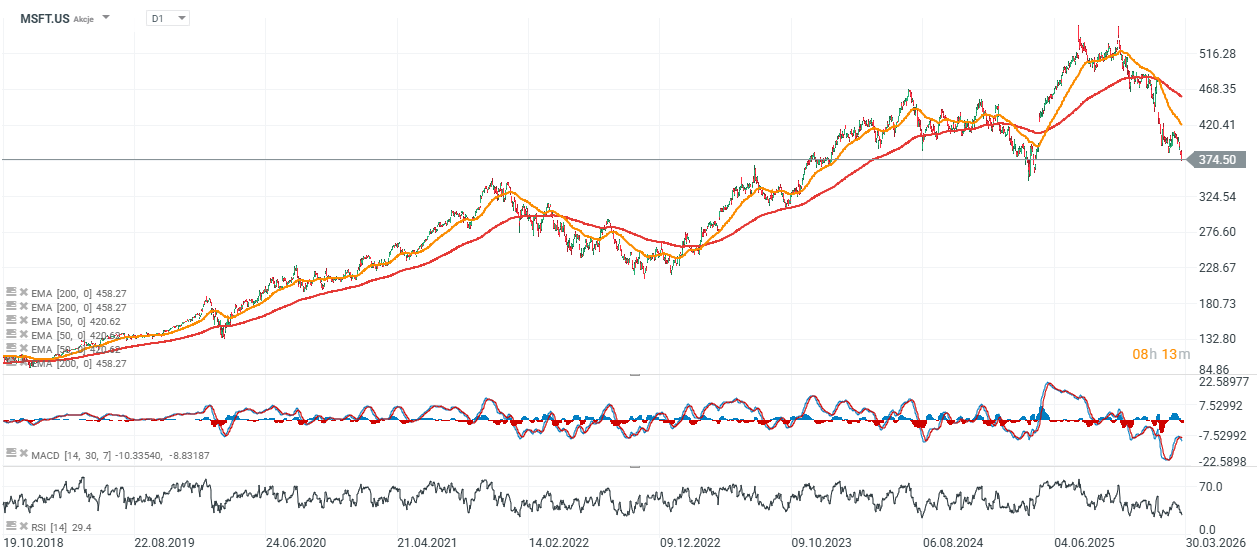
Source: xStation5



Is Starbucks eyeing Chipotle❓ The market reacts nervously to the FT's reports of a takeover🔥


Stock of the Week: Marvell Technology and the Race for AI Infrastructure’s Most Valuable Resource



Market Wrap: A 4% surge in oil prices weighs on indices (08.10.2026)


🚩 Caterpillar shares extend decline, down 30% from record high