



Microsoft is once again drawing investor attention with new AI updates, demonstrating that the company is maintaining its pace in the race for dominance in generative artificial intelligence. The latest step is the launch of Critique, a research tool that combines multiple AI models, including GPT and Claude, to provide more reliable and verified responses. This approach reduces the risk of so-called “AI hallucinations,” where artificial intelligence produces answers that sound plausible but are actually incorrect or entirely fabricated. This phenomenon is particularly relevant in the context of business analysis, where inaccurate information can lead to misguided strategic decisions.
These actions are part of Microsoft’s broader strategy, which is shifting from merely integrating AI models into existing products toward building a full ecosystem of tools, agents, and services for businesses. Expanding Copilot’s functionality, developing an environment for more advanced analyses, and strengthening the infrastructure in Azure and Foundry indicate the company’s effort to standardize how AI is used in office work, data analysis, and business process automation.
For the markets, the pace of monetizing this strategy remains a key consideration. Microsoft benefits from significant scale, a strong position in the enterprise segment, and broad distribution channels through Windows, Microsoft 365, and Azure. At the same time, rising spending on data centers, computing power, and AI model development may weigh on margins for some time before scale effects fully translate into revenue. Market reactions have been mixed, as new AI features alone no longer trigger strong responses. Investors are focusing on questions regarding actual tool adoption, whether companies are willing to pay higher rates, and whether Microsoft can maintain profitability amid rising infrastructure costs.
In this context, the launch of Critique can be seen both as an attempt to maintain a competitive edge and as an expansion of the existing AI ecosystem. Microsoft emphasizes that AI is a central element of its ongoing development. Successfully combining Copilot functionality, agent capabilities, and Azure infrastructure could contribute to revenue growth in the coming quarters. At the same time, if the pace of investment outstrips actual tool adoption, the stock may remain under pressure despite long-term potential.
For long-term investors, Microsoft remains one of the primary ways to gain exposure to AI, although it carries risk. The company has a large, defensive core business while simultaneously engaging in high-growth areas. This profile generally performs well over a longer horizon but requires consideration of short-term volatility related to investments, margins, and the pace of AI commercialization.
Looking more broadly, the latest announcements do not radically change Microsoft’s investment story but confirm that the company is steadily strengthening its position in AI. In the current market environment, translating technological advantage into sustainable revenue and profit growth is more important than the number of new features. In this context, Microsoft remains well-positioned, with financial results, rather than narrative, set to be the key determinant.
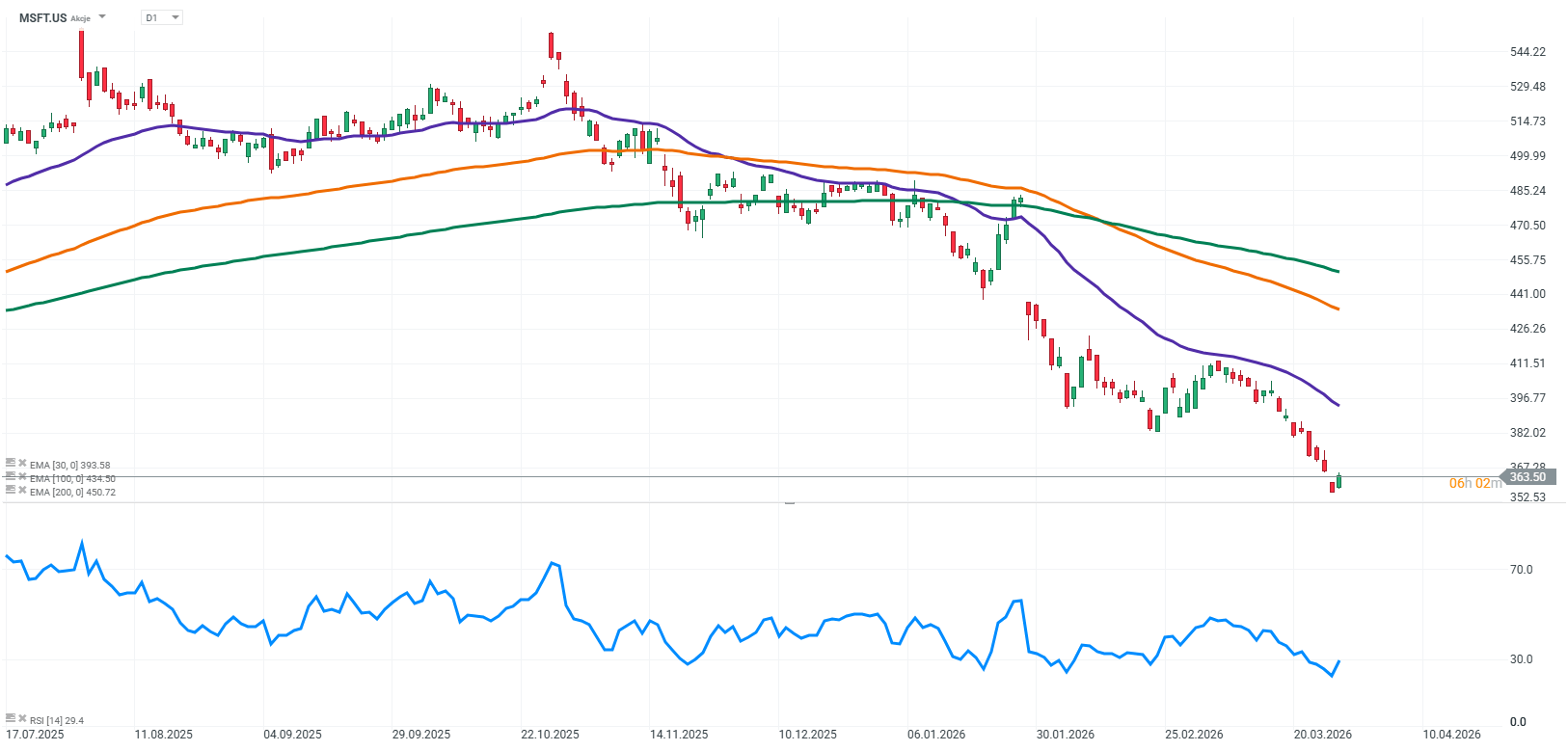
Source: xStation5



Is Starbucks eyeing Chipotle❓ The market reacts nervously to the FT's reports of a takeover🔥


Stock of the Week: Marvell Technology and the Race for AI Infrastructure’s Most Valuable Resource



Market Wrap: A 4% surge in oil prices weighs on indices (08.10.2026)


🚩 Caterpillar shares extend decline, down 30% from record high