


Key points from the Q&A session
- "Family fight" in the FOMC: Warsh admitted that he requested a sharp, substantive discussion within the committee and received one ("good family fight"). Despite three dissenting votes calling for a hike, he noted that the decision to leave rates unchanged had a solid majority.
- No obsession with single data points: He noted some encouraging inflation signals but emphasized that the June Core CPI reading did not have a key impact on the decision. The Fed does not intend to wait "with bated breath" for every new publication or rely on a single indicator.
- All options on the table: Today's lack of action is "the beginning of the story, not the end". If inflation remains at an elevated level, interest rate hikes remain a real option.
- Not ignoring shocks: The Fed does not intend to pretend that economic shocks (e.g., in the energy or geopolitical markets) do not matter. The bank is investigating whether their effects are spreading more broadly through the economy.
- Distance from the market: The Fed wants to give markets space to value the situation on their own and does not intend to artificially disrupt market signals (e.g., rising bond yields).
How to read Warsh's evasive stance?
Masterful "avoidance" and lack of declarations
Warsh's Q&A session was a textbook example of a central banker who talks a lot but declares absolutely nothing specific. He avoided clear answers to questions about the future path of rates (especially in the context of September), consistently building a narrative that the Fed does not give and will not give any promises for the future.
Managing expectations without making decisions
Warsh used a "two-track" tactic. On one hand, he calms the market by pointing to encouraging data on inflation and economic resilience, and on the other, he keeps the threat of potential rate hikes if inflation shocks persist.
This structure allows him to maintain a hawkish market stance (which in itself cools the economy through higher yields) without the need for the Fed to actually raise rates.
Normalization of divisions within the Fed
Presenting the three dissenting votes as a healthy, "family fight" was intended to show the strength and openness of the new chairman, not division or weakness of the committee. In this way, Warsh suggests: we differ in opinions, but we control the situation.
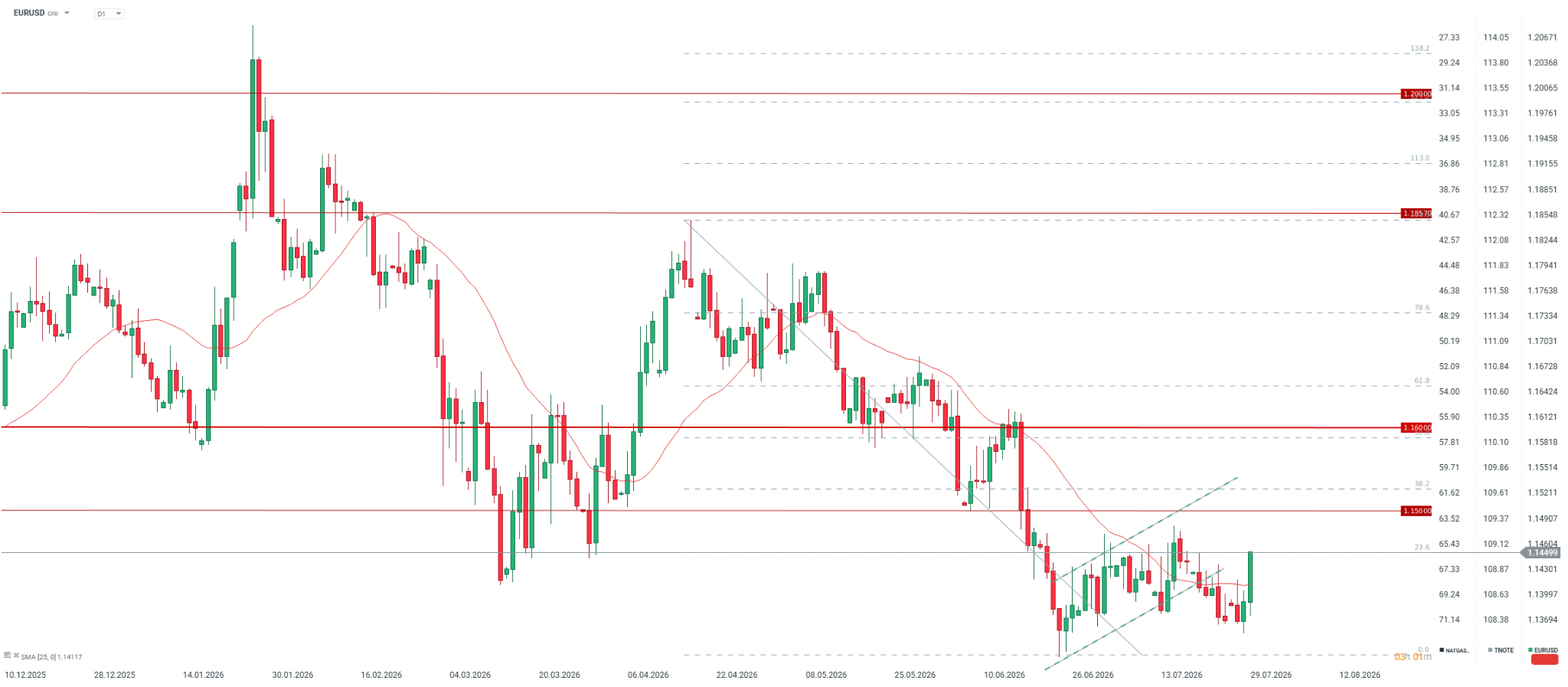
Warsh's evasive words indicate that he is not ready to raise interest rates and will try to dodge strong market expectations as best he can while simultaneously showing a stance of fighting inflation. This leads to a clear weakening of EURUSD, which is rising to 1.1450 and is at its highest since July 16.


BREAKING: France slows down, Germany holds on. Euro falls below 1.12



Daily Summary: Valuations Under Pressure, Capital Moves Away From Technology

Market Wrap: "Decent" results are not enough – tech stocks fall further; oil highest since May (22.10.2026)


Daily Summary: SpaceX and the tech sector drive Wall Street, oil retreats sharply below $97