



Over recent quarters, a dominant narrative has taken hold on Wall Street that the “Magnificent 7” are driving the bulk of earnings growth across the S&P 500. However, first-quarter 2026 data suggest a more nuanced picture. While large technology companies continue to grow faster than the broader market, FactSet indicates that this advantage largely disappears once Nvidia is excluded. This is an important signal for investors, as it shows that the strength of this group is not as broad as it may appear.
On an aggregate basis, the “Magnificent 7” still outpace the rest of the index
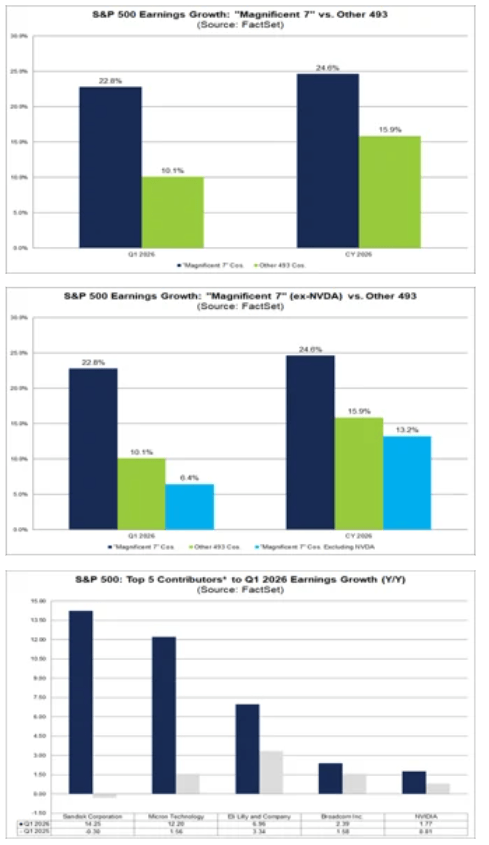
Estimates for the first quarter of 2026 suggest that the “Magnificent 7” will deliver earnings growth of 22.8% year over year. By comparison, the remaining 493 companies in the S&P 500 are expected to post growth of 10.1%. On a headline level, the largest technology firms still appear to hold a clear advantage.
This aligns with trends seen in previous quarters, when the seven largest technology names accounted for a disproportionately large share of total index earnings growth. The issue is that this seemingly broad dominance is now increasingly driven by a single company.
Nvidia is the key driver of earnings growth not only within the “Mag 7,” but across the entire S&P 500
The most important takeaway from the data is straightforward: Nvidia remains the largest single contributor to earnings growth both within the “Magnificent 7” and across the S&P 500. It accounts for a significant portion of the gap between megacap tech performance and the rest of the market.
Excluding Nvidia, projected earnings growth for the “Magnificent 7” in Q1 2026 drops from 22.8% to just 6.4%. This implies that without Nvidia, the rest of the group would actually grow more slowly than the broader index, which is expected to expand by 10.1%. In other words, the outperformance of the “Magnificent 7” becomes far less convincing once the largest beneficiary of the AI boom is removed from the equation.
The rest of the market may not be as weak as the dominant narrative suggests
This is where the interpretation begins to shift. For some time, markets have operated under the assumption that earnings growth is largely concentrated in a handful of large technology companies. However, the data suggest that once Nvidia is excluded, the remaining 493 S&P 500 companies are growing faster than the rest of the “Magnificent 7.”
This is not just a statistical detail. It indicates that earnings growth may be gradually broadening beyond the most obvious names. Among the next-largest contributors to S&P 500 earnings growth after Nvidia are Micron Technology, Eli Lilly, Broadcom, and Sandisk. This alone suggests that the market story is no longer limited to a small group of technology giants.
Source: XTB Research
The same pattern holds for full-year 2026 estimates
The full-year outlook reinforces this dynamic. For calendar year 2026, the “Magnificent 7” are expected to deliver earnings growth of 24.6%, while the remaining 493 S&P 500 companies are projected to grow by 15.9%. At first glance, the advantage again appears substantial.
However, Nvidia once again plays a decisive role. Excluding the company, projected earnings growth for the “Magnificent 7” drops to 13.2%, below the expected growth rate for the rest of the market. This suggests that even over a longer horizon, the group’s advantage is less broad than headline figures imply.
Concentration of growth is becoming a growing risk for the market
From an investor perspective, the key takeaway is that earnings growth in US equities is becoming increasingly concentrated. When a single company accounts for such a large share of overall improvement, the market becomes more vulnerable to disappointment.
This is particularly relevant in an environment where valuations of large technology companies remain elevated and expectations are high. The more growth is concentrated in one name, the greater the risk that weaker results or more cautious guidance could trigger a broader shift in sentiment.
Nvidia’s performance and market implications
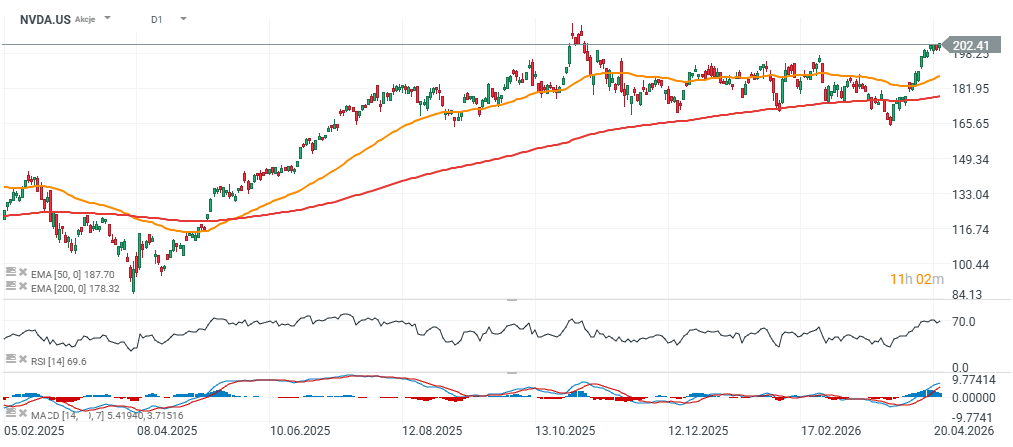
The simplest conclusion is this: the “Magnificent 7” still appear strong, but their strength is increasingly a story about Nvidia rather than broad-based dominance across the group. This does not mean the remaining companies are weak. It does mean that their advantage over the rest of the market is no longer as clear. For investors, this represents an important shift in perspective. Rather than treating the “Magnificent 7” as a uniform growth block, there is a growing need to analyze individual companies more closely. First-quarter data and full-year 2026 forecasts clearly show that without Nvidia, the narrative of overwhelming dominance begins to weaken. Nvidia shares are trading above $200 and have moved roughly 8% above the 200-day EMA (red line), increasing the likelihood of a breakout above the previous highs seen in autumn 2025.
Source: xStation5


Daily summary 📈 Precious metals and stock indices rebound as Treasury yields fall


US Open: Nasdaq 100 extends losses 🚩 AI stocks under pressure, CoreWeave falls 8%



Market Wrap: Tech Sell-Off Hits Europe, Gold Shines Again


TSMC breaks records once again driven by the AI boom