



Company updates
- Ryanair expects certification of the Boeing 737 MAX 10 in the third quarter of the year, with deliveries scheduled to begin on time early next year. Timely aircraft deliveries are critical for expanding capacity and supporting further network growth.
- The airline plans to increase passenger numbers from 207 million to around 215 million in the next financial year, alongside modest fare increases. This points to continued volume-driven growth while maintaining pricing discipline.
- Ryanair will reduce operations at Brussels Charleroi Airport by about 10% due to a new passenger tax, cutting approximately 1.1 million seats annually. This decision highlights the model’s sensitivity to regulation and the company’s ability to quickly reallocate capacity.
- The company has decided against installing Starlink satellite internet on its aircraft, citing increased fuel consumption and a lack of economic justification on short-haul routes. This reflects its consistent focus on cost optimization.
- A key risk remains the pace of aircraft deliveries and potential certification delays at Boeing. At the same time, maintaining cost leadership and disciplined capital allocation continues to underpin the investment case.
Valuation appears relatively attractive, with a P/E ratio of around 12 and a low PEG (~0.3), suggesting upside relative to growth prospects. Evercore ISI upgraded the stock to “outperform” with a price target of $80 after a roughly 15% pullback from January highs, while Bernstein raised its target to $71, citing steady operational progress, including 1.1% growth in revenue per available seat kilometer (RASK). However, the Middle East conflict—driving higher jet fuel prices—along with macro uncertainty tied to inflation and geopolitical tensions, continues to weigh on airlines broadly. Ryanair remains in strong financial shape, with around €1 billion in net cash and a positive net cash position overall. Its high-quality balance sheet and strong cash generation provide flexibility for investment and shareholder returns. The company’s operating profitability stands out within the sector, with return on equity around 26%, while its ultra low-cost model continues to support a structural cost advantage - even in a higher fuel price environment.
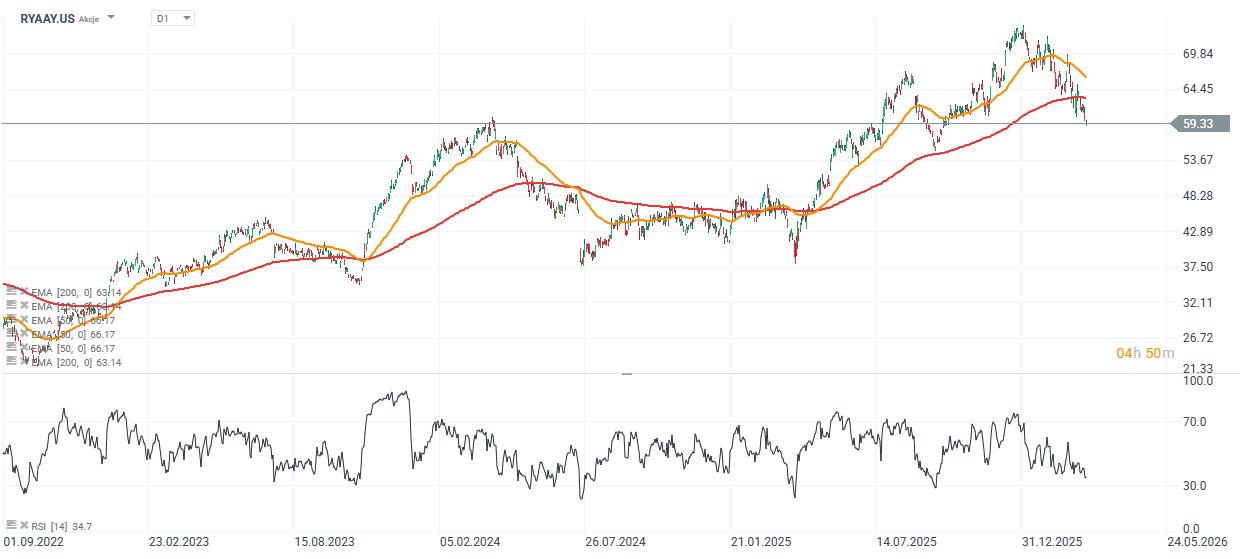
Source: xStation5
How big the problem with jetfuel is?
-
IATA warns that the US/Israeli conflict with Iran has exposed serious vulnerabilities in jet fuel supply chains. The organization says the war could lead to severe jet fuel shortages and potentially disrupt flights.
-
The Strait of Hormuz is a critical chokepoint for global energy markets. It normally handles around 20% of global oil supply, but shipping traffic there has now collapsed.
-
A breakdown in oil flows from the Persian Gulf could quickly spill into aviation. Lower crude availability and damaged refining capacity would reduce jet fuel output globally.
-
Europe appears especially vulnerable to any prolonged disruption. Around 25–30% of European jet fuel supply comes from the Persian Gulf, while reserves cover only about one month of normal demand.
-
Asia is also under pressure, limiting alternative sourcing options. Roughly 84% of crude passing through Hormuz normally goes to Asia, especially India and China, which constrains their ability to offset shortages elsewhere.
-
Airlines are already facing higher fuel consumption because of rerouting. Ongoing conflicts in Ukraine and the Middle East are forcing long-haul flights onto longer paths, raising both costs and fuel burn.
-
IATA says aviation is particularly exposed because jet fuel cannot be easily substituted at scale. Unlike some other sectors, airlines have very limited short-term alternatives if supply disruptions intensify.
-
The group is calling for immediate policy action. Its short-term recommendations include strategic jet fuel reserves, more diversified sourcing, and tighter coordination between governments, airlines, and refiners.
-
Legal and industry experts warn that refinery damage in the Middle East could worsen the problem materially. If airport and airline fuel stocks are depleted for any sustained period, carriers may be forced to cut operations and cancel flights.
Any large-scale jet fuel shortage would likely be felt directly by passengers. Easter travel, charter operations, and even international air ambulance services could face significant disruption if the situation deteriorates further. As we can see, there is a good reason for the Ryanair shares to decline. However, potential deescalation may support Ryanair and make the stock set to rebound.



US OPEN: Preparations for Tesla's mega-merger with SpaceX. Diplomatic stalemate with Iran cools Wall Street's enthusiasm

Meta Preview: Billions in AI spending, but when will the investments start paying off?

Tesla Preview: Will Robotaxis Save Earnings?


Supermicro Raises Forecast by $4 Billion as AI Server Demand Once Again Surprises the Market