



The race for artificial intelligence is most often presented as a competition for more powerful chips, better models, and larger data centers. At the center of this narrative are companies such as NVIDIA, Microsoft, and Alphabet, which directly build the computational backbone of the new era.
However, this is only one side of the story. Every AI model, every GPU cluster, and every data center ultimately comes down to one fundamental resource: energy. Without stable power supply, distribution systems, cooling, and control infrastructure, even the most advanced chips become useless.
This is where Schneider Electric comes in.
The company does not design semiconductors or develop AI models. Instead, it builds the physical and digital infrastructure layer that allows this technology to operate at industrial scale.
The AI boom therefore translates for Schneider not into demand for computing power, but into demand for energy and the systems that deliver, control, and optimize it.
For this reason, Schneider Electric can be seen as one of the most important, albeit indirect, beneficiaries of the AI revolution — a company that does not stand in the spotlight, but sits at the very core of its physical foundation.
What Schneider Electric actually is
To understand Schneider Electric properly, it is useful to think about it in simple terms.
It is a company that helps deliver energy where it is needed and then controls how that energy is used.
Its solutions are present in buildings, factories, data centers, and urban infrastructure. In practice, this includes everything from electrical distribution systems and power supply equipment to software that monitors and manages energy consumption in real time.
The key point is that Schneider does not sell only individual devices. It combines hardware, software, and services into a single integrated system.
As a result, the customer does not buy a product, but a complete solution that makes operations cheaper, more efficient, and more reliable.
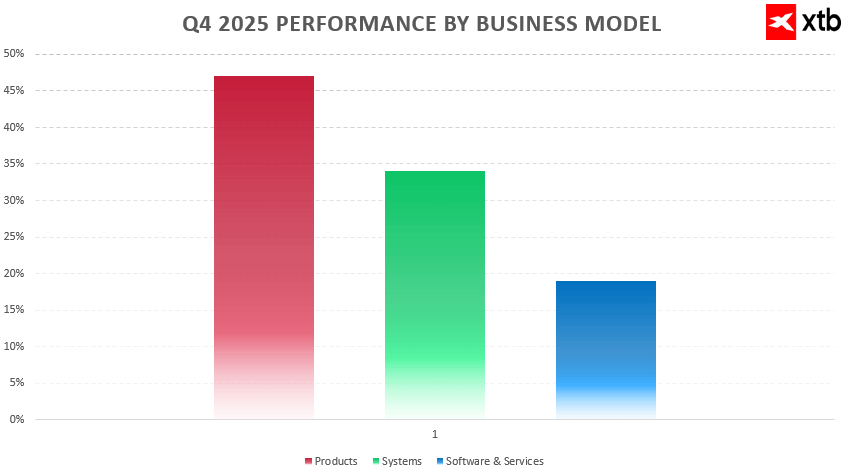
This has an important business implication. Selling a single device generates one-off revenue. Selling a full system often leads to long-term relationships, additional services, and recurring income over time.
In simple terms, Schneider Electric’s model can be broken into three elements: hardware, which provides the physical energy infrastructure; software, which controls and optimizes it; and services, which maintain and continuously improve the system.
This combination makes the company not just a hardware supplier, but a long-term infrastructure partner.
Where Schneider Electric generates revenue
Schneider Electric operates across four main end markets.
The first is buildings, including offices, hotels, shopping centers, and other commercial real estate. Here, the company provides systems that help manage energy consumption and improve efficiency. The second and currently fastest-growing segment is data centers and networks. This is where the impact of artificial intelligence is most visible. Every new AI project requires more advanced and more energy-intensive infrastructure. The third segment is industry. Manufacturing companies are increasingly investing in automation and digitalization to improve productivity and efficiency. The fourth is infrastructure, including power systems, transmission networks, and large-scale modernization projects.
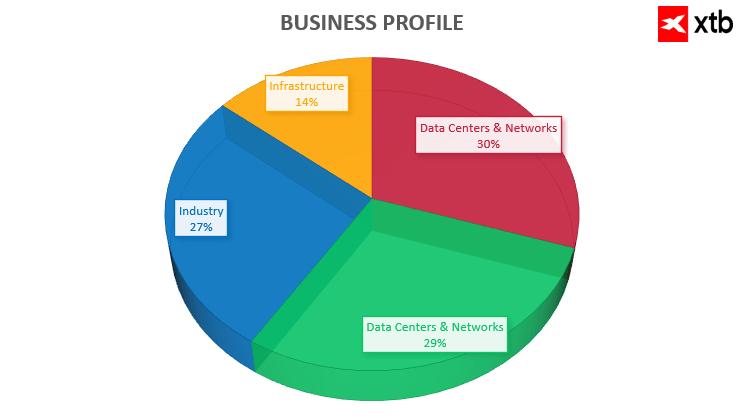
Importantly, Schneider is not dependent on a single segment. Each of these areas contributes to growth and provides diversification.
However, today the strongest momentum is clearly in data centers, which are growing faster than the rest of the business and are directly driven by artificial intelligence.
At the same time, the other segments provide stability and reduce dependence on a single macro trend.
AI and data centers as the main growth engine
The strongest driver of Schneider Electric’s current growth is the rapid expansion of data center investments.
This is where artificial intelligence stops being an abstract concept and becomes physical infrastructure that must operate in the real world.
Every AI model, whether developed by Microsoft, Amazon, or Google, requires massive computing power. This computing power must be delivered by data centers, which in turn require stable electricity, cooling systems, and infrastructure management tools.
This is exactly where Schneider operates.
The company does not monetize AI models or chips. It monetizes the fact that these systems must run continuously, at scale, and under extremely high energy demand.
Each new data center requires a full supporting energy ecosystem: backup power systems, power distribution, cooling solutions, and software that manages the entire infrastructure.
As AI systems become more advanced, power density inside data centers increases. This directly drives demand for Schneider’s solutions.
Importantly, this is not a one-off effect. AI investments are long-term and multi-stage, meaning demand for energy infrastructure is spread over many years.
In this sense, Schneider operates in the second layer of the AI value chain. It does not compete in model creation, but enables the industrial-scale deployment of AI systems.
It is also worth noting that demand is not limited to new data centers. A significant part of growth comes from upgrades and expansions of existing facilities, which must adapt to higher computing density and energy consumption.
Financial performance
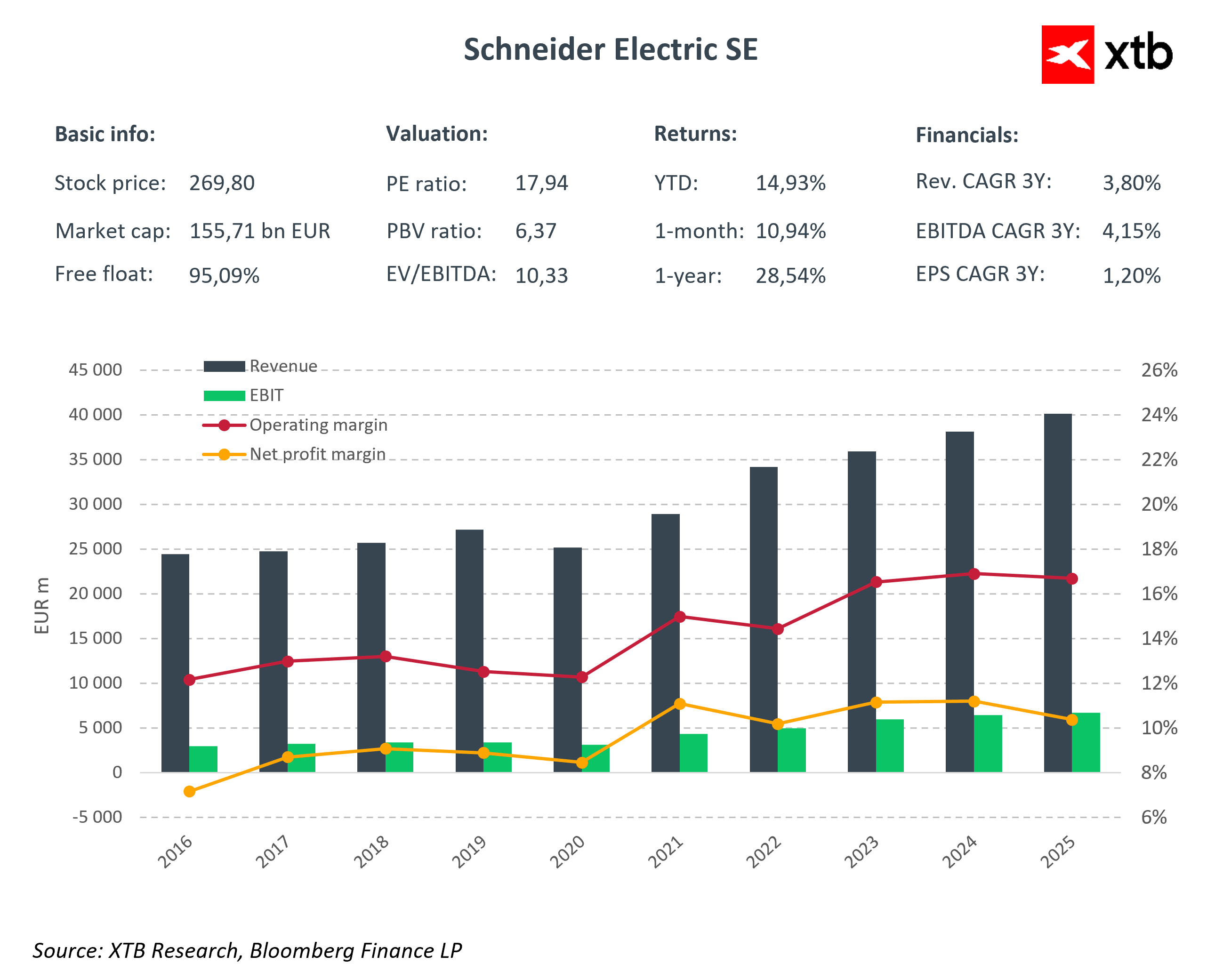
In 2025, Schneider Electric demonstrated a combination of stable growth and high-quality financial performance.
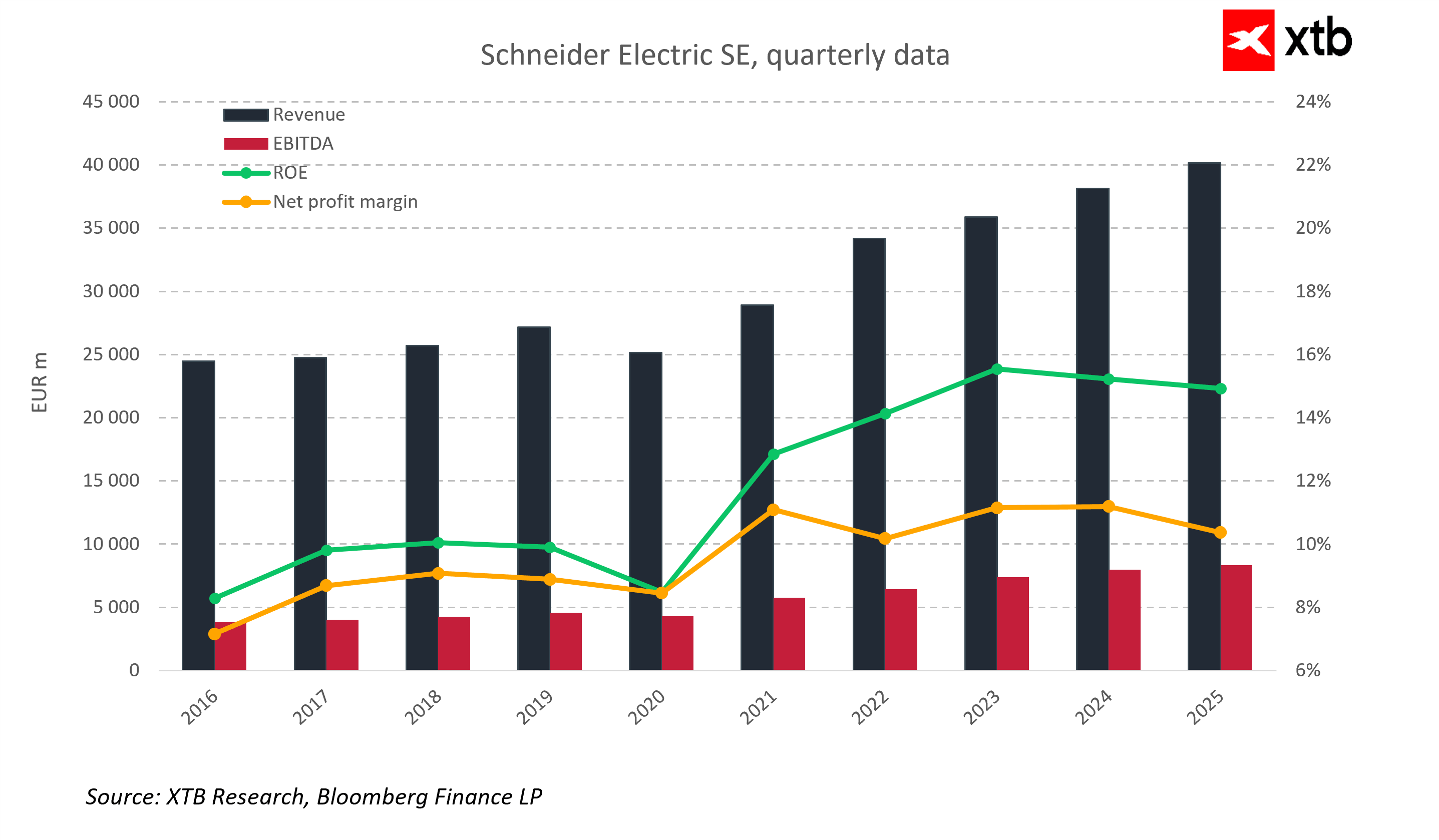
Revenue exceeded 40 billion euros, representing organic growth of approximately 10 percent year over year. This is significant for a company of this scale, showing that growth is still possible despite its global size.
At the same time, profitability improved. Operating margins remained at a high level, indicating that the company is not only growing revenue but also improving efficiency and generating more profit per unit of sales.
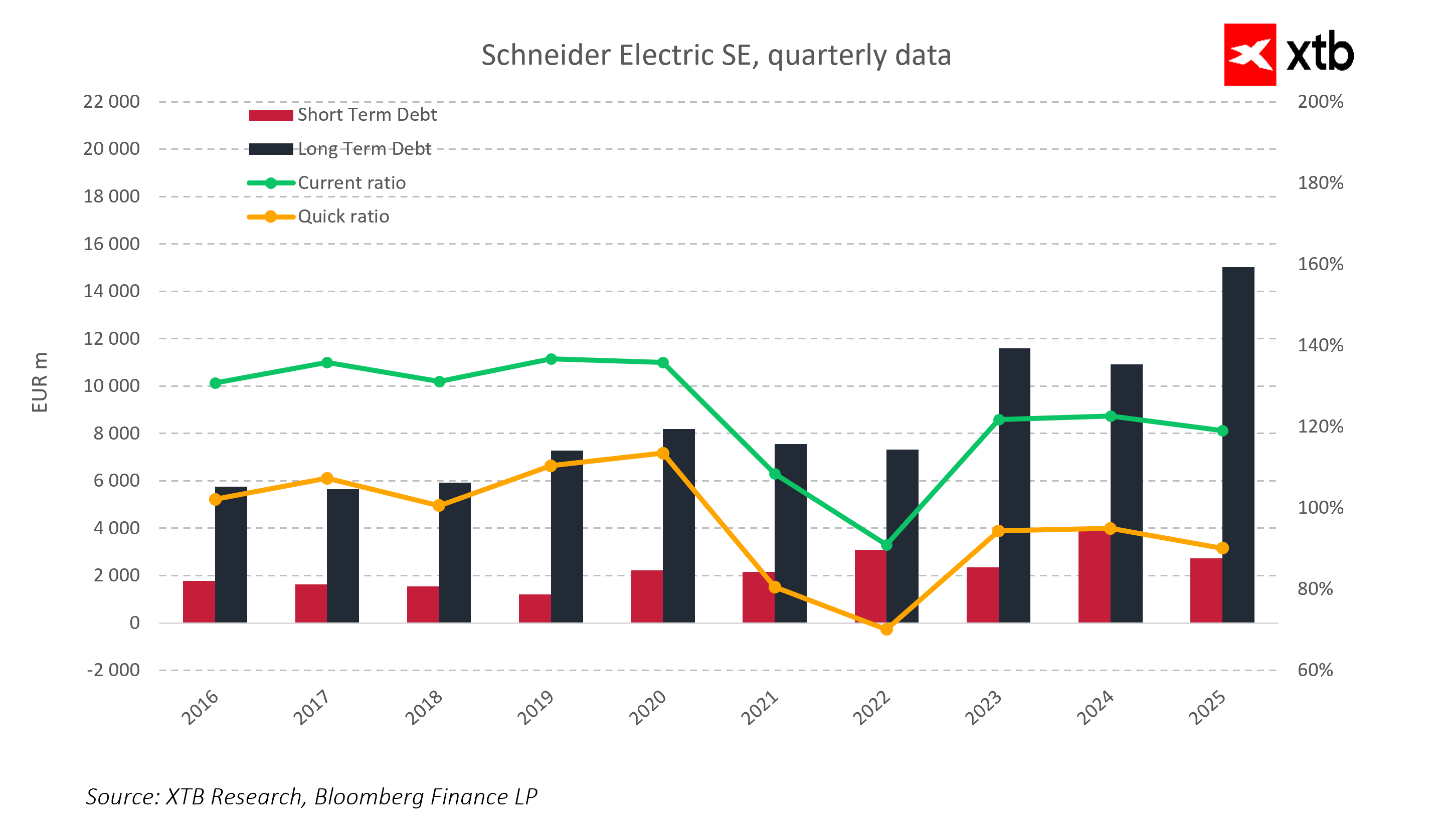
Free cash flow was another key highlight, reaching a record level of around 4.6 billion euros. This is one of the most important indicators of business quality, as it shows that accounting profits are translating into real cash that can be reinvested, distributed, or used for further growth.
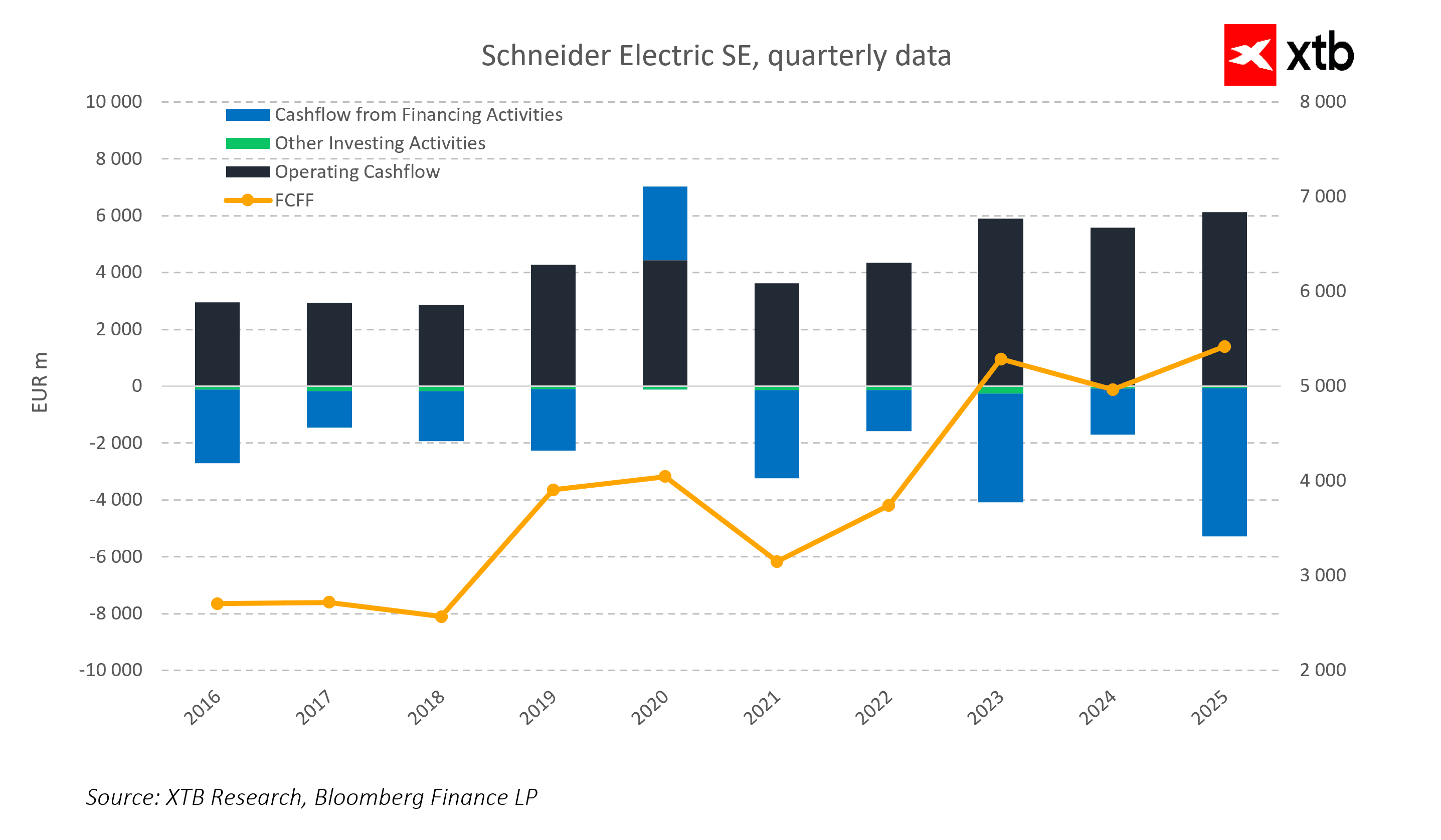
The main driver of performance was the energy management segment, particularly data centers. This is where AI-driven demand had the strongest impact.
In the final part of the year, the data center segment grew significantly faster than the rest of the business, confirming that the AI boom is directly reflected in financial results, not through chips, but through energy infrastructure.
Geographically, North America remained the strongest region, with growth of around 15 percent year over year. This is particularly important, as it is also where most AI and data center investments are concentrated.
Overall, the 2025 results present a consistent picture: Schneider Electric is a large industrial company with stable foundations and a strong additional growth engine driven by digital infrastructure.
Risks and future opportunities
Although Schneider Electric is currently benefiting from strong investment momentum in data centers and artificial intelligence, the future is not one-dimensional.
On the risk side, the most important factor is the cyclical nature of infrastructure investment. Data center construction and grid modernization are capital-intensive projects that take time, meaning even small delays can impact quarterly results.
Another risk is the current concentration of growth around data centers and AI. If the pace of AI investment slows, part of this growth momentum could weaken.
The company also operates in a highly competitive environment, with strong players such as Siemens and ABB. This means technological leadership must be continuously defended.
At the same time, these risks are balanced by significant opportunities.
Europe is increasingly focused on technological and energy independence. This implies the development of local data centers, regional computing hubs, and modernization of critical infrastructure. In such a scenario, demand for energy management systems, automation, and digital infrastructure may grow not only from global tech giants, but also from government-led and private European investment programs.
Schneider is well positioned in this environment, as it operates both globally and strongly within Europe. This allows it to benefit from both global AI-driven demand and regional industrial policy trends.
At the same time, AI growth is not limited to hyperscalers. Increasing investment is also coming from mid-sized and regional data centers, expanding the overall market.
Another long-term support factor is the growing share of software and services in the revenue mix, which improves stability and reduces cyclicality.
As a result, Schneider Electric sits at an intersection of multiple megatrends: artificial intelligence, electrification, digitalization, and the push for technological independence in Europe.
Valuation
We present a valuation of Schneider Electric using a discounted cash flow (DCF) model. It should be emphasized that this valuation is for informational purposes only and should not be interpreted as an investment recommendation or a precise valuation.
Schneider Electric is a global leader in energy management and automation technologies, benefiting from long-term structural trends such as digitalization, electrification, artificial intelligence, and rising investment in data center and power infrastructure. The company combines hardware, software, and services, which enables it to generate stable cash flows and an increasing share of recurring revenue.
The valuation is based on a base case scenario of projected revenues and earnings, incorporating continued growth in data centers, infrastructure, and industrial automation. The assumptions regarding cost of capital (WACC) and long-term growth are conservative and reflect a stable yet still expanding business profile.
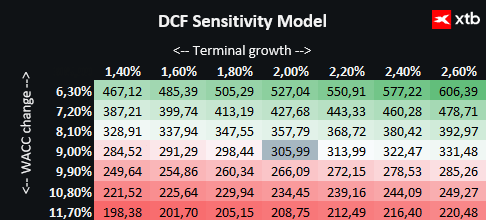
Based on the current share price of 270 euros and a DCF valuation of 305 euros, the estimated upside potential is approximately 13 percent. This indicates a moderate but positive upside, supporting the view of Schneider Electric as a high-quality company that combines the stability of a large industrial business with exposure to long-term technology megatrends.
Chart perspective
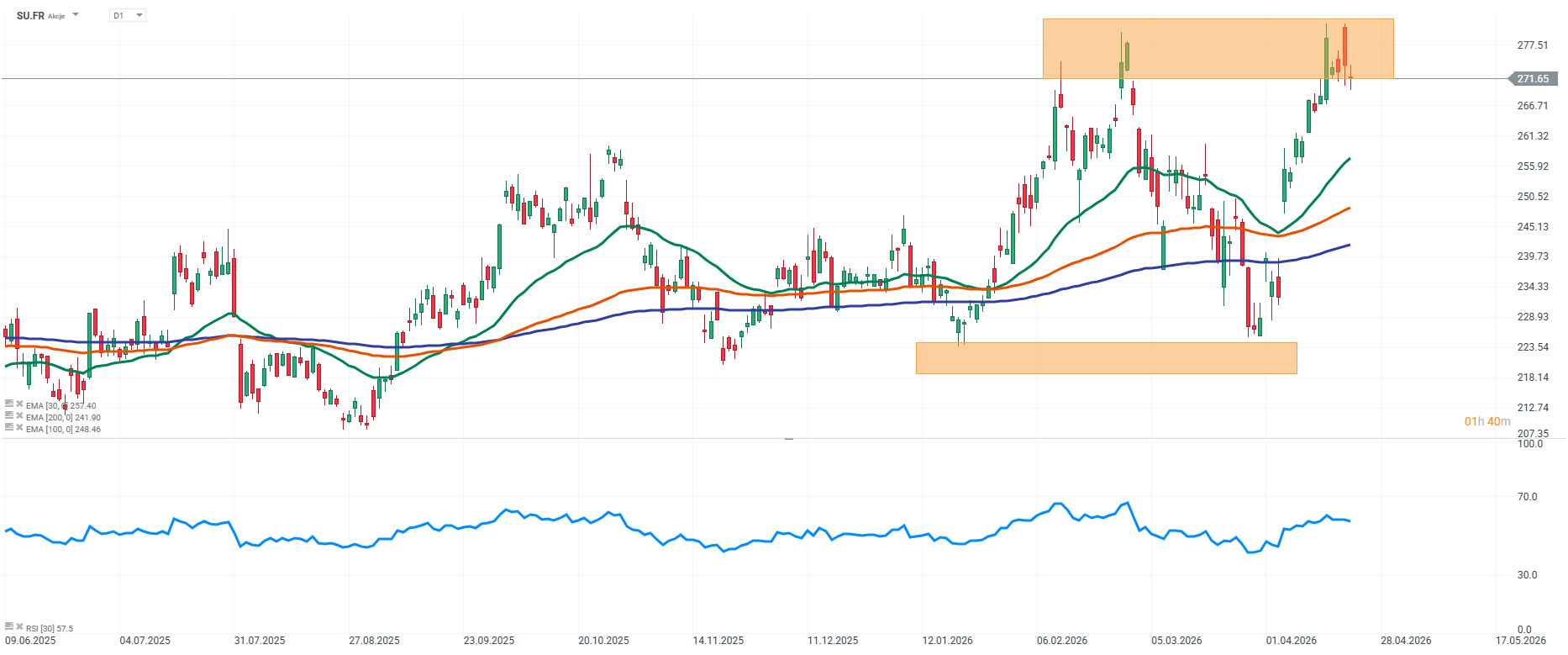
Looking at the share price performance of Schneider Electric over the analyzed period, we observe a clear upward trend that remains stable and well-structured despite periodic corrections.
In the longer term, the stock moves in a pattern of higher highs and higher lows, indicating a sustained dominance of buyers. The corrections that occurred along the way were mostly technical in nature and did not change the overall direction of the trend.
The chart also shows gradual support from moving averages, which over time align in a configuration typical of an uptrend. Pullbacks toward these levels were often used by the market as entry opportunities, further strengthening the trend.
From a fundamental perspective, this structure is consistent with the company’s performance. Schneider Electric operates in an environment of rising demand for energy, automation, and data center infrastructure, which translates into stable demand and solid revenue growth prospects.
It is particularly important that the price appreciation is not driven by a single impulse, but instead by several parallel trends, including the development of artificial intelligence, modernization of power grids, and the digitalization of industry and buildings.
The combination of these factors means that the chart reflects not only improving market sentiment, but also a gradual strengthening of a long-term growth story.
Source: xStation5


Webull shares down 20% amid fears over potential China ties



US Open: Wall Street in the Red 🚩 Nasdaq Falls 1% From Record Highs, Constellation Brands Back at March 2020 Level



Market Wrap: Oil rises again, French fiscal concerns weigh on euro (07.10.2026)


US Open: Wall Street Pushes Back Expectations of Another Fed Hike