



Cocoa (COCOA) prices are showing elevated volatility today during the first session of 2026, as the market awaits the first indications of commodity purchases from institutions tracking the Bloomberg Commodity Index (BCOM). Capital is gradually positioning for the 2026 season, which is expected to be far more favorable for production after a disastrous 2025. Cocoa tree diseases in Africa have stabilized, while high prices have encouraged farmers to expand plantings and increase spraying. In addition, weather conditions have been more supportive, and the progress of the main harvest in West Africa (Ghana and Côte d’Ivoire) has been solid.
At the same time, cocoa demand in 2026 could strengthen due to structural factors, including cocoa’s addition to the Bloomberg Commodity Index (BCOM) and the related institutional flows. ICE cocoa inventories are also declining. So what exactly will the market focus on in 2026, and what are the key bullish and bearish catalysts for cocoa prices?
Bullish (supportive) factors
1) Index-related demand as a potential catalyst
Cocoa is expected to benefit from anticipated buying linked to the inclusion of cocoa futures in the Bloomberg Commodity Index (BCOM) starting in January. According to Citigroup, this may attract up to around $2 billion of buying in New York cocoa futures.
2) Falling ICE inventories
ICE-monitored cocoa stocks held in US ports dropped to a 9.5-month low of 1,626,105 bags, providing support from the “visible” supply side.
3) A tightening global balance outlook
-
The International Cocoa Organization (ICCO) lowered its 2024/25 surplus forecast to 49k MT (from 142k MT) and reduced its 2024/25 global production estimate to 4.69 MMT (from 4.84 MMT).
-
Rabobank also cut its 2025/26 surplus forecast to 250k MT (from 328k MT).
4) Nigeria as an additional supply-side risk
Nigeria (the world’s 5th largest cocoa producer) expects 2025/26 production to decline by 11% y/y, to 305k MT, which supports prices in the medium term.
Bearish (limiting) factors
1) Favorable weather in West Africa
A supportive mix of rainfall and sunshine in Côte d’Ivoire and regular rains in Ghana have supported flowering and pod development ahead of the harmattan season. This reduces near-term supply concerns.
2) Stronger signals from pod counts
Mondelez noted that the latest West Africa pod count is 7% above the five-year average and “materially higher” than last year. Côte d’Ivoire’s main crop harvest has begun and farmers are optimistic about quality.
3) The EU’s EUDR delay keeps supply more available
The European Parliament approved a one-year delay to the EU deforestation regulation (EUDR), which effectively allows continued imports of cocoa from regions where deforestation remains a concern. This reduces near-term regulatory pressure on supply.
4) Weakening global demand (grindings)
-
Asia: Q3 grindings -17% y/y (lowest Q3 in 9 years)
-
Europe: Q3 grindings -4.8% y/y (lowest Q3 in 10 years)
-
North America: Q3 grindings +3.2% y/y, but the data was likely skewed due to the inclusion of new reporting companies
Overall, the grinding data point to clear demand weakness, especially in Asia and Europe.
Summary
The 2023/24 season was historically tight: the ICCO revised the global deficit to -494k MT, the largest in more than 60 years, and production fell -12.9% y/y to 4.368 MMT. Meanwhile, the 2024/25 season is expected to deliver the first surplus in four years, with the ICCO estimating a surplus of 49k MT, alongside production of 4.69 MMT (+7.4% y/y). This is an important argument on the supply side, but it will be tested by real-time data from West Africa and the trajectory of inventories.
What to watch next:
-
the actual size and pace of BCOM-related index flows,
-
the impact of West African weather through the harmattan period,
-
the level and trend of ICE inventories,
-
and upcoming grinding reports from key regions: Asia, Europe, and North America.
COCOA (H1 chart)
Cocoa has retraced part of the recent decline and is attempting to move higher again, which increases the probability that the 1:1 correction is complete and that prices may return above $6,000 (EMA50) in the near term.
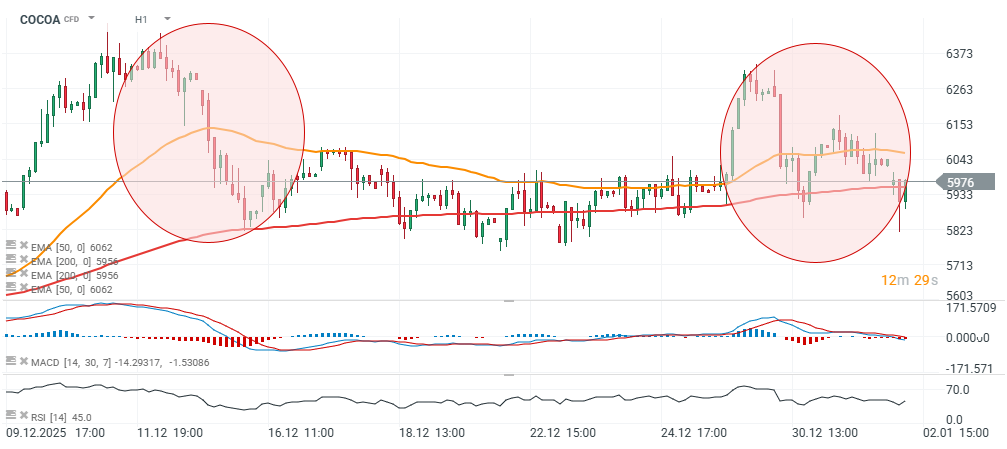
Source: xStation5



Daily Summary: Oil at five-month highs, indices under pressure (23.10.2026)


US Open: Further declines on Wall Street, Brent above 111 USD, AI correction continues (14.10.2026)


Chart of the Day: Is USDJPY running out of road? Inflation forces the BoJ to act, but the Fed could spoil the Yen’s rally



Macro Calendar: Preliminary PMI Readings and Earnings Ahead