

Forex trading is the simultaneous buying of one currency and selling of another within currency pairs on a global, decentralized market to profit from exchange rate fluctuations. The foreign exchange market records a daily trading volume exceeding $9 trillion. Market participants engage in this activity for both speculation and hedging, but transitioning from traditional forex investing to active trading requires specific steps. Below we break down the market mechanics and detail how to start safely.
- Forex trading involves exchanging currency pairs to capture value changes based on global supply and demand.
- Leverage magnifies both potential gains and potential losses, acting as the primary risk factor.
- Practicing on a demo account and formulating a trading plan are mandatory steps before risking real capital.
- Operating exclusively with a regulated broker protects your funds from counterparty insolvency.
What is Forex Trading?
Forex trading is the simultaneous buying of one currency and selling of another, in currency pairs, on a global over-the-counter (OTC) market without a central exchange. The global foreign exchange market facilitates up to $9 trillion in daily volume, providing immense liquidity for its participants. During the volatile months average volume may be very high - for example in April 2025 (trade war fears), trading volume surged to $9.6 trillion according to Bank of International Settlements data.
Unlike a stock exchange operating from a single centralized venue, the forex market is a global electronic network connecting banks, brokers, financial institutions, companies and other market participants across different regions. Currency transactions are executed through this decentralized network rather than on one physical exchange, allowing the market to operate continuously across major financial centres around the world.
Every transaction inherently involves two assets: a base currency and a quote currency. For instance, in the EUR/USD currency pair, the euro acts as the base currency while the US dollar serves as the quote currency. This article focuses on the spot market, the most common way retail traders access forex, though currencies are also traded as forwards, futures and options.
Participants execute these trades primarily for speculation or hedging, seeking to benefit directly from price movements rather than holding physical currency long-term. This distinction matters because forex trading (actively buying and selling currency pairs over short time frames, often with leverage) is frequently confused with forex investing (holding a currency position for a longer period without leverage) - beginners often conflate the two, even though the risk profile and time horizon differ significantly. Retail traders frequently utilize CFD instruments as an alternative mechanism to gain exposure to these currency fluctuations without physically settling the underlying assets. Beginners typically start with major currency pairs such as EUR/USD or GBP/USD, which tend to offer higher liquidity and narrower spreads than minor or exotic pairs.
How does forex trading actually work?
Exchange rates move based on supply and demand, and trading occurs electronically via a network of brokers 24 hours a day, 5 days a week. The foreign exchange market operates continuously through overlapping major sessions in London, New York, Tokyo, and Sydney.
Price movements are measured in pips, which represent the smallest standard price change in a currency pair, while the transactional cost is typically determined by the spread, which is the difference between the bid and ask price. For example, if a trader buys one standard lot (100,000 units) of EUR/USD and the price moves by 10 pips in their favor, the position gains $100.
[WIDGET: Price chart: EUR/USD]
Past performance is not a reliable indicator of future results
Because forex operates as an over-the-counter (OTC) market, transactions happen directly between counterparties through a network of banks and brokers rather than via a centralized physical exchange. This decentralized structure is what allows forex trading to execute rapidly across major currency pairs even if the spread is wide.
What makes leverage different in forex trading?
Forex leverage stands out because even relatively small currency moves can translate into much larger gains or losses on a trader’s account when high leverage is used. This market traditionally offers some of the highest available leverage levels among financial instruments, typically ranging from 30:1 to 50:1 for retail clients depending on the jurisdiction, and features specific overnight holding costs.
Regulatory limits on leverage differ significantly between major currency pairs, minor pairs, and exotics, generally allowing higher exposure for major pairs due to their deep liquidity. Additionally, holding a leveraged forex position overnight incurs a swap or rollover fee (or credit), which is strictly driven by the interest rate differential between the two currencies in the pair, a mechanism absent in equity trading. If you are unfamiliar with the core mechanics of margin and borrowed capital, start by reading about leverage.
|
|
This example is strictly illustrative; actual losses may differ due to position size, leverage, spreads, slippage and market conditions. Past performance and hypothetical scenarios are not reliable indicators of future results.
How do you start trading forex, step by step?
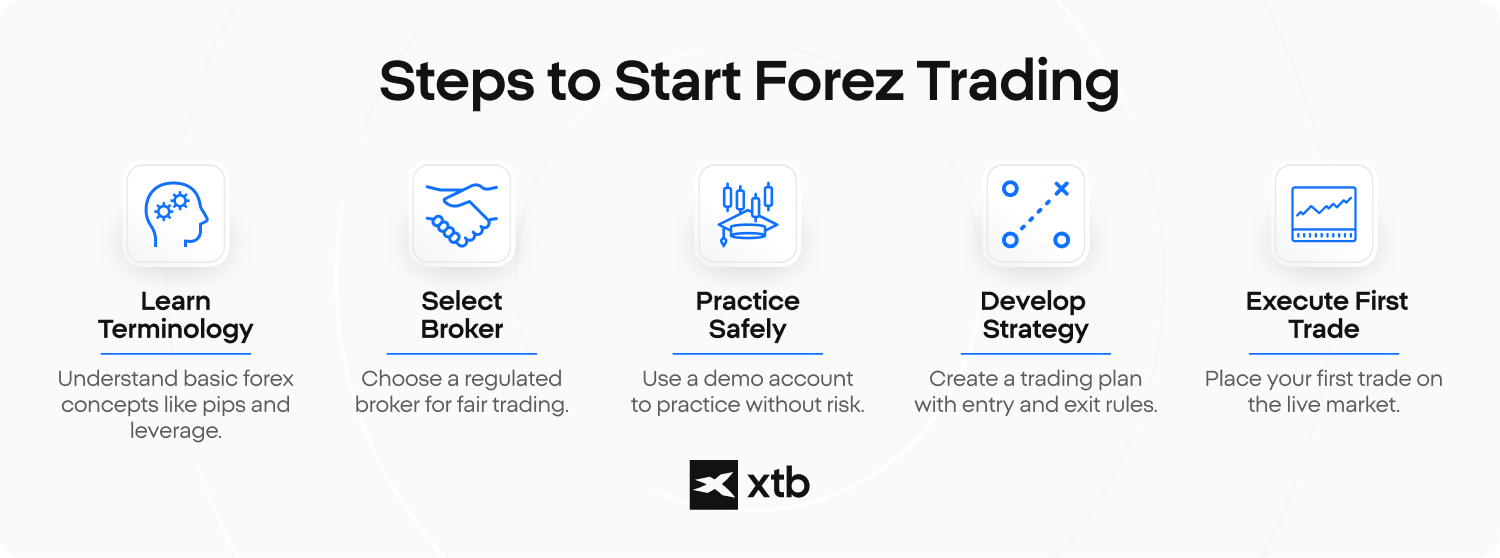
Starting forex trading requires learning the basics, selecting a regulated broker, opening a demo account before risking real capital, and building a strict trading plan. Before entering the live foreign exchange market, beginners typically follow a structured educational and practical sequence to mitigate early risks:
- Learning the terminology: Understanding pips, lots, leverage, and margin is a mandatory foundational step.
- Selecting a provider: Traders must verify the credentials of a regulated broker to ensure fair execution and fund segregation.
- Practicing safely: Operating a demo account allows traders to execute virtual trades without financial exposure.
- Developing a strategy: A strict trading plan dictates exact entry and exit rules, as well as daily risk management protocols.
- Executing the first trade: The final phase involves selecting a currency pair and placing an initial order on the provider's trading platform.
A common question among beginners is whether starting with $100 is sufficient. While minimum deposits can technically be as low as tens or hundreds of dollars, adequate capitalization is necessary to absorb normal market volatility without triggering a margin closeout. You can read more about the general technical prerequisites in how to start trading.
|
|
What are the main risks of forex trading?
The main risks of forex trading come from leverage, rapid market volatility, poor risk management and exposure to unreliable or unregulated companies. A majority of retail forex traders lose money, primarily due to excessive leverage and a lack of disciplined capital management or lack of managing positions. According to National Competent Authorities and ESMA’s 2018 product analysis, approximately 74 to 89% of retail client accounts lose money when trading forex and CFDs.
High volatility in the foreign exchange market can cause rapid, unpredictable price swings, amplifying both psychological stress and the financial impact of leveraged positions. As demonstrated in the earlier trader comparison, failing to manage this volatility often leads to holding losing positions too long or facing sudden, catastrophic liquidations.
Another significant factor is counterparty risk, which arises if an unregulated provider becomes insolvent, or if it has excessive control over trade execution in an over-the-counter market with no central exchange. Operating exclusively with a regulated broker ensures client funds are segregated from company capital and protected under statutory compensation schemes.
|
|
Is forex trading regulated and legal?
Forex trading is legal in most countries, but regulatory oversight varies heavily by jurisdiction, making it essential to verify a broker's license before opening an account. Different regions operate under distinct regulatory bodies, such as the CFTC and NFA in the United States, or the FCA and ESMA in Europe. When evaluating a regulated broker, you must consult official regulator databases to check their registration status, disciplinary history, and withdrawal conditions.
Due to the decentralized nature of the foreign exchange market, red flags for scams include unsolicited social media contacts, promises of guaranteed profits, and platforms that only accept cryptocurrency (i.e. a crypto-asset) deposits. Forex trading can be compared to navigating changing market conditions: analytical strategies help identify potential opportunities, while strict risk management defines how much capital is exposed when those expectations prove wrong.
CFDs are complex instruments and come with a high risk of losing money rapidly due to leverage. 78% of retail investor accounts lose money when trading CFDs with this provider. You should consider whether you understand how CFDs work and whether you can afford to take the high risk of losing your money.
FAQ
Forex trading is the speculation on changes in exchange rates between two currencies. A trader is never buying “the euro” or “the dollar” in isolation, but expressing a relative view through a pair such as EUR/USD, GBP/USD or USD/JPY. In practice, that means every trade is a judgment about which of two economies, interest-rate paths or currencies is likely to outperform the other.
Traders usually speculate on whether a currency pair will rise or fall in value. If their pediction is correct they can profit, if their prediction is false they will take a loss.
To start trading forex you will need a trading account with a broker and a good understanding of forex concepts and education. Please note forex trading can be complex and is not suitable for everyone.
To mitigate risk in forex trading make sure you use stop-loss orders and trailing stop to limit potential losses, diversify your porfolio and avoid overtrading.
XTB provides a varity of sources including ebooks, educational articles and educational videos on our Youtube Channel.
Forex is easy to access but difficult to master. The platform mechanics are simple, yet the combination of leverage, fast-moving prices and macroeconomic sensitivity means beginners can make large mistakes quickly if they focus on potential returns before understanding risk. A demo account is useful for learning execution, but it should be treated as training rather than proof that a strategy will work with real money. Overall, forex can be a reasonable starting point for beginners who are willing to learn the mechanics and manage risk deliberately, but it is not a good fit for anyone looking for quick or guaranteed returns.
There is no single correct amount. What matters more than the deposit itself is whether the account is large enough to support sensible position sizing, normal drawdowns, spreads and margin requirements without forcing excessive leverage. A small account can technically place trades, but that does not mean it can do so with robust risk management.
Leverage lets a trader control a much larger market position with a relatively small amount of deposited capital. That is useful because currencies often move in relatively small daily percentages, but it also means that a normal market move can translate into a large gain or loss relative to account equity. The real danger is not leverage itself, but using more exposure than the account can realistically absorb.
- Higher leverage reduces the margin required to open a position, but increases the percentage impact of each market move on your account.
- Lower leverage gives a trader more room to survive volatility, but it does not remove market risk or guarantee better results.
A pip is a standard unit used to describe small changes in an exchange rate. For many major currency pairs, one pip equals 0.0001, although there are exceptions such as many yen pairs. The financial value of a pip is not fixed: it changes with position size and, in some cases, with the currency denomination of the trading account.
The spread is the difference between the price at which you can buy a currency pair and the price at which you can sell it. It is a direct trading cost and matters especially for short-term traders, because even a good market view can be undermined by poor execution or an unusually wide spread. Spreads are usually tighter in highly liquid major pairs and can widen sharply around major data releases or periods of market stress.
The biggest risks are excessive leverage, poor position sizing, sudden volatility and weak execution discipline. Many retail traders focus too heavily on predicting direction and not enough on controlling the size of a potential loss. In professional trading, surviving bad trades is often more important than being right on any single market call.
- Stop-loss orders can help define risk, but the final execution price may differ from the requested level during gaps or fast markets.
- Margin close-outs can occur quickly when leverage is high, especially if several correlated positions move against the trader at the same time.
Forex trading is legal in many countries, but the rules differ significantly by jurisdiction. Regulation matters because it can determine leverage limits, how client money is handled, what disclosures brokers must provide and which protections apply if a provider fails. A broker should always be checked against the official register of the relevant regulator rather than judged by marketing claims alone.
A structured approach to forex trading is based on market analysis, predefined entry and exit rules, position sizing and risk management. Traders typically evaluate macroeconomic data, monetary policy, technical signals and market sentiment before taking a position. A consistent process does not eliminate losses, but it helps ensure that individual trades remain part of a broader, measurable strategy.
Understanding Forex Volatility: Causes, Effects, and Strategies
UK General Election 2024: What Investors Need to Know
Investing in Currencies
This content has been created by XTB S.A. This service is provided by XTB S.A., with its registered office in Warsaw, at Prosta 67, 00-838 Warsaw, Poland, entered in the register of entrepreneurs of the National Court Register (Krajowy Rejestr Sądowy) conducted by District Court for the Capital City of Warsaw, XII Commercial Division of the National Court Register under KRS number 0000217580, REGON number 015803782 and Tax Identification Number (NIP) 527-24-43-955, with the fully paid up share capital in the amount of PLN 5.869.181,75. XTB S.A. conducts brokerage activities on the basis of the license granted by Polish Securities and Exchange Commission on 8th November 2005 No. DDM-M-4021-57-1/2005 and is supervised by Polish Supervision Authority.