



Microsoft came under modest pressure today following reports of a restructuring in its relationship with OpenAI. The market quickly latched onto one detail that dominated the narrative: the company is expected to stop sharing a portion of its revenue with OpenAI. At first glance, this may appear to weaken the economic foundation of the partnership, but the reality is more nuanced.
This is not the end of the partnership, but rather its redefinition. The most important shift is not the revenue-sharing mechanism itself, but a change in the balance of power. OpenAI is gaining greater operational flexibility, with its technologies expected to be available beyond the Azure ecosystem. At the same time, Microsoft is losing part of the exclusivity that has been a key pillar of its AI narrative in recent years.
From a strategic perspective, the relationship remains important, but it is becoming less closed than before. Microsoft retains access to OpenAI’s core technologies and long-term rights to use them, yet the structure is evolving into a more market-driven and less asymmetric arrangement.
For investors, the key question is whether this change materially weakens the investment case for Microsoft. In the short term, the market may interpret it as a slight deterioration in Microsoft’s negotiating position vis-à-vis OpenAI, which helps explain today’s price reaction. Over a longer horizon, however, the removal of revenue-sharing obligations could improve the economics of the partnership, while Microsoft remains one of the primary beneficiaries of AI monetization through Azure and its Copilot suite.
Timing also matters. Microsoft is set to report quarterly earnings on Wednesday, placing this development squarely in the context of an upcoming catalyst. As a result, the market is not only digesting a shift in narrative but also preparing for hard data. In this environment, the earnings report is likely to carry more weight than the contractual details themselves.
Investors will be looking closely at Azure growth, the pace of AI adoption, and whether demand driven indirectly by OpenAI continues to translate into tangible performance in the cloud segment. In previous quarters, Microsoft has emphasized the measurable impact of its OpenAI partnership, both in accelerating Azure growth and in expanding commercial commitments tied to AI.
In that context, the latest development does not undermine Microsoft’s fundamentals as much as it reshapes the emphasis within its strategy. The company is not losing OpenAI, but it is giving up some degree of control over a relationship it helped build and that has been central to its growth narrative.
Ultimately, what matters more for the market than the structure of the agreement is whether Wednesday’s results confirm that Azure remains the core engine of Microsoft’s growth in the AI era. If that holds true, the evolving relationship with OpenAI may prove to be less of a risk and more of a natural step in the maturation of the broader AI ecosystem.
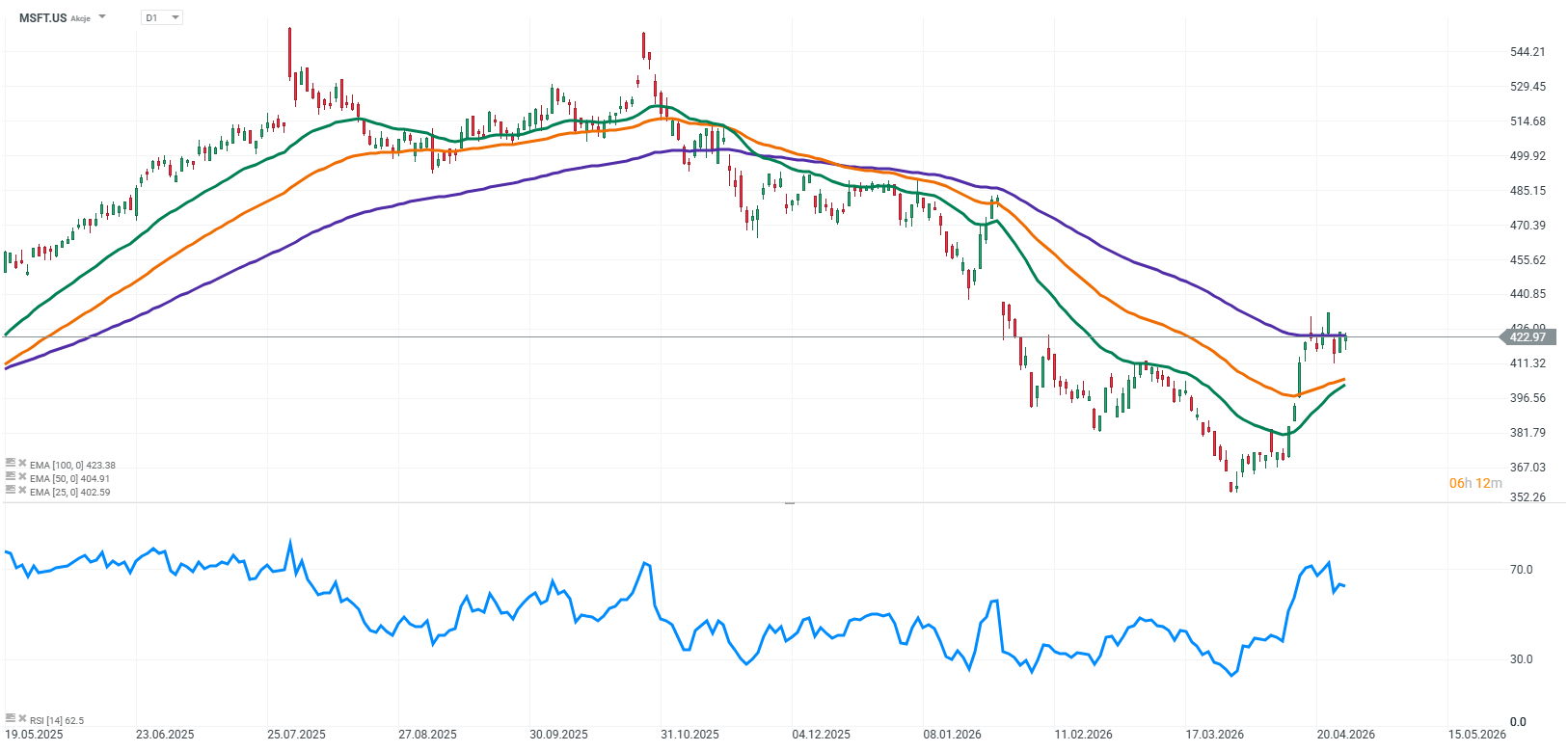
Source: xStation5


POET: A “meme stock” in photonics, is there still hope?



Market Wrap: ASML lifts tech sentiment, EU yields pull back



US CPI in focus, as UK Gilts outperform

ASML disappoints on revenue but delivers stronger profits and raises guidance 🍳 What’s next for the AI sector?
This content has been created by XTB S.A. This service is provided by XTB S.A., with its registered office in Warsaw, at Prosta 67, 00-838 Warsaw, Poland, entered in the register of entrepreneurs of the National Court Register (Krajowy Rejestr Sądowy) conducted by District Court for the Capital City of Warsaw, XII Commercial Division of the National Court Register under KRS number 0000217580, REGON number 015803782 and Tax Identification Number (NIP) 527-24-43-955, with the fully paid up share capital in the amount of PLN 5.869.181,75. XTB S.A. conducts brokerage activities on the basis of the license granted by Polish Securities and Exchange Commission on 8th November 2005 No. DDM-M-4021-57-1/2005 and is supervised by Polish Supervision Authority.