
The reader wants concrete, doable ways to spend less and save more; they leave with a starting system (budget + pay yourself first), day-to-day methods, savings rules that work, and a sense of where to keep savings and what to do next.
The reader wants concrete, doable ways to spend less and save more; they leave with a starting system (budget + pay yourself first), day-to-day methods, savings rules that work, and a sense of where to keep savings and what to do next.


Learning how to save money starts with creating a rigorous budget and adopting the "pay yourself first" principle to automatically set aside capital before you have the chance to spend it. The 50/30/20 rule, popularised by Elizabeth Warren and Amelia Warren Tyagi in “All Your Worth”, is a widely used framework for this system It suggests allocating exactly 20% of your income to savings. Building a financial cushion is a continuous, automated process rather than a one-time effort, and establishing this habit fundamentally secures your long-term stability. This guide provides actionable methods to optimize your expenses, from making smarter daily choices to deciding exactly where to keep your accumulated wealth.
Key Takeaways
- Start with a budget: Track your monthly income and expenses meticulously to establish your financial baseline.
- Automate your savings: Apply the "pay yourself first" principle to automatically transfer funds immediately on payday.
- Build an emergency fund: Make a safety net covering several months of expenses your absolute first financial target.
- Focus on the percentage: Consistently saving a set percentage of your earnings works far better than chasing a specific dollar amount, regardless of your income level.
How do you start saving money?
You actually start saving money by creating a budget and using the "pay yourself first" method to automatically set aside a portion of your income before it is spent. The core mechanism is treating your savings as a non-negotiable fixed expense, much like a rent payment, rather than waiting to see what loose cash remains at the end of the month. By setting up an automated bank transfer that executes precisely on payday, you completely remove the emotional temptation to spend those funds on discretionary purchases.
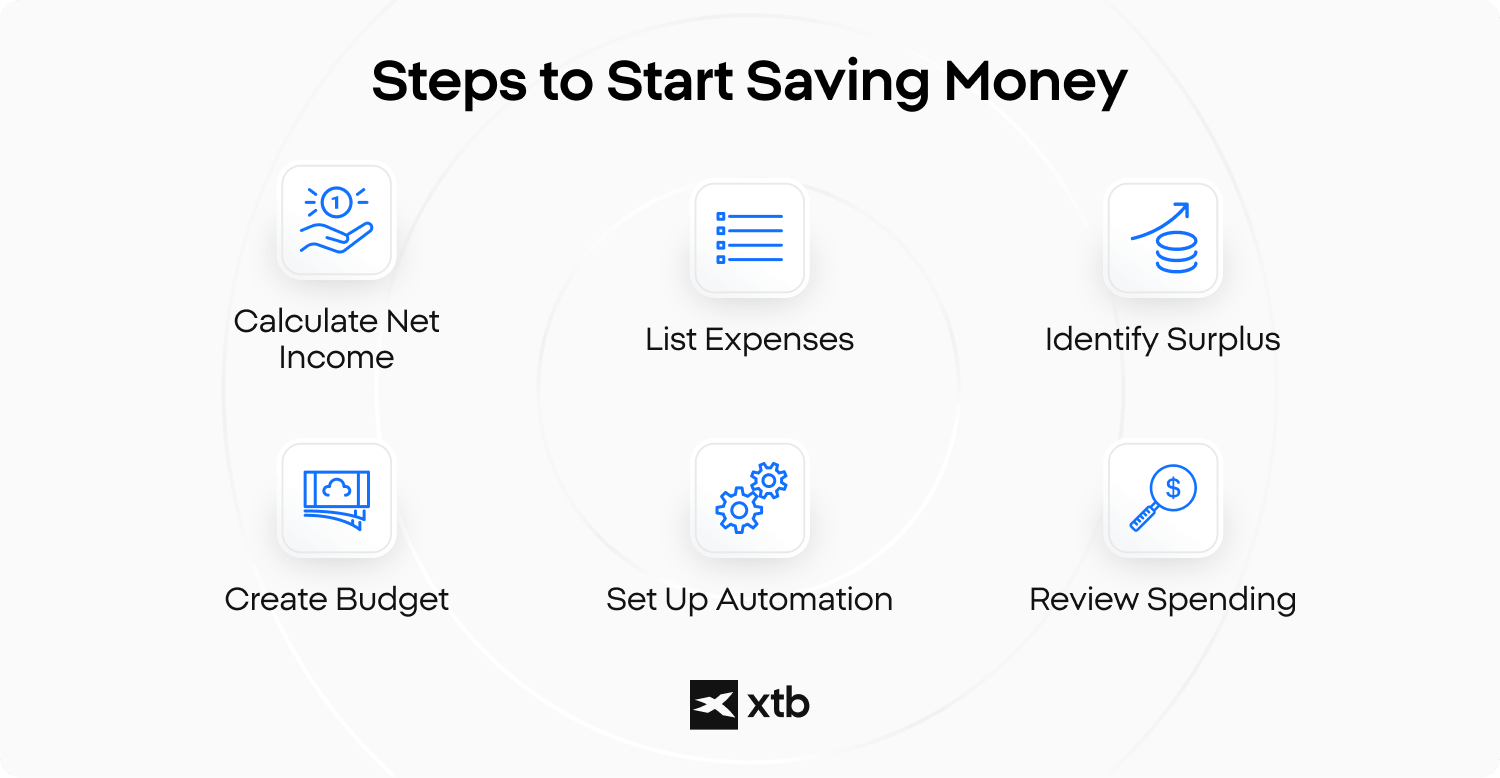
To accurately figure out how to budget and save money, you must first calculate your total net income and list all of your recurring monthly expenses. Once you identify your financial baseline and locate your monetary surplus, you can create a budget that dictates exactly how much capital goes directly into your savings account. Separating true, biological needs from discretionary lifestyle wants acts as a strict analytical filter, ensuring you prioritise future security over instant gratification.
Executing this initial phase requires complete honesty about your spending habits. By formally evaluating your bank and credit card statements from the past three months, you can easily identify wasteful spending patterns and redirect that misallocated capital toward your long-term financial stability.
What are the best ways to save money day to day?
The best ways to save money come from cutting recurring, cyclical costs such as digital subscriptions, utility bills, and frequent dining out, rather than relying on exhausting one-time deprivations. Categorising your daily expenses into fixed costs, variable costs, and discretionary wants reveals exactly where these recurring financial leaks occur in your monthly cash flow.
Building a consistent daily savings habit requires adding deliberate friction to your impulsive decisions and actively managing both your variable and fixed outflows. Implementing practical saving money tips systematically can drastically reduce your monthly burn rate and accelerate your path to financial independence.
Here are several highly effective ways to save money on a daily basis:
- Saving money through subscription audits: Review your credit card statements at the start of every month to identify and cancel recurring digital services, streaming platforms, or gym memberships that you no longer actively utilise.
- Strategy of negotiating bills: Contact your internet, insurance, or mobile phone providers annually to politely ask for customer retention offers, loyalty discounts, or to strategically switch to significantly cheaper competitor plans.
- Strict meal planning: Cook your meals at home and create a rigid grocery list before entering the supermarket, completely avoiding the incredibly high markups associated with restaurants and food delivery applications.
- The 48-hour rule: Add deliberate friction to your discretionary spending by enforcing a mandatory 24 to 48-hour waiting period before purchasing any non-essential item, which effectively eliminates emotionally driven impulse buying.
How can you save money on a low income?
When determining how to save money on a low income, the percentage of your earnings matters significantly more than the exact dollar amount, as even small, regular transfers build a strong financial habit. Your immediate priority should be establishing a modest financial cushion to absolutely prevent relying on high-interest consumer debt during sudden, unexpected emergencies.
Implementing automated micro-saving techniques allows you to learn how to save money fast even when operating with highly restricted cash flow. Consistently transferring just five or ten dollars a week trains your brain to treat wealth accumulation as a necessary routine. Furthermore, you can systematically reduce your highest fixed costs, such as housing or transportation, by downsizing your living space or utilising public transit networks instead of maintaining a personal vehicle.
Additionally, exploring and applying for generic government assistance programs, local community grants, or specific tax reliefs can rapidly free up vital capital. Reallocating the money saved through these relief programs directly into your bank account ensures that your savings rate steadily increases over time.
How much money should you save each month?
A highly popular and effective framework is the 50/30/20 rule, which dictates allocating exactly 20% of your income to savings, and your first goal should be an emergency fund fully covering 3 to 6 months of living expenses. Tracking your savings rate—the exact percentage of your gross income safely retained—provides a universal, income-agnostic metric of your overall financial health.
An emergency fund acts as a vital, liquid barrier against unexpected job loss, critical home repairs, or sudden medical bills. Storing 3 to 6 months of your calculated monthly overhead ensures that you can comfortably weather severe economic downturns without liquidating long-term investments or taking out expensive personal loans.
Once you successfully accumulate this defensive cash position, your financial strategy shifts toward offensive wealth building. You can then confidently redirect that ongoing 20% monthly allocation away from standard savings and toward more aggressive long-term goals, maximising your compound returns over the following decades.
What should you save for first?
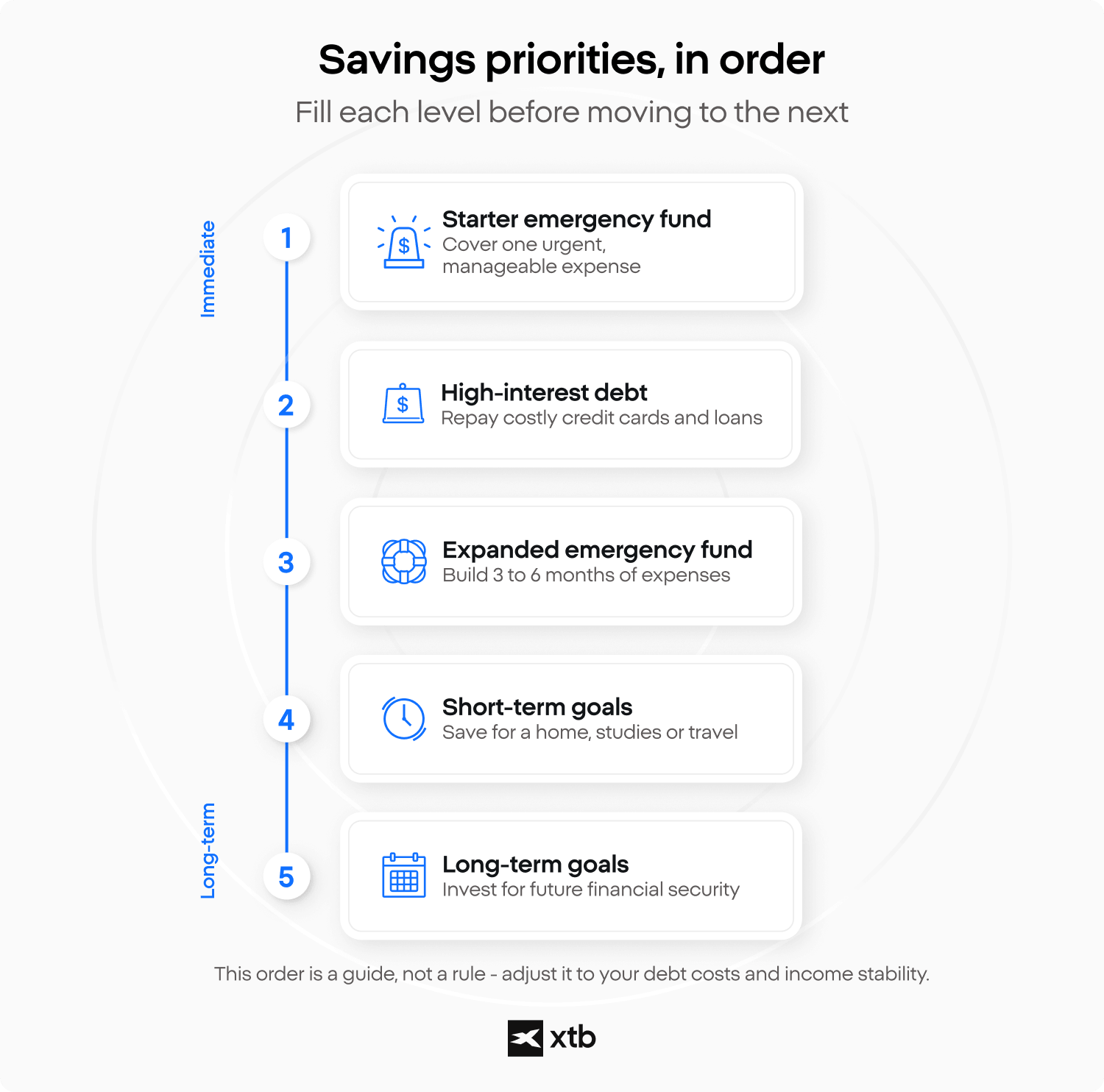
Your first savings priority should normally be a small emergency buffer that protects you from immediately relying on credit cards or loans when an unexpected expense occurs. After that, the correct order depends on the cost of your debt, the timing of your financial goals, and how stable your income is.
A practical order of priorities may look like this:
- Build a starter emergency fund. Set aside roughly $500 to $1,000 (or about one month of essential expenses) - enough to cover an urgent but manageable expense, such as a medical bill, car repair, or temporary loss of income.
- Repay high-interest consumer debt. Credit card debt and expensive short-term loans can grow faster than savings, making repayment financially more valuable than keeping large amounts of cash.
- Expand your emergency fund. Once costly debt is under control, work toward a reserve covering approximately three to six months of essential expenses.
- Save for known short-term goals. Money needed for a home deposit, education, travel, taxes, or major repairs should usually be kept separate from the emergency fund.
- Invest for long-term goals. Capital that will not be needed for several years may then be directed toward diversified investments based on your risk tolerance and time horizon.
This order is not universal. Someone with unstable employment may prioritize a larger cash reserve, while a person carrying very high-interest debt may need to focus more aggressively on repayment. The key is to assign each part of your savings a specific purpose rather than keeping all of your money in one undifferentiated account.
Which money-saving rules and challenges actually work?
Rules like the 30-day rule, the $27.40 rule, and the 50/30/20 rule actually work because they systematically automate your financial decisions and turn saving into a highly measurable, objective habit. By completely removing the daily psychological burden of asking "can I afford this item?", these frameworks make saving measurable and help build a consistent habit.
The 30-day rule
The 30-day rule dictates that you must wait a full 30 days before making any non-essential, discretionary purchase. This enforced cooling-off period completely severs the emotional impulse tied to modern consumer spending, frequently resulting in the realisation that you do not actually need the desired item.
The $27.40 rule
The $27.40 rule breaks down large, intimidating financial goals into manageable, bite-sized daily increments. Saving exactly $27.40 per day multiplied by 365 days mathematically results in $10,000 a year, providing a clear, actionable path for individuals trying to quickly accumulate a five-figure balance.
The 50/30/20 rule
The 50/30/20 rule provides a strict macro-budgeting structure for your entire incoming paycheck. It dictates allocating exactly 50% to essential biological needs, 30% to discretionary lifestyle wants, and 20% directly to savings and debt repayment.
No-spend challenge
A no-spend challenge aggressively forces you to eliminate all discretionary spending for a set, predefined period, such as a single weekend, a week, or a full month. During this austere timeframe, you are exclusively permitted to spend money on absolute necessities like housing, utility bills, and basic, unprepared groceries.
Round-up saving
Round-up saving effortlessly automates your wealth building by rounding up every single debit or credit card transaction to the nearest whole dollar. The remaining fractional spare change is instantly transferred to a dedicated, separate savings account, compounding quietly and efficiently in the background of your life.
Where should you keep your savings (and what next)?
Short-term savings and emergency funds are best kept in an easily accessible, interest-bearing high-yield savings account. At the same time, you can also look to invest with little money as your long-term capital position grows. Keeping liquid cash sitting idle in a standard, zero-interest checking account usually guarantees that you are actively losing purchasing power to annual inflation over time.
Once your defensive financial safety net is fully secure, the inevitable question becomes whether you should continue to save or invest. Transitioning from a conservative saver to an active investor involves strategically directing your ongoing monthly surplus into a licensed brokerage account to systematically purchase productive assets like stocks, bonds, or broadly diversified ETFs.
This shift fundamentally changes how your money functions. Instead of merely storing capital, investing allows your accumulated wealth to grow independently and exponentially, utilising the mathematical power of compound interest to build substantial, multi-generational wealth over the long term.

FAQ
FAQ
The easiest way to start is to automate a small transfer from your current account to a separate savings account immediately after payday. This is often called the “pay yourself first” method because saving is treated as a fixed monthly obligation rather than something done only when money is left over.
The amount does not need to be large at the beginning. A smaller transfer that happens consistently is usually more effective than an ambitious target that cannot be maintained.
There is no universal percentage that works for every household. The commonly used 50/30/20 budgeting framework suggests allocating 20% of take-home income to savings and debt repayment, but this should be treated as a flexible guideline rather than a strict requirement.
A realistic savings rate depends on factors such as:
income stability,
housing and childcare costs,
existing debt,
financial goals,
and the cost of living in your area.
Someone with limited disposable income may begin with 2% or 5% and gradually increase the rate as their financial position improves.
When income is limited, the priority should be building a repeatable habit rather than reaching a large monthly amount. Even small weekly transfers can create a basic financial cushion and reduce dependence on credit cards or expensive loans during an emergency.
It is also worth reviewing the largest recurring expenses first. Cutting housing, transport, insurance, telecommunications, or debt costs can have a much greater impact than repeatedly reducing small everyday purchases.
It often makes sense to build a small emergency reserve before aggressively repaying debt. Without any accessible savings, an unexpected expense may force you to borrow again, undermining the repayment plan.
After establishing a basic buffer, high-interest debt such as credit card balances should generally receive priority because its cost may be substantially higher than the interest earned on savings. The right balance depends on the interest rate, repayment terms, income security, and access to emergency support.
Many financial planners recommend building an emergency fund that covers three to six months of essential living expenses. However, the right amount depends on your personal circumstances, including your income stability, financial obligations, and job security.
A larger emergency fund may be appropriate if you:
have irregular or commission-based income,
support children or other dependants,
work in a cyclical or unstable industry,
have significant medical or housing expenses,
or rely on a single household income.
For example, if your essential monthly expenses total $3,000, a reserve of $9,000 to $18,000 would cover the commonly recommended three- to six-month emergency fund.
Conversely, someone with stable employment, comprehensive insurance, and two reliable household incomes may be comfortable maintaining a smaller emergency reserve.
Emergency savings should normally be kept somewhere secure, liquid, and easy to access. Depending on the country, suitable options may include an interest-bearing savings account, a money market deposit account, or a short-term bank deposit that does not impose a significant early-withdrawal penalty.
The main objective is accessibility rather than maximum return. Emergency money should generally not be held in volatile assets such as individual shares, cryptocurrencies (crypto-assets), or long-duration bonds because its value may fall precisely when the funds are needed.
No. The 50/30/20 rule can be a useful starting point, but it may be unrealistic in areas where rent, mortgages, transport, or childcare consume much more than 50% of income. It may also be too conservative for high earners who are able to save substantially more than 20%.
The rule works best as a budgeting reference:
50% for essential needs,
30% for discretionary wants,
20% for savings and debt repayment.
The percentages can be adjusted while preserving the underlying principle of assigning every part of income a clear purpose.
Start with recurring expenses that provide little value, because reducing them creates savings every month without requiring constant effort. Unused subscriptions, expensive mobile plans, insurance renewals, banking fees, food delivery, and memberships are common examples.
After that, examine the largest variable spending categories, such as groceries, restaurants, transport, and entertainment. A few meaningful changes in these areas are usually more effective than trying to control every minor purchase