
The user wants to understand what a cash flow statement is, its three sections, and how to read it to assess a company's real liquidity and earnings quality before investing.
The user wants to understand what a cash flow statement is, its three sections, and how to read it to assess a company's real liquidity and earnings quality before investing.


A cash flow statement is a financial document that tracks the exact amount of real cash entering and leaving a company over a specific reporting period. This statement breaks down cash movements into three distinct categories: operating, investing, and financing activities. Investors use the statement of cash flows to assess a company's true liquidity and financial health, bypassing accrual-based accounting profits that can obscure a business's actual ability to generate cash.
Key takeaways:
-
What it measures: The cash flow statement tracks real cash movements over a specific reporting period (like a quarter or a year).
- Core structure: The document divides cash flows into operating, investing, and financing sections.
- Cash vs. profit: Net income does not equal cash in the bank; the cash flow statement bridges the gap between accounting profit and actual liquidity.
- Investor value: You can use this statement to identify red flags, verify earnings quality, and ensure a company has enough cash to fund operations or pay dividends.
What is a cash flow statement and what is it used for?
A cash flow statement is a financial report showing the precise inflow and outflow of a company's cash over a defined reporting period. Unlike a balance sheet, which captures a company's financial snapshot at a single moment in time, the statement of cash flows tracks financial movements across a timespan, such as a fiscal quarter or year. This distinction helps you understand how a company bridges the gap between the profit reported on the income statement and the actual cash accumulating in its bank accounts.
Financial professionals, creditors, and company management use the cash flow statement to measure actual liquidity. Accrual accounting allows companies to record revenue before receiving the cash, which means a highly profitable company on paper can still face bankruptcy if it runs out of liquid funds. By stripping away non-cash accounting adjustments, the cash flow statement reveals the hard truth about a business's operational viability.
In simple terms, cash flow is the net amount of cash moving into and out of a business over a period. When more comes in than goes out, cash flow is positive, and reserves grow, funding debt payments, reinvestment, and shareholder returns; when more leaves, it is negative and reserves shrink. For instance, a firm that collects $8,000 but pays $6,000 in a month nets positive $2,000. Negative cash flow can signal trouble - or deliberate investment in growth.
What Are the Direct and Indirect Cash Flow Methods?
The cash flow statement divides all corporate cash movements into three distinct sections: operating activities, investing activities, and financing activities. Operating activities show the cash generated from a company's core business operations, making it the most critical section for long-term equity investors. If a company cannot consistently generate cash from its primary business, it will eventually rely on outside financing to survive.
Investing activities record the cash spent on or generated from long-term assets and capital expenditures (CapEx). This section tracks investments in equipment, property, or acquisitions of other businesses. Financing activities detail the cash flow between the company and its owners or creditors, including issuing debt, repurchasing stock, or paying out dividends.
What does a cash flow statement format look like?
Different corporate actions generate specific cash flow entries across the three main sections. You will commonly see these standard entries when analysing corporate reports:
- Operating cash flow examples: Cash received from customers, cash paid to suppliers, and cash paid for employee salaries.
- Investing cash flow examples: Cash paid to purchase new factory equipment, or cash received from selling a subsidiary.
- Financing cash flow examples: Cash received from issuing a corporate bond, or cash paid to shareholders as a quarterly dividend.
What are the direct and indirect methods?
Accountants calculate cash from operations using either the direct method or the indirect method, with the indirect approach being the standard choice for most public companies. When analysing direct vs indirect cash flow, the main difference lies in the starting point. The direct method lists all actual cash receipts and cash payments made during the period, providing a straightforward tally of cash moving in and out of the operational registers.
The indirect method, conversely, starts at the bottom line of the income statement with net income and adjusts it backwards to reach the actual cash figure. Accountants reverse non-cash expenses like depreciation and amortization, and account for changes in working capital (such as accounts receivable and inventory). Because companies already track accrual accounting metrics for their income statements, the indirect method is significantly easier and less costly to prepare, explaining its dominance in corporate reporting.
What does a cash flow statement look like? (format and example)
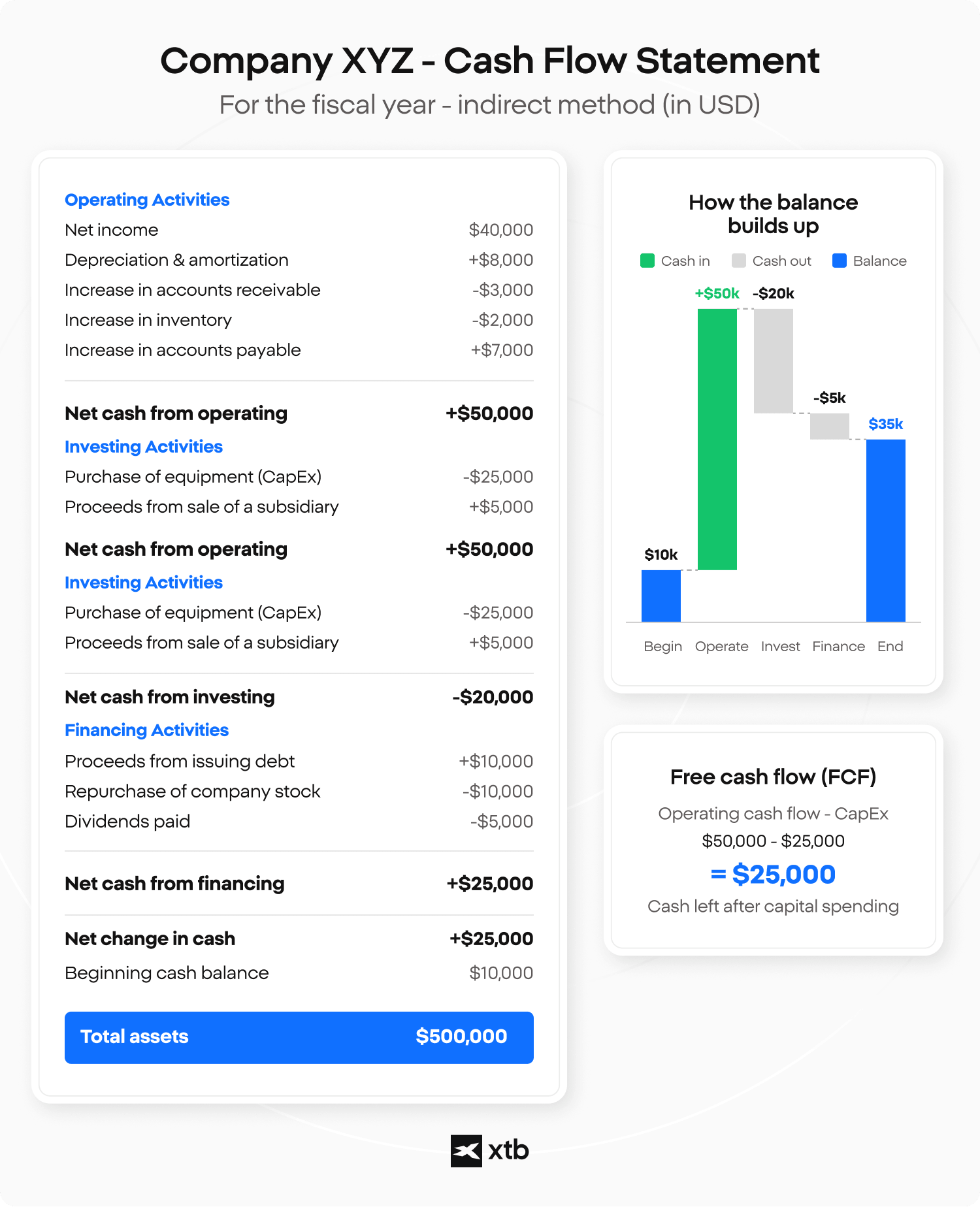
The standard cash flow statement format sequentially stacks the three activity sections, summing their totals to calculate the net change in cash for the period. You read the document top-to-bottom: it begins with operating activities, moves through investing and financing, and calculates the total net increase or decrease in cash. Finally, the statement adds this net change to the cash balance from the beginning of the period to prove the ending cash balance.
To prepare a cash flow statement, you work through the three sections in order and reconcile them against the opening cash balance:
- Total operating activities - sum the cash generated or used by core business operations.
- Add or subtract investing activities - net the cash spent on assets like equipment against cash from selling them.
- Add or subtract financing activities - net cash raised from debt or equity against dividends, buybacks, and debt repaid.
- Add the net change to the beginning balance - the result is the ending cash balance, which must match the cash line on the balance sheet.
The example below applies these steps to a hypothetical Company XYZ, showing at a glance which of the three levers - operations, investing, or financing - is driving its cash position.
How do you read and analyse a cash flow statement?
Investors reading a cash flow statement primarily check for a consistently positive operating cash flow, calculate free cash flow metrics, and compare actual cash generation against accounting profit. A healthy company consistently generates positive operating cash flow, and over time it should exceed reported net income - proof that accounting profits are turning into real money. When they diverge, work through this checklist.
Red flags to watch for:
- Operating cash flow trails net income, period after period - profits are not converting into cash (weak earnings quality).
- Cash balance stays positive only through financing - negative operating cash flow masked by new debt or share issuance means the core business is not self-funding.
- Receivables grow faster than revenue - sales are booked but the cash has not arrived.
- Free cash flow is consistently negative outside a clear investment phase - nothing left after CapEx to cut debt or reward shareholders.
- Rising net income paired with falling operating cash flow - the gap should not widen; if it does, investigate.
You can derive a company's free cash flow (FCF) by subtracting capital expenditures (found in the investing section) from the operating cash flow. Free cash flow represents the discretionary cash a business has left over to reward shareholders, reduce debt, or aggressively expand. Because FCF tracks tangible money rather than accrual estimates, it forms the backbone of fundamental valuation models and offers a clearer picture than a simple P/E ratio.
How to calculate and prepare a cash flow statement?
Calculating cash flow means summing the three sections and reconciling them against the opening cash balance. Add the totals from operating, investing, and financing activities to get the net change in cash, then add that to the cash you started with to prove the ending balance. Investors also isolate free cash flow, the discretionary cash left after capital spending, to judge how much a company can return to shareholders or reinvest.
- Net change in cash = Operating CF + Investing CF + Financing CF
- Ending cash = Beginning cash + Net change in cash
- Free cash flow (FCF) = Operating cash flow − Capital expenditures (CapEx)
Cash Flow Statement vs. Income Statement vs. Balance Sheet
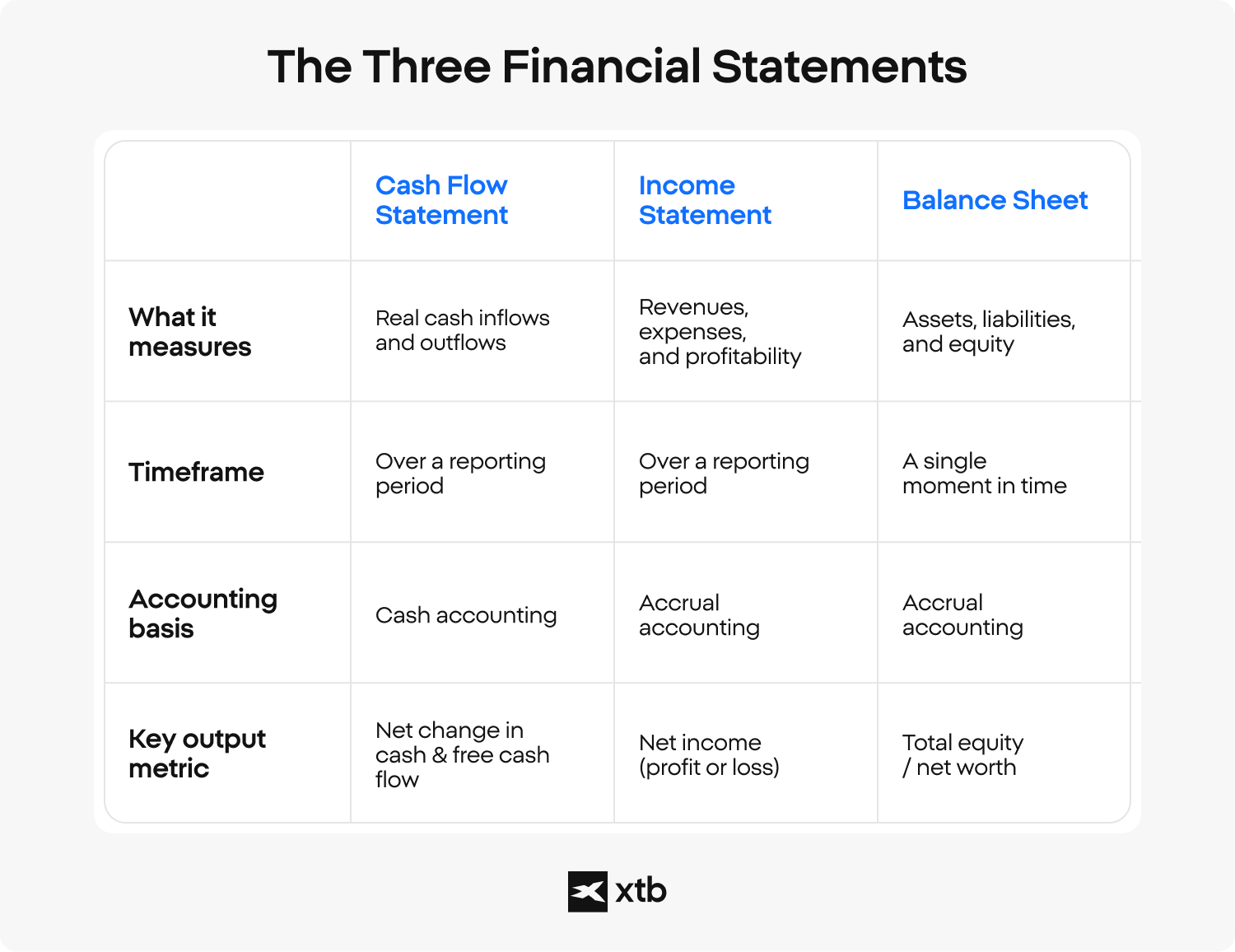
The cash flow statement tracks tangible cash movements over a period, the income statement records accrual-based profitability over a period, and the balance sheet displays a company's total assets and liabilities at one specific moment. When looking at a cash flow statement vs income statement, the core difference is cash versus accruals. The income statement recognises revenue when a product is delivered, while the cash flow statement only recognises it when the customer actually pays the bill.
These three financial documents are inextricably linked and form the foundation of corporate accounting. Net income from the income statement flows directly into the top of the cash flow statement (under the indirect method) and into retained earnings on the balance sheet. Simultaneously, the ending cash balance calculated at the bottom of the cash flow statement must perfectly match the cash asset line on the balance sheet for that same exact date.
Comparison of Core Financial Statements
Cash Flow Statement
- Measures real cash inflows and outflows
- Covers a reporting period
- Based on cash accounting
- Key output metric: Net change in cash and free cash flow
Income Statement
- Measures revenues, expenses, and profitability
- Covers a reporting period
- Based on accrual accounting
- Key output metric: Net income (profit or loss)
Balance Sheet
- Measures assets, liabilities, and equity
- Represents a single moment in time
- Based on accrual accounting
- Key output metric: Total equity / Net worth
FAQ
Neither statement is inherently more important because they answer different questions. The income statement measures profitability, while the cash flow statement reveals whether those profits are actually turning into cash. Professional investors almost always analyse both together to assess earnings quality and financial strength.
A company may report accounting profits while still generating negative cash flow if customers have not yet paid invoices, inventories are growing rapidly, or the business is making significant investments. This is why cash flow is often viewed as a reality check for reported earnings.
A healthy business typically generates positive operating cash flow on a consistent basis. While temporary declines can occur, especially during economic slowdowns, companies that repeatedly fail to produce cash from their core operations may eventually need external financing to continue operating.
No. The reason behind the negative cash flow matters. A company investing heavily in new factories, technology, or acquisitions may temporarily report negative investing cash flow while strengthening its long-term growth prospects. However, persistent negative operating cash flow deserves much closer attention.
Most listed companies publish a cash flow statement every quarter and every fiscal year as part of their financial reports. In the United States, these reports are typically included in Forms 10-Q and 10-K filed with the SEC, while companies listed in other countries publish them through their local stock exchange or investor relations website.
Cash flow is a broad term describing the movement of cash through a business. Free cash flow is a specific metric that measures the cash remaining after a company has paid for the capital investments needed to maintain or expand its operations. Many investors use free cash flow to evaluate financial flexibility and shareholder returns.
You can usually find the cash flow statement within a company's quarterly and annual financial reports. These reports are available on the company's investor relations website, through the SEC's EDGAR database for U.S. companies, or via the relevant stock exchange for companies listed in other markets.
Cash generation varies by business model. Mature software companies, consumer staples businesses, and utilities often produce stable operating cash flow, while capital-intensive industries such as mining, energy, airlines, or manufacturing may experience larger swings because of substantial investment spending.
Comparing these figures helps investors judge the quality of earnings. If profits consistently grow while operating cash flow remains weak or declines, it may indicate aggressive revenue recognition, slower customer payments, or other issues that deserve further investigation.
Manipulating cash flow is generally more difficult than managing accounting earnings because it reflects actual cash movements. However, management can temporarily improve reported cash flow by delaying payments, accelerating collections, or changing the timing of certain transactions. For this reason, experienced investors analyse cash flow trends over several reporting periods rather than relying on a single quarter.