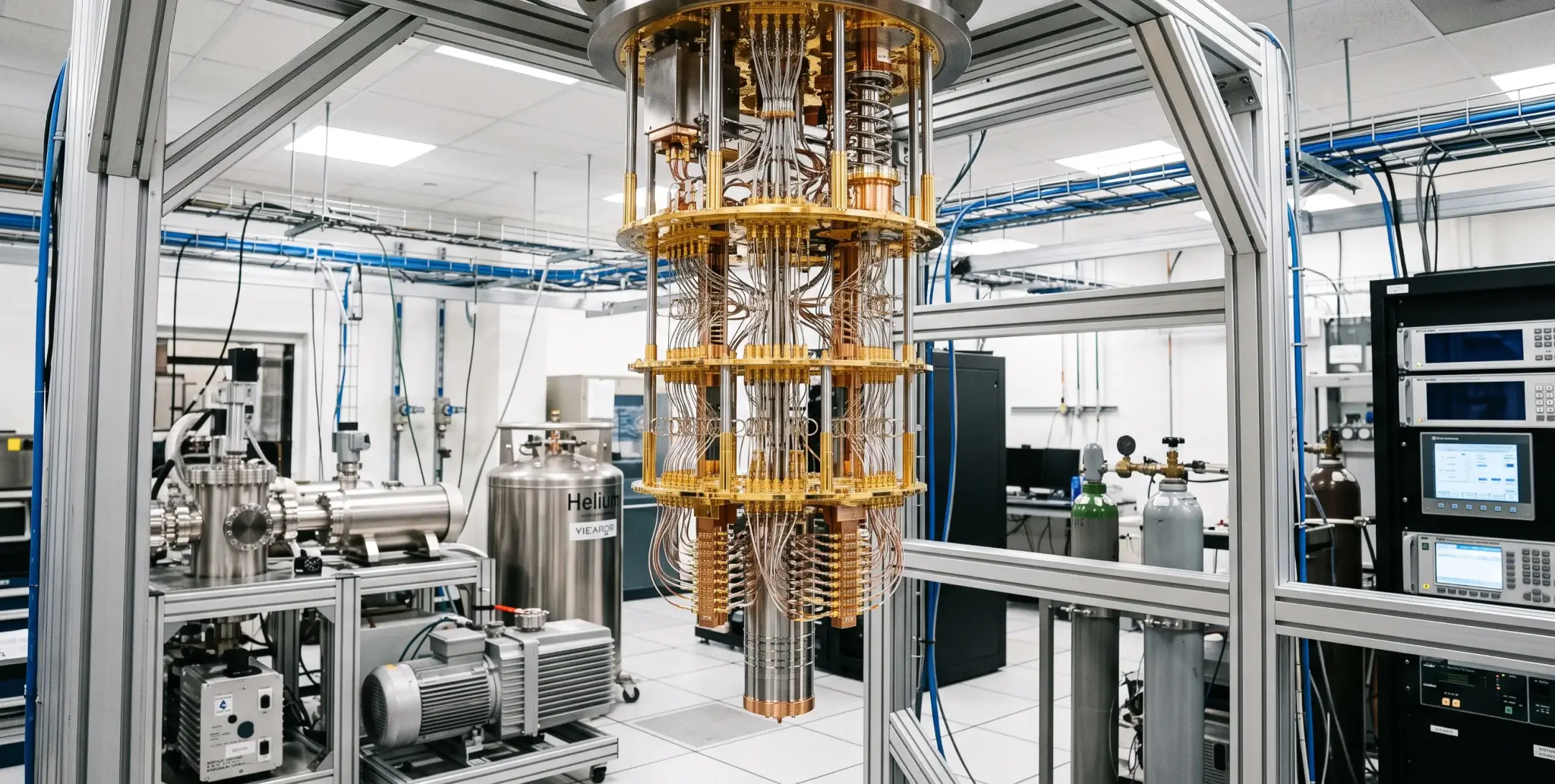
Investor learns which real companies operate in the quantum computing sector, what distinguishes each one, and what risks and exposure options apply - without a ranking or buy recommendation.
Investor learns which real companies operate in the quantum computing sector, what distinguishes each one, and what risks and exposure options apply - without a ranking or buy recommendation.


Several public companies such as IonQ, Rigetti Computing, D-Wave Quantum, Creotech Quantum but also giants such as IBM and Alphabet operate within the quantum computing sector today. Each of those is employing distinct hardware architectures and commercial models to address complex computational problems. The global market for this technology is projected to reach approximately $100 billion by 2035 according to McKinsey report, so it's definitely a next big thing alongside with AI and robotics.
Pure-play quantum stocks combined market capitalization hovering near $28.5 billion as of October 2026, alongside modest early earnings. Rather than ranking these businesses or issuing buy recommendations, this overview outlines what distinguishes individual market participants across hardware design, enterprise integration, and financial structure. Prospective investors examining the landscape can use these operational distinctions to evaluate how different corporate models navigate an evolving high-tech industry.
Key Takeaways
-
Quantum computing stocks represent companies building quantum hardware processors, providing quantum-as-a-service cloud platforms, or developing quantum software layer applications.
- Hardware approaches vary widely across the sector, dividing market participants into pure-play hardware developers, hybrid systems integrators, and diversified tech giants.
- Operational risks remain elevated due to high research expenditures, early-stage commercialization timelines, and the lack of a single dominant hardware architecture.
- If quantum technologies achieve broader commercial adoption, both established technology leaders such as IBM, Alphabet, Microsoft, and Nvidia, and smaller pure-play companies could benefit.
What makes a company part of the quantum computing sector?
A business is categorized as part of the quantum computing sector when it builds quantum hardware processors, provides quantum-as-a-service cloud platforms, or develops quantum software layer applications. Unlike classical computers that process binary bits (0s and 1s), quantum computing systems utilize quantum bits (qubits) that leverage physical phenomena like superposition and entanglement to solve specialized optimization, simulation, and data calculations.
Industry participants typically fall into three distinct structural categories that define their risk profiles and balance sheets. Pure-play developers focus exclusively on quantum hardware and software, relying heavily on capital markets to fund research. Hybrid companies pair growing quantum divisions with established IT services, while tech giants integrate quantum R&D into existing enterprise cloud ecosystems. Investors examining the broader technology space often compare these hardware structures against semiconductor stocks when assessing advanced component supply chains.
Evaluating firms in this sector requires looking beyond traditional short-term valuation metrics. Because many developers remain in early-stage commercial rollouts, analyzing technological benchmarks, hardware gate fidelity, and strategic corporate partnerships offers clearer insight into each firm's market positioning. The six public companies detailed below illustrate how different corporate structures approach this emerging industry without ranking their investment viability. Pure-play quantum firms are risky but may create valuable proprietary hardware, control systems or software platforms. Some could eventually become acquisition targets for Big Tech groups seeking to accelerate their quantum capabilities, although such consolidation remains speculative at this stage.
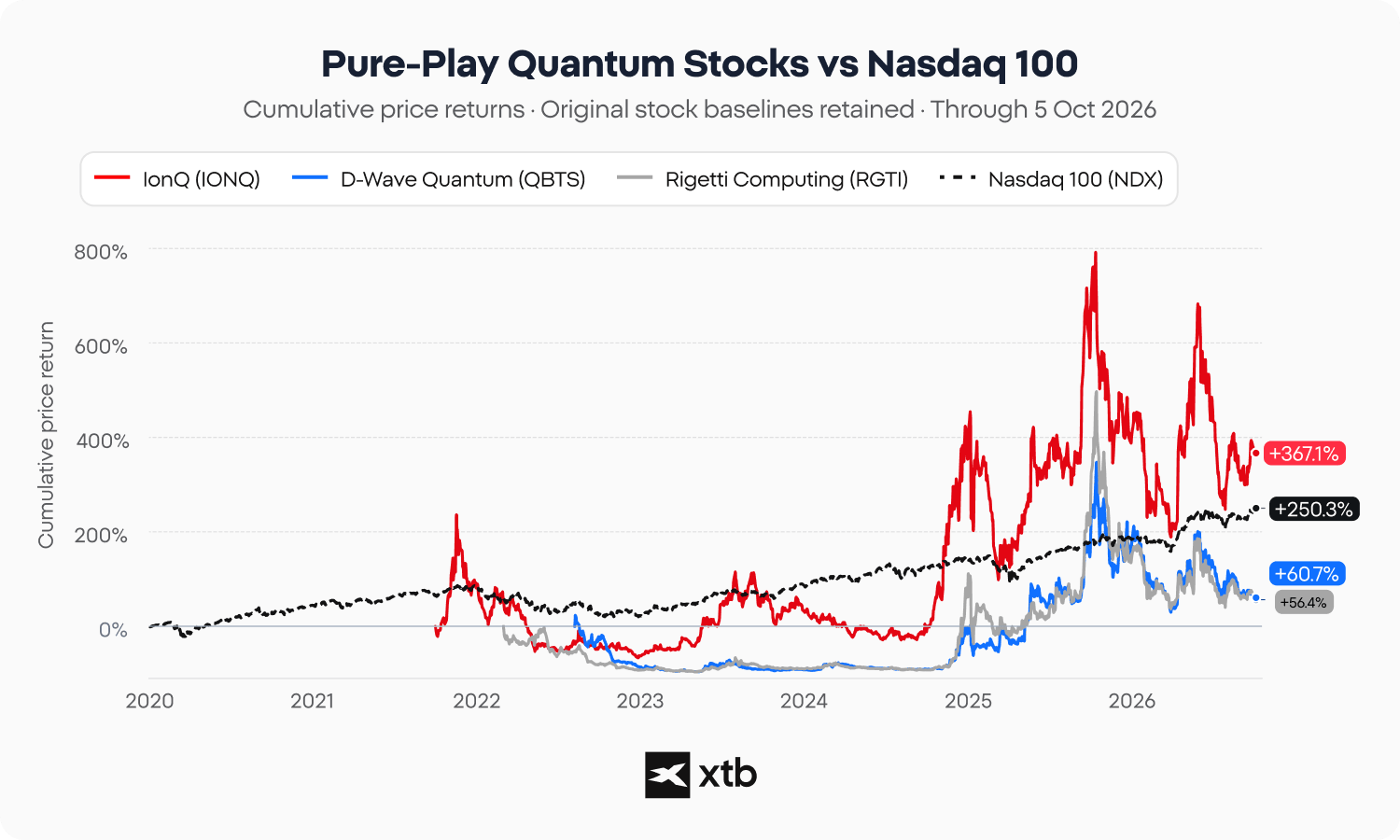
Since the beginning of 2020 Nasdaq 100 index surged 250%, but quantum computing stocks debuted on Wall Street in 2022. Since then IonQ outperformed Nasdaq 100, while Rigetti Computing and D-Wave Quantum lagged the benchmark. However shares of both spiked during the speculative rallies in 2024, 2025 and 2026. Past performance is not an indicator of future results. Source: XTB Research, Yahoo Finance
Why could quantum computing become a breakthrough technology?
Quantum computing could become commercially important because it may eventually solve certain classes of problems that are extremely difficult or impractical for classical computers. The strongest potential use cases include molecular and materials simulation, drug discovery, complex logistics, financial optimization, cryptography, and selected AI workloads. In these areas, even a narrow quantum advantage could reduce calculation times, improve optimization quality, or enable simulations that are currently too computationally expensive.
The commercial value would come not from replacing conventional computers, but from complementing them in highly specialized tasks. Pharmaceutical companies could model molecules more efficiently, manufacturers could optimize supply chains and materials, financial institutions could improve portfolio and risk calculations, while governments and technology companies could use quantum systems for advanced security and research. The main uncertainty is timing: widespread commercial adoption still depends on major improvements in qubit quality, error correction, scalability, and cost.
IonQ: A pure-play trapped-ion architecture pioneer
IonQ operates as a pure-play quantum computing enterprise centered on trapped-ion hardware architecture accessible through major public cloud infrastructure providers. By using individual ionized atoms suspended in electromagnetic fields as qubits, the company focuses on achieving high quantum gate fidelity and room-temperature processor operation without requiring massive cryogenic cooling systems. IonQ also works with major organizations including Hyundai, Airbus, NVIDIA, Oak Ridge National Laboratory, Amazon Web Services, Microsoft Azure and Google Cloud, giving the company exposure to automotive, aerospace, AI, research and cloud-based quantum computing use cases.
What distinguishes IonQ from competing hardware developers is its dedicated focus on trapped-ion architecture and multi-cloud distribution. The company makes its trapped-ion processors available across Amazon Braket, Microsoft Azure Quantum, and Google Cloud, allowing enterprise clients to deploy quantum algorithms without installing proprietary hardware on-site. This multi-cloud delivery model provides broad commercial reach while isolating the business from dependence on a single infrastructure vendor.
From a financial perspective, IonQ remains an early-stage growth company despite rapidly expanding commercial activity. According to its latest annual SEC filing, the company generated approximately $130 million in revenue in 2025, up from $43 million in 2024, while R&D expenses reached about $306 million and the net loss attributable to IonQ was roughly $510 million. As of early October 2026, the company’s market capitalization stood at around $17 billion, highlighting how strongly its valuation still depends on future technology milestones, system scaling and commercial adoption rather than current profitability.
Past performance is not a reliable indicator of future results
Rigetti Computing: A superconducting architecture specialist
Rigetti Computing functions as a pure-play quantum processor manufacturer that builds superconducting hardware and operates an integrated quantum-classical cloud infrastructure. The company manufactures its own quantum processing units in-house at its Fab-1 facility, giving it direct engineering control over chip design, fabrication, and packaging processes. Rigetti also works with major organizations including AWS, Microsoft Azure, HPE, NASA, Fermilab, HSBC, Standard Chartered, ADIA Lab, Moody’s Analytics and US Department of Commerce, spanning cloud distribution, hybrid quantum-HPC systems, government research and financial-services use cases.
What sets Rigetti apart in the industry is its focus on modular superconducting quantum processing units (QPUs) and full-stack vertical integration. By manufacturing chips internally, the business can rapidly iterate on superconducting qubit designs aimed at reducing latency in hybrid quantum-classical algorithms. Its proprietary Quantum Cloud Services platform connects superconducting QPUs directly with classical computing clusters to handle high-performance computational workloads.
The firm's commercial metrics illustrate the financial dynamics typical of early-stage pure-play quantum computing stocks. According to Rigetti’s latest annual SEC filing, the company generated approximately $7.1 million in revenue in 2025, while spending about $61.3 million on R&D. As of early October 2026, Rigetti’s market capitalization stood at roughly $5 billion, highlighting how strongly its valuation depends on future technology milestones rather than current sales. The company also has a relatively strong funding position after raising $350 million through an at-the-market equity offering and securing up to $100 million in additional U.S. government funding for superconducting quantum computing R&D.
Past performance is not a reliable indicator of future results
D-Wave Quantum: Quantum annealing pioneer
D-Wave Quantum is a pure-play quantum computing company best known for its focus on quantum annealing, a technology designed primarily for complex optimization problems. Its Advantage2 system uses more than 4,400 superconducting qubits and is available through the company’s Leap cloud platform as well as in on-premises deployments. D-Wave is also developing gate-model systems, giving it a broader strategy than an annealing-only business. D-Wave’s technology has been used by major organizations including Volkswagen, Mastercard, Deloitte, ArcelorMittal, Siemens Healthineers, NEC, DENSO, Lockheed Martin and Los Alamos National Laboratory, giving the company exposure to automotive, finance, industrial optimization, healthcare and even defense.
What sets D-Wave apart is the commercial maturity of its annealing platform and its focus on practical use cases across logistics, manufacturing, telecommunications, finance and AI. Its hybrid solvers combine quantum and classical computing to tackle large optimization problems, while ongoing gate-model development could expand its addressable market over time.
Financially, D-Wave remains an early-stage growth company. According to its 2025 SEC filings, revenue reached about $24.6 million, while R&D spending remained high at roughly $50.7 million. The company also ended 2025 with around $884.5 million in cash and marketable securities, giving it substantial resources to fund further development.
Past performance is not a reliable indicator of future results
Creotech Quantum: A pure-play European quantum company
Creotech Quantum is a small, European pure-play quantum technology company spun off from Poland’s Creotech Instruments in April 2026. Rather than focusing on a single qubit architecture, the company develops critical infrastructure for quantum systems, including control electronics, quantum cryptography, single-photon detection and precision timing technologies. Its products are also used in major scientific facilities and quantum research laboratories across Europe. Creotech Quantum works within an ecosystem that includes major European research and institutional partners such as the European Space Agency (ESA), OHB System, NASK and EuroQCI-related consortia, while the broader Creotech group has also worked with organizations including CERN, MIT, Airbus, Thales Alenia Space and Oxford University.
What sets Creotech Quantum apart is its position as an enabling-technology supplier rather than a full quantum computer manufacturer. The company participates in projects such as Millenion, which aims to scale trapped-ion quantum computers toward 1,000 qubits, with Creotech providing control electronics and other key components. It is also commercialising QKD systems and single-photon detectors, targeting PLN 100 million (appx. $27 million) in revenue between 2026 and 2028.
Following the spin-off, Creotech Quantum became an independent company focused entirely on quantum technologies, giving investors more direct exposure to this segment than through the former diversified Creotech Instruments structure. The technologies with the greatest breakthrough potential are QKD systems, single-photon detectors and quantum-control electronics, as they address key infrastructure needs in quantum communications and computing. Funding improved after the 2026 Series D share issue, while EU and national grants also support R&D. The main risk is execution: commercialization may take longer than expected, and further capital raises could dilute shareholders if revenue scales too slowly.
Past performance is not a reliable indicator of future results
IBM: A hybrid tech giant leading enterprise quantum deployments
International Business Machines (IBM) represents a hybrid tech giant that combines superconducting quantum hardware development with an established global IT services and enterprise cloud business. IBM has deployed multiple generations of superconducting processors, including its IBM Quantum System Two architecture, which links multiple quantum processing units into modular computational clusters. What's important is that IBM is not a pure-play quantum computing company. It can benefit from its quantum research, but it is not an indicator of the overall quantum computing market as such.
What distinguishes IBM's market position is its enterprise footprint and open-source software ecosystem. Through its Qiskit framework, IBM has built one of the largest developer networks in the quantum sector, allowing corporate developers and academic researchers to write quantum software across its cloud network. Unlike pure-play firms, IBM funds its quantum initiatives through steady cash flows generated by its core enterprise software, hybrid cloud, and consulting divisions.
Financial disclosure documents filed with the SEC indicate that IBM maintains an overall market capitalization exceeding $208 billion while serving over 250 enterprise clients through its IBM Quantum Network. This hybrid structure insulates its quantum hardware program from short-term liquidity pressures, allowing long-term capital allocation toward multi-thousand qubit processor roadmaps while generating multi-billion dollar total corporate revenue.
Past performance is not a reliable indicator of future results
Alphabet: A tech giant leveraging quantum R&D for expansion
Alphabet Inc. operates as a leading tech giant that advances quantum hardware and software through its dedicated Google Quantum AI division. The company's hardware efforts center on its Sycamore superconducting processor, which achieved a notable scientific milestone by demonstrating quantum computational supremacy in specialized benchmark calculations.
Alphabet's strategic approach differs from pure-play competitors by treating quantum computing as an internal technology engine designed to enhance its broader software ecosystem. Rather than selling standalone quantum hardware, Alphabet integrates quantum research with its Google Cloud platform and open-source Cirq library, prioritizing long-term applications in machine learning, materials science, and complex optimization.
Corporate filings with the SEC show Alphabet supporting its quantum research through an annual R&D budget exceeding $60 billion in 2025 substantially rising in 2026, and an overall market cap above $4 trillion. This massive internal capital support removes the immediate revenue pressure faced by pure-play developers, allowing the firm to focus on multi-year quantum error correction milestones.
Past performance is not a reliable indicator of future results
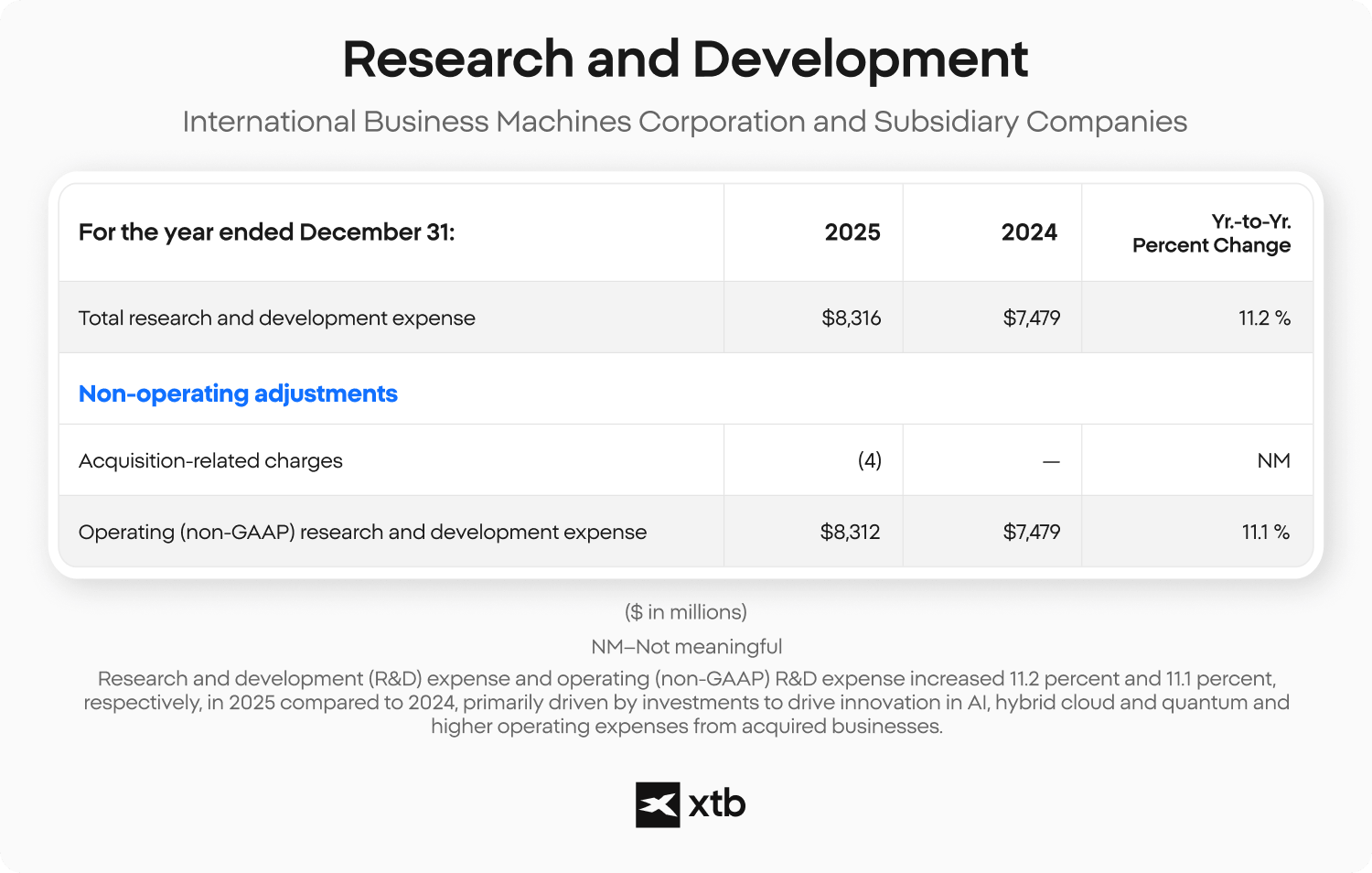
Source: IBM Annual Report 2025
What risks and options should you weigh before adding a quantum computing stock to your watchlist?
The quantum computing sector remains in an early-stage development phase without an established technological winner. This situation presents elevated operational and market volatility risks for prospective investors. Because competing architectures including superconducting circuits, trapped ions, and quantum annealing each possess distinct trade-offs in gate speed, error rates, and cooling requirements, identifying which technology will achieve long-term commercial dominance remains uncertain.
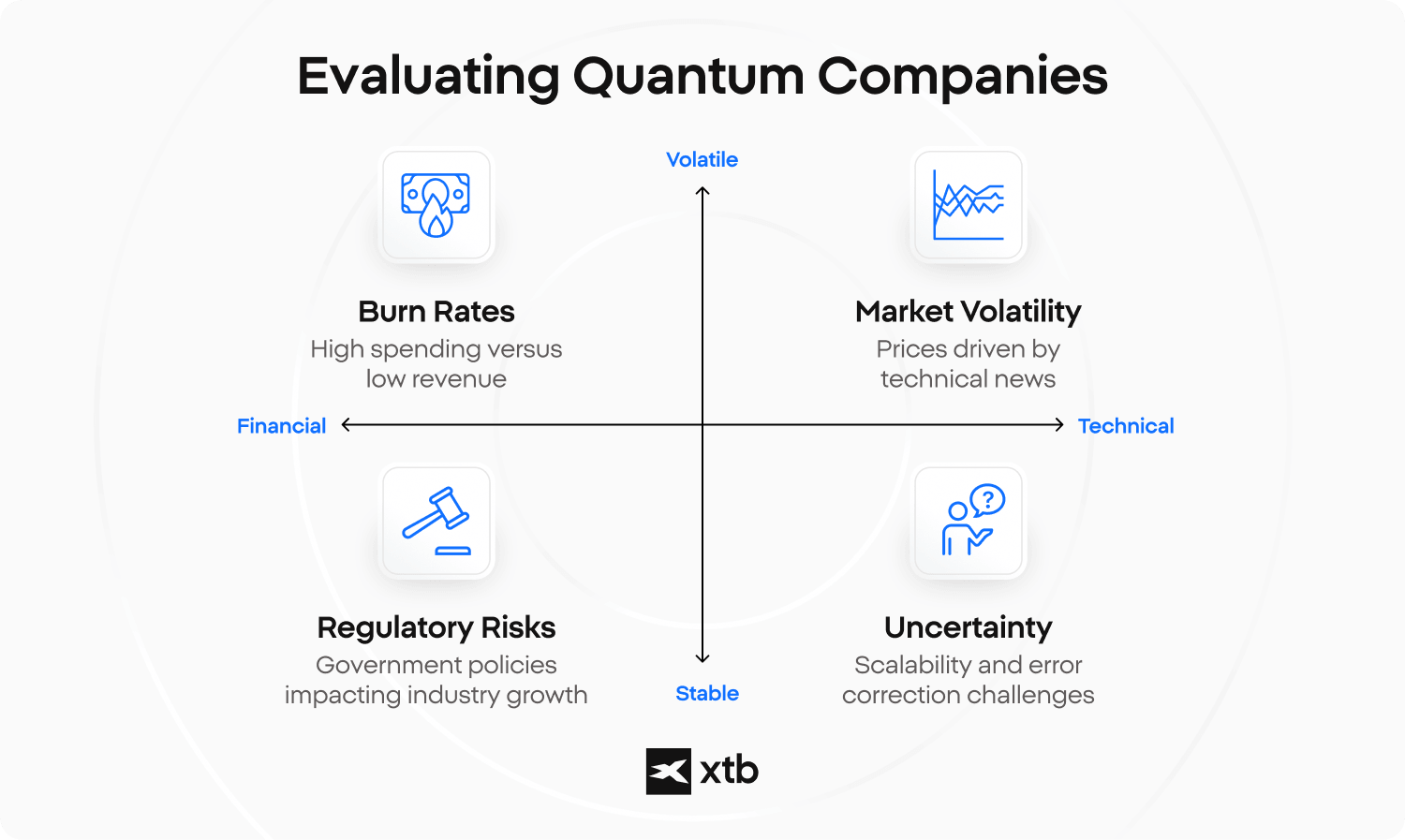
Evaluating companies in this space requires weighing several key structural factors and risks:
- Financial burn rates relative to commercial adoption across pure-play firms with limited annual revenue.
- Technological uncertainty surrounding quantum error correction timelines and architecture scalability.
- Geopolitical and regulatory policies, including federal research funding, national security export controls, and government technology restrictions.
- Valuation volatility, where market prices can fluctuate rapidly based on technical announcements rather than quarterly earnings growth.
Investors seeking exposure to the sector can consider multiple implementation avenues depending on their risk tolerance. Individual equity purchases offer direct focus on specific hardware developers, while a thematic quantum computing ETF provides sector-wide diversification across hardware manufacturers, software creators, and supply chain partners. Alternatively, holding diversified tech giants provides indirect exposure while shielding portfolio capital behind established enterprise cash flows. Opening a brokerage account with a licensed broker allows investors to add these instruments to a personal watchlist and execute trades aligned with their broader financial goals. Past performance is not a reliable indicator of future results, and early-stage technology sectors carry heightened potential for capital volatility.

FAQ
FAQ
Quantum computing stocks are shares of companies building hardware, software or infrastructure for quantum systems. The category ranges from specialist developers whose future depends heavily on quantum commercialization to diversified groups such as IBM and Alphabet, where quantum research is only one part of a much larger business.
Its potential lies in solving narrow but highly valuable problems that classical computers handle poorly or very slowly. The most promising areas include drug discovery, materials science, optimization, cryptography, logistics and selected financial or AI workloads, where even a limited quantum advantage could have significant economic value.
The sector includes pure-play names such as IonQ, Rigetti Computing, D-Wave Quantum and Creotech Quantum, alongside diversified technology companies including IBM and Alphabet. The distinction matters because pure plays offer more direct exposure to quantum adoption, while larger groups are cushioned by established cloud, software and enterprise businesses.
They are pursuing materially different architectures. IonQ is built around trapped ions, Rigetti focuses on superconducting gate-model processors, while D-Wave is best known for quantum annealing, which is aimed primarily at optimization problems rather than general-purpose quantum computing. Pasted text
IonQ emphasizes trapped-ion hardware and broad cloud access.
Rigetti and D-Wave both use superconducting technology, but target different computational models.
What makes IonQ stand out?