
Understand SWOT analysis, its four components, how to conduct one, and how investors can use it to evaluate a company before investing.
Understand SWOT analysis, its four components, how to conduct one, and how investors can use it to evaluate a company before investing.


A SWOT analysis evaluates a subject by identifying its Strengths, Weaknesses, Opportunities, and Threats. You use this framework to assess situations, such as evaluating a company before allocating capital. By translating raw financial and market data into these four categories, an investor can structure fundamental data to make more informed investment choices.
- Acronym meaning: SWOT stands for Strengths, Weaknesses, Opportunities, and Threats.
- Factor division: The framework separates internal factors you control from external factors in the environment.
- Evaluation tool: The analysis organizes data but does not make a final decision on its own.
- Investor application: You can map a company's financial health, market position, and risks into a framework to streamline fundamental research.
What is a SWOT analysis and what does SWOT stand for?
A SWOT analysis is an assessment tool that organizes four areas: Strengths, Weaknesses, Opportunities, and Threats. This framework originated in academic and corporate management circles to evaluate strategic positioning. According to the Origins of SWOT Analysis, by Richard W.Puyt, Finn B.Lie, Frank J. De Graaf, Celeste P.M. Wilderom, the empirical basis of SWOT started in 1952 within the Lockheed’s Corporate Development Planning Department, pioneered by Robert Franklin Stewart.
The term SWOT means exactly what its letters represent: Strengths, Weaknesses, Opportunities, and Threats. You use this model in business and finance to capture a comprehensive view of an entity's current standing. The model transforms qualitative and quantitative data into clear, distinct categories to facilitate structured strategic planning.
Originally designed for corporate strategy, the SWOT analysis now serves as a foundational step in various fields, including investment research. By mapping out these four areas, you identify what an entity does well, where it lacks resources, what market shifts it can exploit, and what external risks it faces.
What are the four components of a SWOT analysis?
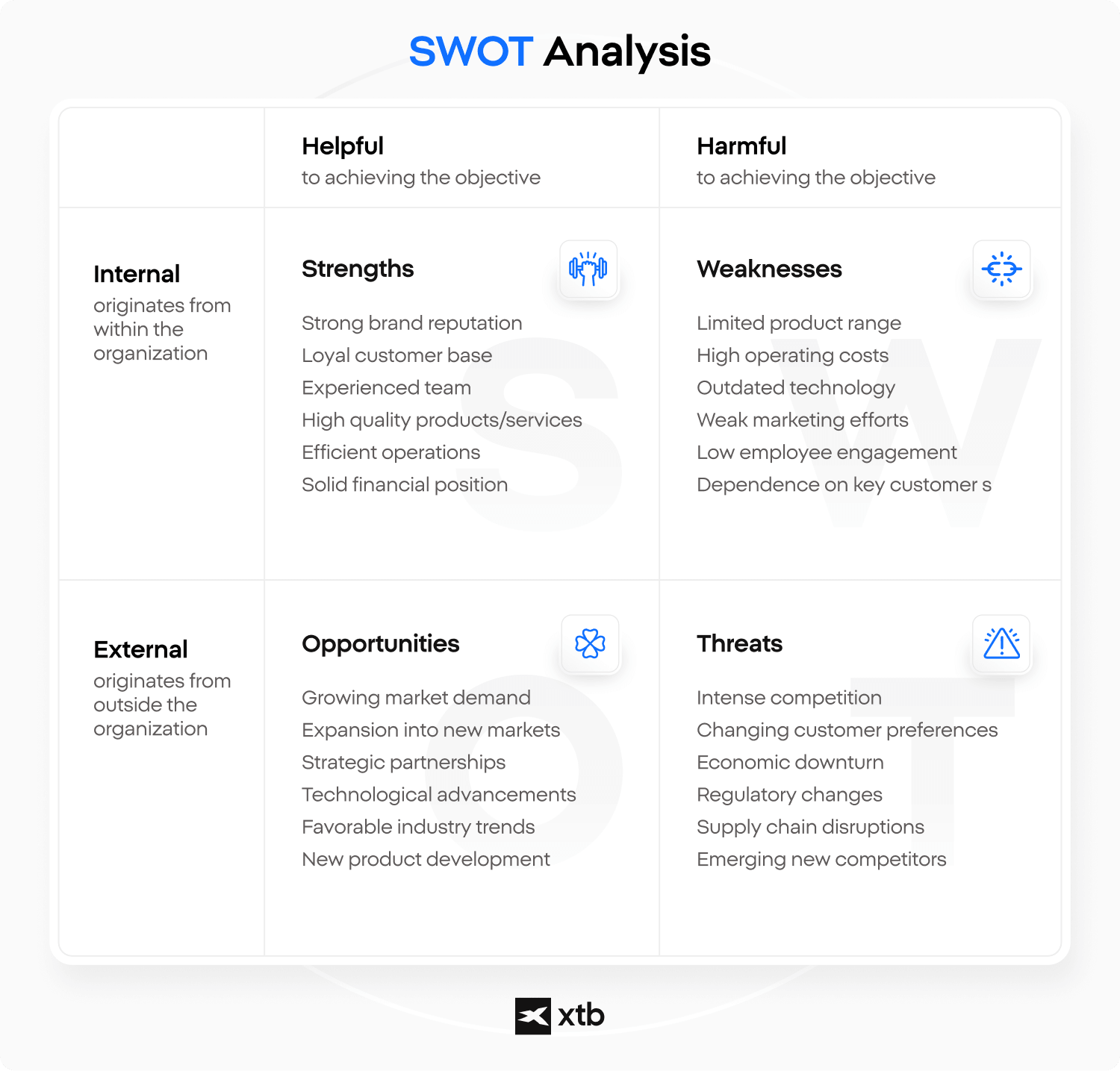
The four components divide into internal factors (Strengths and Weaknesses, which are under the entity's control) and external factors (Opportunities and Threats, originating from the environment). You plot these elements onto a visual grid to easily compare them.
To populate a standard SWOT analysis template, you must fill out the four distinct quadrants:
- Strengths (Internal): These represent inherent advantages, such as a strong brand, proprietary technology, or high profit margins.
- Weaknesses (Internal): These are operational or financial liabilities, including high debt levels, supply chain bottlenecks, or outdated equipment.
- Opportunities (External): These are external market conditions an entity can leverage for growth, like changing consumer trends, favorable regulatory shifts, or declining competitor presence.
- Threats (External): These represent outside risks that could harm performance, such as new industry competitors, economic downturns, or supply shortages.
The division of internal and external factors helps you pinpoint which issues require immediate internal fixing and which require external monitoring. A company controls its internal factors but can only react to external factors.
How do you conduct a SWOT analysis step by step?
You conduct a SWOT analysis in four steps: gather data, fill each of the four quadrants with specific points, and then combine them into strategic conclusions. A good analysis relies on concrete, verifiable evidence rather than generic statements.
When moving from a blank SWOT matrix to actionable insights, you should follow these specific steps for decision making:
- Step 1: Gather relevant data: Collect objective information, such as financial statements, market research, and industry reports, to base the analysis on facts.
- Step 2: Identify internal factors: List the entity's strengths and weaknesses using specific metrics, such as a "20% market share" rather than a generic "strong market presence."
- Step 3: Identify external factors: Map out the opportunities and threats by analyzing the broader macroeconomic environment, competitor actions, and industry trends.
- Step 4: Synthesize for decision making: Combine the four quadrants to formulate a strategy, matching strengths with opportunities or addressing weaknesses to mitigate threats.
A high-quality evaluation requires precision and evidence. Listing "good products" is a weak entry, whereas stating "patented technology yielding a 45% gross margin" provides a concrete basis for further analysis.
How can investors use SWOT to evaluate a company?
An investor uses a SWOT analysis to organize the fundamental analysis of a company by mapping competitive advantages, operational weaknesses, market opportunities, and external threats onto the four quadrants. You extract these insights directly from official financial documents and market data.
To evaluate a company effectively, you map specific investment variables onto the SWOT matrix. A company's strengths often translate to its competitive advantage, while weaknesses might appear as excessive debt or low profit margins. Opportunities reflect market expansion potential, and threats involve intense competition, regulatory hurdles, or business cycle shifts.
You source this data primarily from annual reports (like the 10-K form) and how to read financial statements. For publicly traded companies in the US, the SEC's EDGAR database provides unfiltered access to these filings.
Keep in mind that a SWOT analysis structures your fundamental data, but it does not generate a direct "buy" or "sell" verdict on its own. It serves to organize risks and potential upside before you decide how to trade stocks in a given sector. Past performance does not guarantee future results, so historical strengths must be weighed against future threats.
What is a real example of a SWOT analysis?
A real-world SWOT analysis fills each quadrant with specific, evidence-backed points rather than generalizations. By looking at a specific publicly traded company, you can see how raw data translates into an organized framework. Consider Apple Inc. as a practical example. Drawing from its , you can plot clear data points into the four quadrants.
Here is how Apple's data fits into the four components:
- Strengths: A massive installed user base of over 2.2 billion active devices and deep ecosystem integration creating high switching costs.
- Weaknesses: Heavy reliance on iPhone sales for a large percentage of total revenue, representing almost 50% of total net sales.
- Opportunities: Expansion into emerging markets like India and the continued growth of high-margin services revenue.
- Threats: Intense global competition, supply chain vulnerabilities in Asia, and increasing regulatory scrutiny over app store practices.
Strengths (Internal, Helpful)
- Strong financial performance: Quarterly revenue reached $109.4 billion (+16% YoY), while net income increased to $29.8 billion (+27% YoY).
- Exceptional iPhone momentum: iPhone revenue rose to $54.3 billion (+22% YoY), exceeding analyst expectations and accounting for nearly half of total revenue.
- Highly profitable business: Gross profit reached $54.8 billion, reflecting an exceptionally strong quarter.
- Massive liquidity: Apple held $39.5 billion in cash and cash equivalents plus $107.0 billion in marketable securities, providing outstanding financial flexibility.
- Fast-growing Services business: Services generated $30.7 billion in quarterly revenue, representing one of Apple's highest-margin and most recurring revenue streams.
- World-class ecosystem and brand loyalty: Apple's integrated hardware, software and services ecosystem continues to support customer retention and premium pricing. (Strategic assessment.)
Data: Apple Earnings Report as of Q2 2026
Weaknesses (Internal, Harmful)
- High dependence on iPhone sales: The iPhone generated approximately 50% of quarterly revenue, making overall performance highly sensitive to smartphone demand.
- Mixed product performance: iPad revenue declined year-over-year to $6.19 billion, while Services revenue slightly missed Wall Street expectations despite continued growth.
- Supply constraints affecting outlook: Management issued softer guidance for the coming quarter, citing supply constraints despite strong current results. (Management commentary from earnings call.)
- Execution risk in AI: Investors continue to closely monitor Apple's ability to accelerate artificial intelligence capabilities relative to competitors. (Market assessment.)
Opportunities (External, Helpful)
- New iPhone product cycle: Upcoming hardware launches could support another upgrade cycle and higher device sales.
- AI-powered Siri rollout: Planned integration of redesigned Siri with new AI capabilities could strengthen Apple's ecosystem and improve user engagement.
- Further Services expansion: Apple's installed base creates opportunities to increase recurring revenue through subscriptions, payments, cloud, entertainment and other digital services.
- Growing international markets: Continued expansion in markets such as India and other emerging economies offers long-term growth potential.
- Strong financial capacity: Apple's balance sheet and cash generation provide significant flexibility for continued investment, acquisitions and shareholder returns.
Threats (External, Harmful)
- Global supply chain disruptions: Management highlighted ongoing supply constraints, while industry-wide memory shortages could continue to affect production and costs.
- Intense competition: Apple faces strong competition across smartphones, AI, PCs, wearables and digital services from companies including Samsung, Google, Microsoft and Chinese manufacturers.
- Regulatory pressure: Increasing antitrust scrutiny, digital market regulation and privacy legislation may affect Apple's business model.
- Potential consumer weakness: Slower global economic growth could reduce demand for premium consumer electronics.
- Rapid technological change: The accelerating pace of AI innovation increases execution risk if competitors commercialize new technologies more quickly.
From this breakdown, you conclude that while the company's ecosystem (Strength) provides a moat, its revenue concentration (Weakness) requires monitoring against potential supply chain disruptions (Threat). Note that any past performance figures cited in an annual report do not guarantee future results.
How do you interpret a SWOT analysis?
Completing a SWOT matrix is only the beginning of the evaluation process. The real value comes from understanding how the four categories interact with one another. Rather than viewing strengths, weaknesses, opportunities, and threats as isolated observations, investors should look for combinations that reveal whether a company is well positioned for future growth or faces meaningful strategic challenges.
Professional investors rarely focus on a single quadrant. Instead, they ask whether a company's strengths are sufficient to capitalize on emerging opportunities and whether its weaknesses could become more damaging if external threats materialize. This broader perspective helps distinguish temporary business challenges from structural competitive advantages and often leads to more balanced investment decisions.
When interpreting a completed SWOT analysis, consider questions such as:
- Can the company's strengths help capture the identified opportunities?
- Are any weaknesses likely to become more significant during an economic slowdown?
- Which threats could have the greatest financial impact?
- Can management realistically address the key weaknesses?
- Which factors are temporary, and which represent long-term structural trends?
- Does the SWOT analysis support or contradict the company's financial statements and valuation?
A well-constructed SWOT analysis should not produce a simple "buy" or "sell" conclusion. Instead, it provides a structured framework that helps investors organize qualitative information before combining it with financial analysis, valuation metrics, and broader market research.
What are the limitations of a SWOT analysis?
A SWOT analysis is subjective, static, and does not prioritize or make decisions on its own; it is the starting point for analysis, not the end. Because it captures a single moment in time, it requires continuous updating.
For an investor, the SWOT matrix complements, rather than replaces, hard numerical data. You should pair it with quantitative methods, and explore concepts like fundamental analysis vs technical analysis to ensure your evaluation process remains well-rounded and objective.

FAQ
A SWOT analysis is a strategic framework used to evaluate four key aspects of a business, project, or investment: Strengths, Weaknesses, Opportunities, and Threats. It helps organize both financial and qualitative information into a structured format, allowing investors and managers to better understand a company's competitive position before making strategic or investment decisions.
SWOT is an acronym for Strengths, Weaknesses, Opportunities, and Threats. Strengths and weaknesses describe internal factors that a company can largely control, while opportunities and threats refer to external factors such as market trends, competition, regulation, or economic conditions.
Investors use SWOT analysis to organize information gathered during fundamental research. Strengths may include strong profitability, a well-known brand, or proprietary technology, while weaknesses could involve high debt or declining margins. Opportunities often relate to new markets or long-term industry trends, whereas threats include competitive pressure, regulation, or economic downturns. The framework helps investors evaluate the overall quality of a business before estimating its potential risks and rewards.
Internal factors include strengths and weaknesses that originate within the company, such as management quality, financial performance, cost structure, or intellectual property. External factors include opportunities and threats that arise from the broader business environment, including technological innovation, customer demand, government policy, inflation, or competitive dynamics. Understanding this distinction helps identify which issues management can influence directly and which require adaptation.
A practical SWOT analysis begins by gathering objective information from financial statements, annual reports, industry research, and competitor analysis. Investors then identify the company's main strengths, weaknesses, opportunities, and threats before evaluating how these factors interact. Rather than treating each category independently, experienced investors look for connections, such as whether a company's strengths are sufficient to capitalize on emerging opportunities or offset potential risks.
A SWOT analysis is primarily a qualitative framework, but it becomes significantly more valuable when supported by quantitative evidence. Instead of describing a company as having "strong profitability," investors may reference operating margins, return on equity, market share, or revenue growth. Combining measurable financial data with strategic analysis produces a more balanced and evidence-based assessment.
No. A SWOT analysis does not forecast future share prices or generate automatic buy or sell signals. Instead, it organizes information that helps investors better understand a company's competitive advantages, operational challenges, growth opportunities, and external risks. It should be used alongside financial statement analysis, valuation methods, and broader market research rather than as a standalone investment tool.
One of the biggest limitations is subjectivity. Different investors may classify the same factor differently depending on their assumptions and investment objectives. In addition, SWOT captures a business at a specific point in time and does not automatically rank the importance of each factor. Because markets evolve continuously, the analysis should be updated regularly and supported by objective financial data whenever possible.
The most reliable information comes directly from official company filings and reputable market sources. Investors often use annual reports, quarterly reports, investor presentations, earnings calls, and regulatory filings such as Form 10-K and Form 10-Q in the United States. Industry reports, government statistics, and competitor disclosures can also provide valuable context when evaluating external opportunities and threats.
Despite its simplicity, SWOT remains one of the most widely used strategic frameworks because it organizes complex information into a clear and logical structure. Professional investors often use it as an early stage of fundamental analysis to identify key business drivers before building financial models or estimating intrinsic value. When combined with valuation metrics and financial statement analysis, it helps create a more comprehensive view of both long-term opportunities and potential investment risks.