
The reader wants to know whether OpenAI is publicly traded and, if not, whether and when it plans to IPO - leaving with a clear view of its current status, likely timeline, estimated valuation and what must happen first.
The reader wants to know whether OpenAI is publicly traded and, if not, whether and when it plans to IPO - leaving with a clear view of its current status, likely timeline, estimated valuation and what must happen first.


OpenAI is not currently a publicly traded company, meaning retail investors cannot purchase its shares on public stock exchanges. Recent venture funding and private market estimates place the AI company at an IPO valuation reaching $850 billion or more according to Bloomberg. The company CEO Sam Altman said in September 2026 that the company would not go public this year, pushing a potential listing to 2027 as the industry focuses increasingly on AI safety concerns following calls from Anthropic CEO Dario Amodei and other technology leaders to slow the development of frontier AI models.
Understanding the underlying mechanics behind a prospective OpenAI IPO helps market participants evaluate rumors, understand corporate milestones, and separate speculation from official filings with regulators. This guide outlines OpenAI’s current private status, prospective public market plans, corporate prerequisites, and how its path compares to industry peers.
Key Takeaways
-
Private Status: OpenAI remains a private company, meaning no public common stock or ticker symbol exists on equity exchanges as of the summer of 2026.
- Listing Preparations: Reports indicate strategic discussions surrounding an OpenAI IPO are underway including potential preliminary steps such as a confidential filing, though an official offering remains unconfirmed.
- Valuation Expectations & Timing: Market analysts estimate a public debut could yield an IPO valuation of $850 billion, possible in the beginning of 2027.
- Prerequisites to Debut: Before going public, OpenAI must resolve structural factors regarding its unique corporate structure and satisfy regulatory compliance guidelines.
Is OpenAI publicly traded yet?
OpenAI is not currently a publicly traded company; it remains a private company and has no publicly available common shares on equity exchanges as of September 2026. In a private company, equity ownership is strictly restricted to founders, employees, venture capital firms, and accredited institutional investors through private funding rounds.
Unlike equities listed on public exchanges such as the Nasdaq or New York Stock Exchange, private equity shares cannot be freely bought or sold by general market participants through a standard brokerage account.
Media reports regarding private equity secondary sales or tender offers often reference pre-IPO liquidity options for early employees. However, participating in private secondary transactions is distinct from owning liquid public stock, and individuals researching how to invest in OpenAI must recognize that no registered OpenAI stock is available to the public.
Will OpenAI go public?
Reports indicate preparations for OpenAI going public (including potential confidential filings with regulators), but an OpenAI IPO has not yet been formally confirmed or finalized as of September 2026.
Technology firms frequently evaluate entering capital markets to raise growth funding, establish secondary liquidity, and scale compute infrastructure. To initiate this process without immediately disclosing operational details to competitors, a firm may submit a confidential filing to the SEC or equivalent regulatory body, enabling preliminary financial auditing and review before public announcement.
Reviewing what is an IPO clarifies how these administrative regulatory steps differ from an active public listing. Market participants must distinguish between exploratory institutional discussions and an official public registration statement. Until a company files a public registration document (such as Form S-1) and receives effective regulatory clearance from the SEC, any prospective public listing remains structural planning rather than an assured corporate action.
When could OpenAI's IPO happen?
The tentative timeline highlighted in market reports points toward 2027, though the exact IPO date remains unconfirmed and subject to change based on market conditions. The company likely needs to ensure that a stock market debut occurs during a period of broad optimism, driven not only by AI trends but also by overall strong stock market conditions.
Establishing a definitive market debut timeline depends heavily on macroeconomic stability, general market volatility, and prevailing institutional appetite for technology equities. Capital markets experience shifting economic cycles where unfavorable conditions or suppressed sector valuations lead corporate leadership to delay planned public debuts.
If broader equity market volatility increases or artificial intelligence sector valuations undergo industry-wide recalibration, a prospective target window slated for 2027 could easily extend. Corporate governance readiness also heavily dictates timing. Prior to completing a listing, a company must establish public-grade financial reporting, robust internal controls, and predictable long-term revenue streams required to withstand quarterly public market scrutiny.
What could OpenAI be valued at in an IPO?
Market estimates place OpenAI's prospective IPO valuation in the $850 billion range, positioning it among the largest stock market debuts in history. These figures are accurate given the closed $122 billion committed capital round, backed by major partners like Amazon, Nvidia, Microsoft, and SoftBank. However, the final valuation is unknown and may fluctuate, even despite Sam Altman’s goal of $1 trillion.
A private company's valuation set during venture funding rounds differs significantly from a public market capitalization. Private valuations represent agreed-upon deal terms between specific institutional investors and corporate management, whereas public market valuations reflect dynamic supply and demand pricing set across global equity markets once trading commences.
When financial analysts evaluate a high-growth AI company, several key financial metrics influence prospective offering valuations:
- Annual Recurring Revenue (ARR): Predictable subscription revenue derived from consumer software subscriptions and enterprise API integrations.
- Capital Expenditure Requirements: Long-term capital required for data center infrastructure, specialized compute hardware, and model training.
- Market Sentiment and Valuation Multiples: Sector-wide revenue multiples applied to software and artificial intelligence equities during specific economic cycles.
- Competitive Differentiation: Proprietary model capabilities, developer ecosystem adoption, and brand recognition relative to competitors..
Investors should remember that past venture funding valuations or historical tech sector debuts do not guarantee future performance or initial trading returns. Past performance does not guarantee future results, and newly listed equities often experience heightened price volatility immediately following market debuts.
Why could Microsoft be the biggest winner from an OpenAI IPO?
While OpenAI remains private, Microsoft already offers investors substantial indirect exposure to the AI leader. Following OpenAI's corporate restructuring, Microsoft holds an estimated 27% economic stake, which could be worth more than $225 billion according to estimates based on Bloomberg data if OpenAI debuts at an $850 billion valuation. That would make it one of the largest strategic investments ever held by a public technology company.
The partnership extends far beyond equity ownership. Microsoft has invested over $13 billion in OpenAI since 2019, while Azure serves as the company's primary cloud platform. In addition, Microsoft's AI products - including Copilot, GitHub Copilot, and Microsoft 365—are deeply integrated with OpenAI's technology, creating multiple long-term revenue streams.
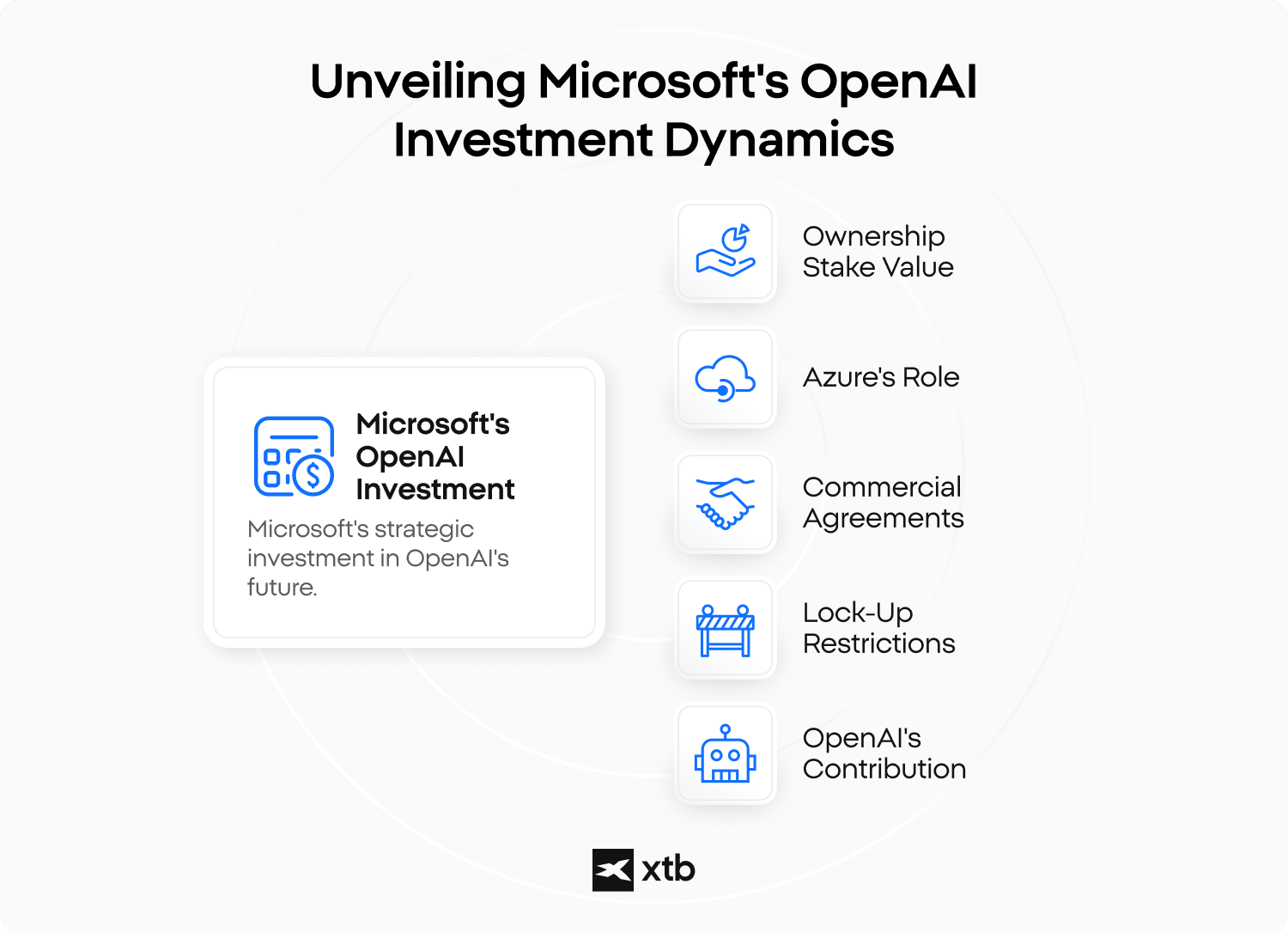
Investors should watch several Microsoft-related factors:
The value of Microsoft's approximately 27% ownership stake after the IPO.
Azure's role in supporting OpenAI's expanding computing needs.
Future commercial agreements between the two companies.
Any post-IPO lock-up restrictions on Microsoft's shares.
The contribution of OpenAI to Microsoft's broader AI ecosystem.
OpenAI faces increasing competition: Anthropic, Google and Chinese AI
Although OpenAI remains one of the industry's leading AI companies, competition is intensifying rapidly. Rivals including Anthropic, Google's Gemini, Meta's Llama, xAI's Grok, and Chinese models such as DeepSeek and Alibaba's Qwen are all competing for enterprise customers, developers, and market share. As a result, OpenAI's long-term valuation will increasingly depend on maintaining technological leadership rather than simply benefiting from first-mover advantage.
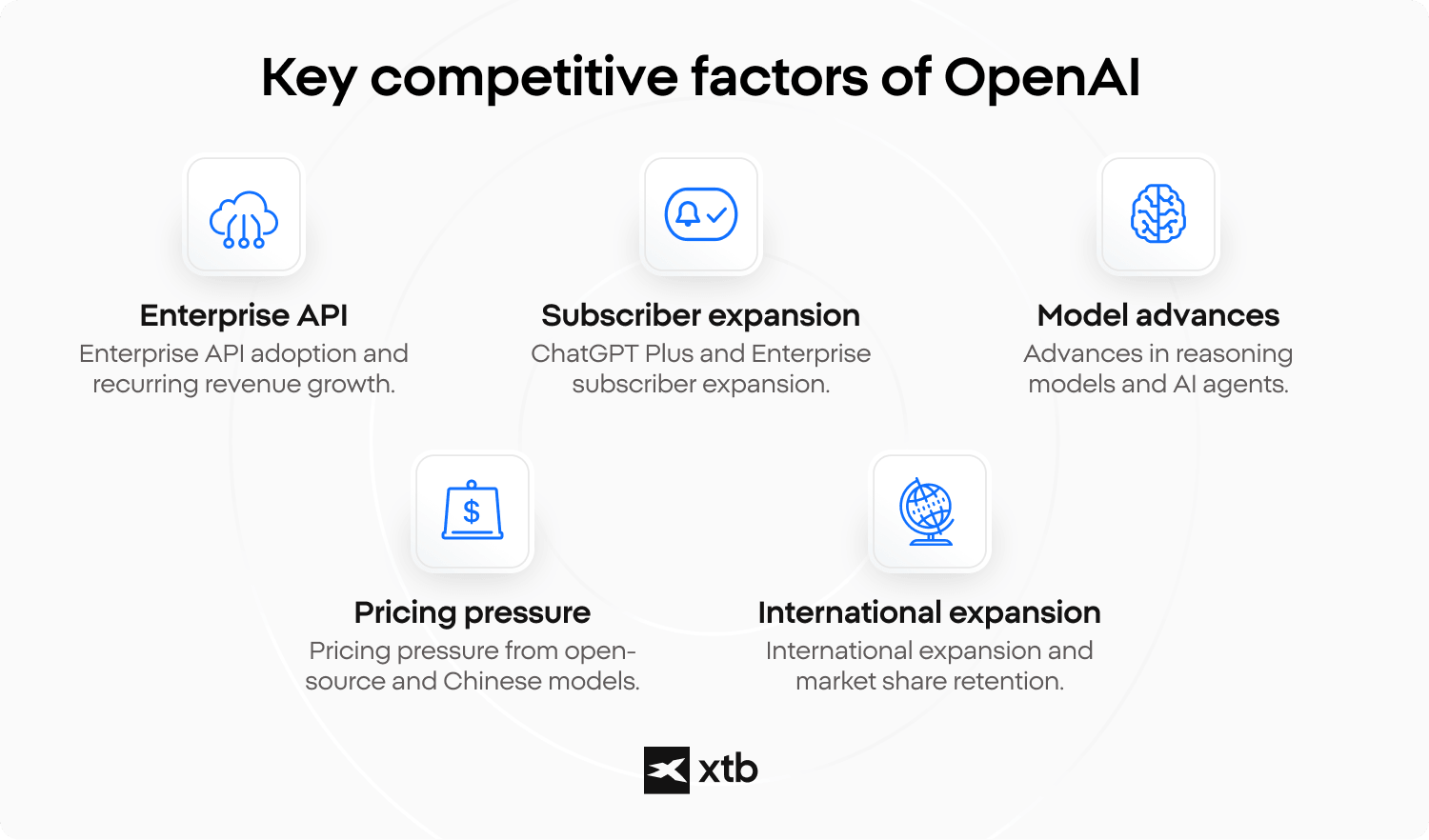
Competition is also becoming more price-driven. Businesses now compare AI providers based not only on model performance but also on API pricing, inference costs, and cloud integration, increasing pressure on margins across the industry. Key competitive factors include:
Enterprise API adoption and recurring revenue growth.
ChatGPT Plus and Enterprise subscriber expansion.
Advances in reasoning models and AI agents.
Pricing pressure from open-source and Chinese models.
International expansion and market share retention.
Why token economics and infrastructure costs matter
Unlike traditional software companies, OpenAI operates an extremely capital-intensive business model. Every AI-generated response consumes computing power, meaning user growth must consistently outpace infrastructure spending. For investors, profitability will depend not only on revenue growth but also on how efficiently OpenAI manages its computing costs.
The company recently completed a funding round valuing it at around $850 billion while raising $122 billion to finance next-generation AI models and infrastructure. Training and operating frontier AI systems require continuous investment in GPUs, data centers, and electricity, making cost efficiency a critical valuation driver.
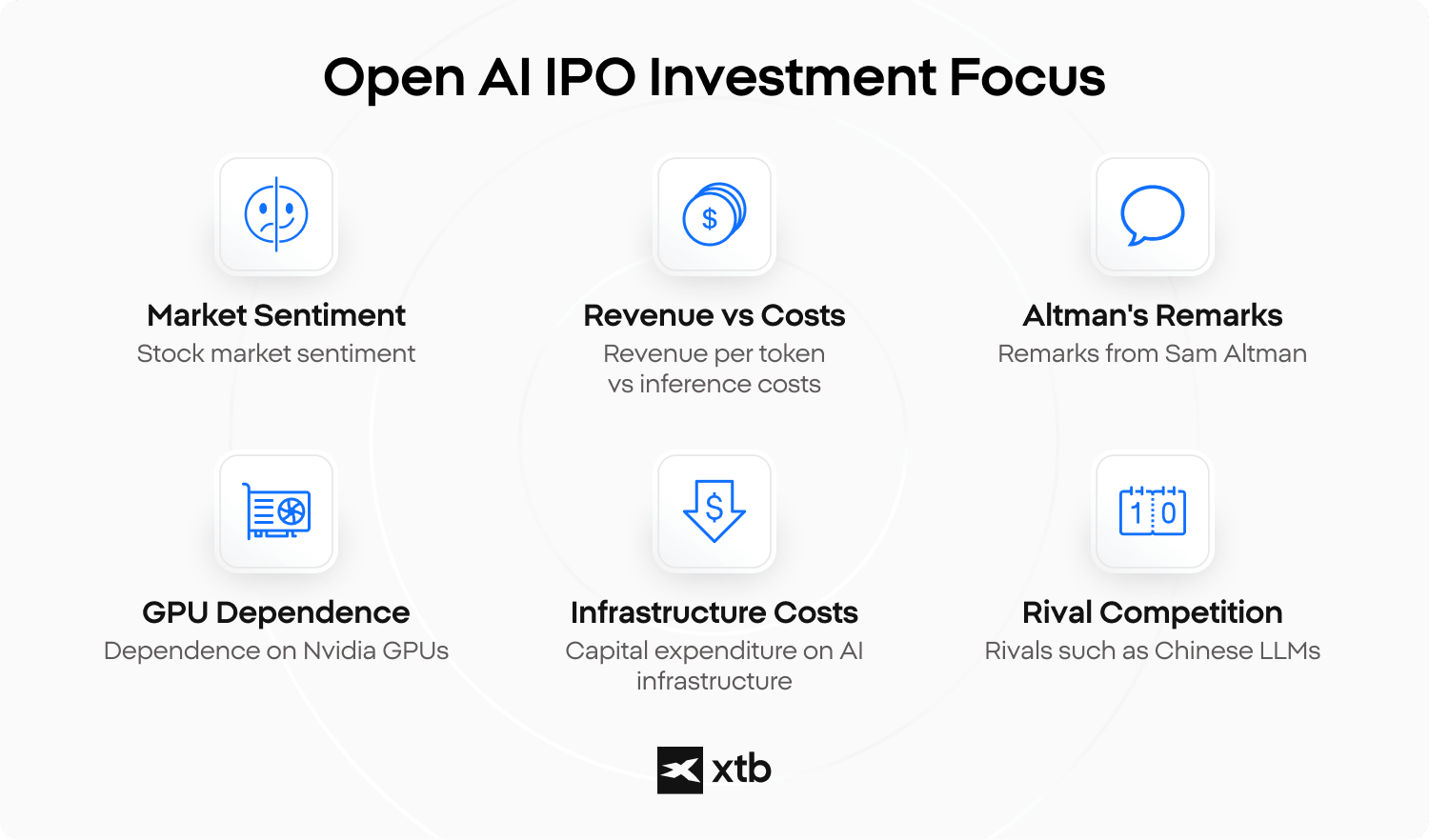
Following an IPO, investors are likely to focus on:
- Revenue per token versus inference costs.
- Gross margins across ChatGPT and API services.
- Capital expenditure on AI infrastructure.
- Dependence on Nvidia GPUs and cloud providers.
- Improvements in model efficiency and operating margins.
What has to happen before OpenAI can go public?
Before an IPO can take place, OpenAI must satisfy major prerequisites, including restructuring its unique corporate structure, auditing financial statements, and completing regulatory filing requirements with financial authorities. One primary structural requirement stems from the firm's historic governance setup. Founded in 2015 as a non-profit organization, OpenAI established a hybrid framework in 2019 consisting of a non-profit controlling board overseeing a capped-profit commercial entity.
To conduct a standard public offering, management must reorganize this hybrid corporate structure into a traditional commercial structure aligned with standard equity market requirements and institutional governance standards. In 2025, OpenAI Group PBC became a Public Benefit Corporation (PBC), replacing the capped-profit mechanism with another framework, still oriented to its public mission.
In addition to corporate restructuring, several standard regulatory milestones must be completed:
- Audited Financial Statements: Comprehensive, multi-year audited financial statements prepared according to recognized accounting standards to verify operations.
- Formal SEC S-1 Registration: Submission and public release of a formal registration statement detailing corporate risks, governance, revenue sources, and share distribution
- Underwriter Selection: Partnering with investment banks to structure the equity sale, perform due diligence, and coordinate institutional allocations.
- Institutional Roadshow: Conducting management presentations to institutional market participants to determine final share pricing prior to trading.
Demonstrating transparent corporate governance, such as clarifying equity distribution and ensuring voting oversight, aligns with public company regulations - remains essential before listing on a public stock exchange.
How does OpenAI's path to IPO compare to other AI companies?
OpenAI is one of several high-profile AI firms weighing a public market transition, with similar expectations surrounding peer AI company Anthropic, placing the move in a broader sector-wide IPO cycle. The artificial intelligence sector has attracted substantial private investment, allowing major foundation model developers to remain private while funding core operations. However, as compute costs scale and competitive expansion accelerates, leading technology developers across the AI landscape are evaluating public market access to secure scalable, long-term equity capital.
When reviewing potential large-scale listings, historical market precedents offer useful context. Previous major technology debuts such as Meta's (then Facebook) 2012 public debut, Arm Holdings' 2023 stock listing, or 2026 SpaceX historic IPO demonstrate how significant public market interest can drive initial trading volume, market attention, and valuation debate during early price discovery. Transitioning from a private technology developer to a publicly traded enterprise presents distinct considerations for retail market participants:
- Public Common Share Access: Public listings allow general investors to buy stock through licensed brokers without accredited investor restrictions.
- Regulatory Financial Reporting: Publicly traded companies must publish audited quarterly earnings reports, disclosing operational expenditure and margins.
- Initial Market Volatility: Newly listed public equities frequently experience elevated volatility during initial trading sessions as the market establishes fair value.
- Macroeconomic Sensitivity: Broader macroeconomic shifts and technology sector corrections directly influence public share prices regardless of standalone growth metrics.

FAQ
FAQ
No. As of 2026, OpenAI remains a privately held company, meaning its shares are not listed on the Nasdaq, NYSE, or any other public stock exchange. Retail investors cannot purchase OpenAI stock through a regular brokerage account until the company officially completes an IPO.
There is currently no officially confirmed IPO date. Market speculation suggests a potential public listing could take place in late 2026 or during 2027, although the timeline depends on market conditions, regulatory approvals, and the company's corporate restructuring.
Most recent market estimates suggest an IPO valuation of around $850 billion, which would make OpenAI one of the largest public offerings in history. However, the final valuation will ultimately depend on investor demand, financial performance, and broader market sentiment at the time of the offering.
Generally, no. OpenAI shares remain available only through private funding rounds and secondary transactions involving accredited investors, venture capital firms, and employees. Any platform claiming to offer "public" OpenAI shares before an IPO should be approached with caution.
Yes. Following OpenAI's latest corporate restructuring, Microsoft is estimated to own approximately 27% of OpenAI's economic interest while also remaining its largest strategic technology partner. Besides its equity stake, Microsoft generates additional revenue through Azure cloud services and AI products powered by OpenAI models.
The most common indirect approach is investing in companies with significant commercial exposure to OpenAI. Microsoft is widely considered the primary beneficiary because of its ownership stake, cloud infrastructure partnership and deep integration of OpenAI technology across products such as Copilot, GitHub Copilot and Azure. However, buying Microsoft shares does not provide direct ownership of OpenAI stock.
Several factors could delay or reduce the valuation of a future IPO, including weaker equity markets, increased competition from companies such as Anthropic, Google, and DeepSeek, rising AI infrastructure costs, regulatory changes, and slower-than-expected revenue growth. As with any major IPO, market conditions could ultimately be just as important as the company's financial performance.
Unlike traditional software companies, OpenAI incurs substantial costs every time users interact with its AI models. Training and operating frontier AI systems requires billions of dollars in GPUs, data centers, and electricity, making infrastructure efficiency one of the most important drivers of future profitability and long-term valuation.
If OpenAI reaches a valuation close to current private market estimates of around $850 billion, it would rank among the largest technology IPOs ever completed. Such a debut would likely surpass most previous software listings and become one of the defining stock market events of the AI era.