



📈 Global Stock Markets
- Wall Street closed Friday's session, shortened due to Thanksgiving, solidly in the green. All three major indices posted gains for the full week. Investors returned to heavily discounted AI-related stocks amid light trading volumes.
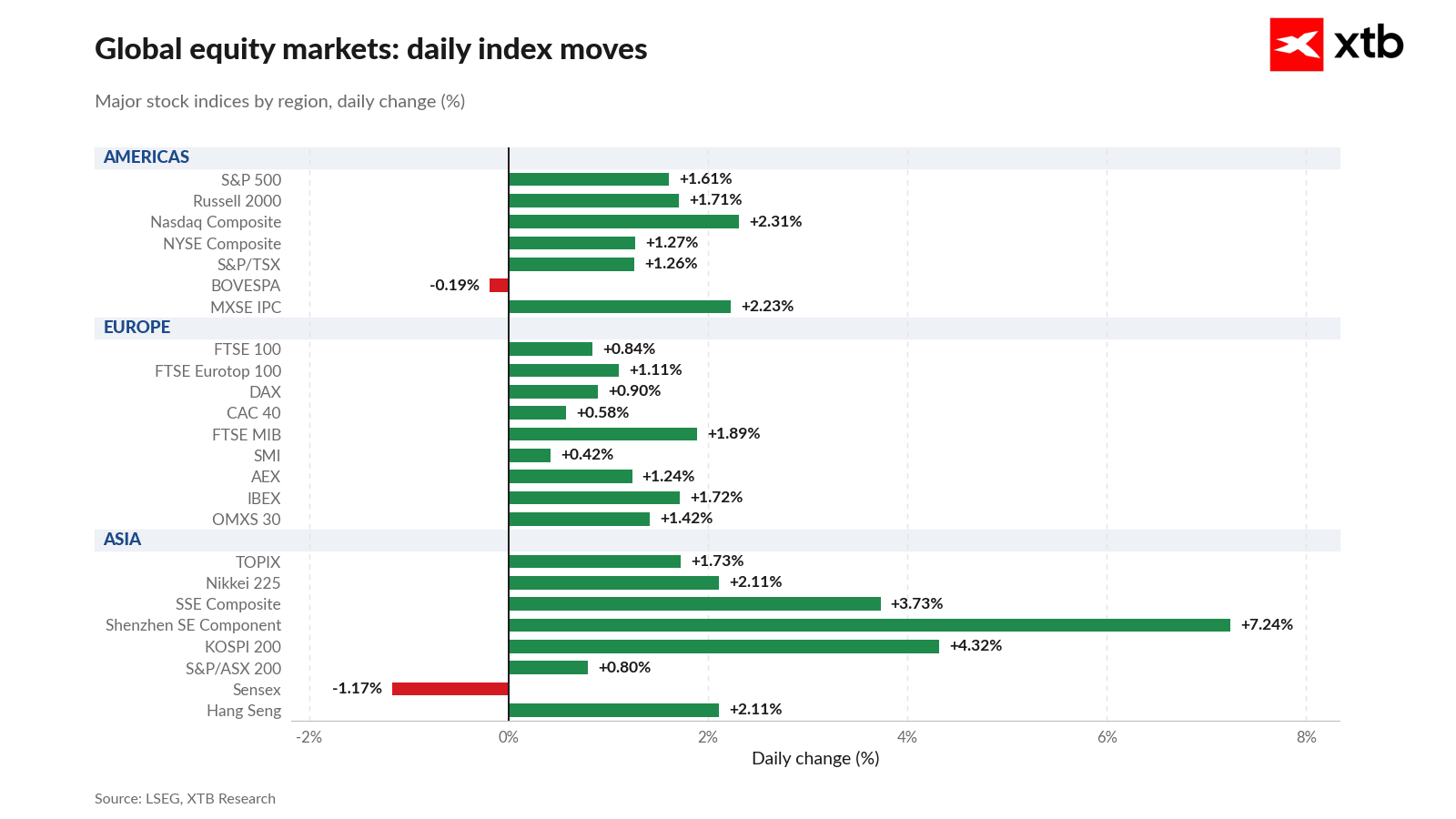
- At the close, the Dow Jones (US30) gained 1.19% to finish at 50,781 pts. The S&P 500 rose 1.61% to 7,298 pts, and the Nasdaq Composite gained 2.31% to close at 24,130 pts.
- The week was exceptionally volatile. The market alternated between bargain hunting after a steep sell-off and concerns over rising AI costs, high debt levels among tech firms, and uncertain returns on investment. Volatility was further fueled by Jensen Huang's return as CEO of Nvidia and Anthropic's stock briefly dipping below its IPO price.
- Friday's gains did not erase November's losses. The S&P 500 and Nasdaq are heading for their weakest November since 2008. Pressure stems from fears of stricter AI regulation following the Democrats' victory in the midterm elections and expectations that monetary policy will remain restrictive.
- The market is almost fully pricing in a Fed rate hike in December. Data released this week showed that the US economy grew significantly faster in Q3 than initially estimated, while inflation accelerated in October.
- At the US close, the S&P 500 is up 1.61%, the Nasdaq Composite is up 2.31%, and the Dow Jones is up 1.19%. The FTSE 100 closed 0.84% higher in London.
💻 Companies and the Tech Sector
- AI-related stocks are recovering losses following a series of sharp swings in recent days. Concerns about when massive capital expenditures will begin to pay off still hang over the market. Nevertheless, capital is flowing back into sector leaders, helping to stabilize sentiment across the New York trading floor.
- Semiconductors, which investors heavily sold off in November, rebounded. Micron and Marvell gained, and upward movement was also visible in the SOX index. Other beneficiaries of the AI boom, such as Sandisk, Lumentum, and Dell, also rose.
- Gains extended to some hyperscalers—companies operating massive data centers—including Amazon, Microsoft, Meta, and Oracle. Tesla posted strong gains.
- Nvidia is in the spotlight as its share price recently pulled back by about 38% from its all-time highs. Its forward P/E ratio has dropped to levels not seen since 2018. For some investors, this signals that the sell-off went too far and the valuation has become attractive. Others see it as pricing in growing risks, such as supply chain issues and trade restrictions.
- At the US close, Nvidia is up 0.8%, Tesla is up 5.2%, Amazon is up 4.1%, Meta is up 3.1%, and Alphabet is up 0.6%. Among semiconductors, Micron leads the gains with a 7.5% jump, while AMD is up 4.4% and TSMC is up 3.5%.
- The financial sector was strong, with the S&P 500 banks index advancing, mainly driven by JPMorgan, which is up 2.1%. Gold and silver mining companies also rebounded after precious metals recovered losses from recent sessions.
🌍 Macroeconomics and Geopolitics
- Surprisingly low inflation in France confirmed that price pressures in the eurozone's second-largest economy are weakening rapidly. At the same time, France's GDP reading pointed to a slowdown in growth, heightening concerns over the country's fiscal health and the stability of the European recovery.
- The slowdown in price dynamics takes pressure off policymakers to tighten monetary policy, opening up a discussion on potential support for the bloc's slowing economy.
- Geopolitically, Ukraine's proposal for a ceasefire in the Black Sea, which could unblock trade routes, reverberated through the markets. The easing of military pressure in these waters triggered an immediate reaction in maritime freight rates and agricultural futures, including wheat and corn.
⛏️ Commodities
- Gold recorded a clear 2% gain, which from a technical standpoint signals a return of demand following an earlier, sharp downward correction. The metal is benefiting from falling bond yields and a weaker dollar driven by lower inflation expectations in Europe. Technical analysis points to the defense of key support levels, favoring further testing of resistance.
- The session also brought a strong rebound in silver, rising nearly 5%, as the metal found support from returning industrial and speculative demand. This move fits into the broader recovery trend in the precious metals segment.
- Copper surged over 3%, recording its most dynamic price jump since January. The move was fueled by short-covering (capitulation by bearish investors) and hopes for stimulus packages in China, which sharply improved sentiment toward base metals.
- Natural gas saw a sharp sell-off. The European gas contract (NATGAS.EU) fell 3.82%, while the US contract (NGAS) lost 2.64%.
- Crude oil also came under pressure. WTI declined 2.20%, while Brent (OIL) fell 1.42%.
💱 Currency Markets
- The Brazilian real strengthened by as much as 4.8%, posting one of its best sessions in recent years following appointments announced by the president. Lula's decision to entrust a key economic portfolio to a financier tied to the banking sector was received by the markets as a guarantee of fiscal pragmatism.
- The European currency remained under pressure from dovish inflation data, which dampened expectations for hawkish action from European central bankers. Persistent easing of price pressures in France limits the room for the euro to appreciate against major base currencies.



US OPEN: AI Stocks Rebound After a Week of High Volatility


Morning Wrap: Nasdaq rebounds from bear market threshold (27.11.2026)


Market Wrap: European Indices Rise 📈


📈 Gains across global stock markets