

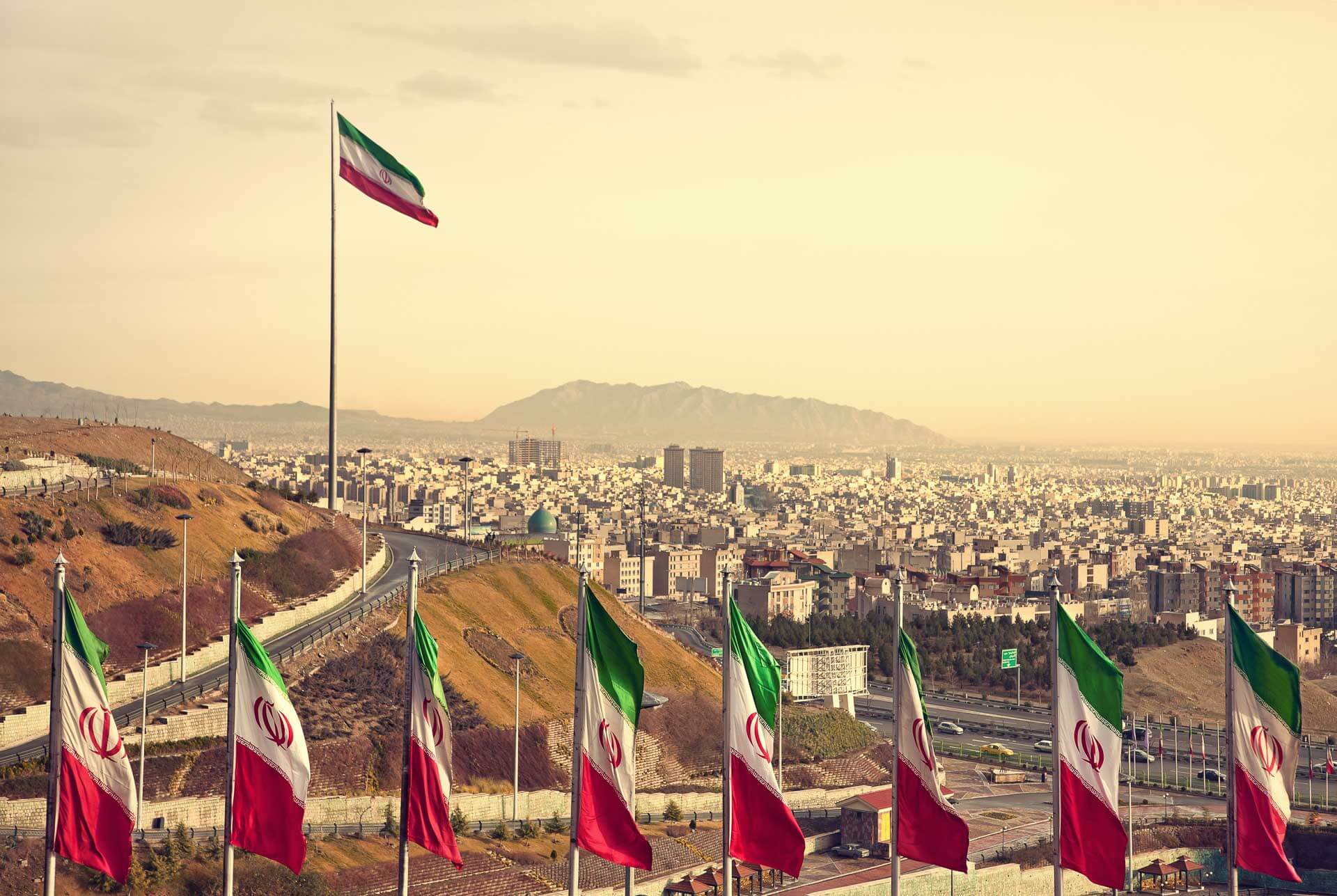

🌍 Geopolitical Situation & Diplomacy
-
The United States has conducted another round of airstrikes on Iran, and Tehran has responded with missile and drone attacks on targets in the region, leading to a further escalation of the conflict.
-
The Iranian Ministry of Foreign Affairs reports that talks with the US regarding the memorandum of understanding are in a "crisis phase", and Tehran announces that it will not fulfill its obligations until the other side complies with its agreements.
-
Iran also reports that attempts to establish a joint mechanism regarding the Strait of Hormuz involving Oman are being hindered by US pressure on that country, which further complicates the diplomatic situation.
-
Tensions are causing an increase in oil prices, pressure on financial markets, and the risk of further economic deterioration if the conflict continues to expand.
-
The international community is appealing for a return to negotiations; however, military actions between the US and Iran currently continue to intensify.
-
The Iranian news agency Mehr News Agency reports that explosions were heard in the vicinity of the Iranian port of Bandar Abbas and Qeshm island.
🛢️ Commodities & Energy
-
Crude oil is gaining approximately 2.5% at this moment, reacting to rising geopolitical risks and potential constraints in commodity supply.
-
The growing risk of disruptions to oil flows through the Strait of Hormuz increases investor concerns over global energy supplies, supporting the rise in commodity prices and stoking inflation fears.
📈 Stock Market
-
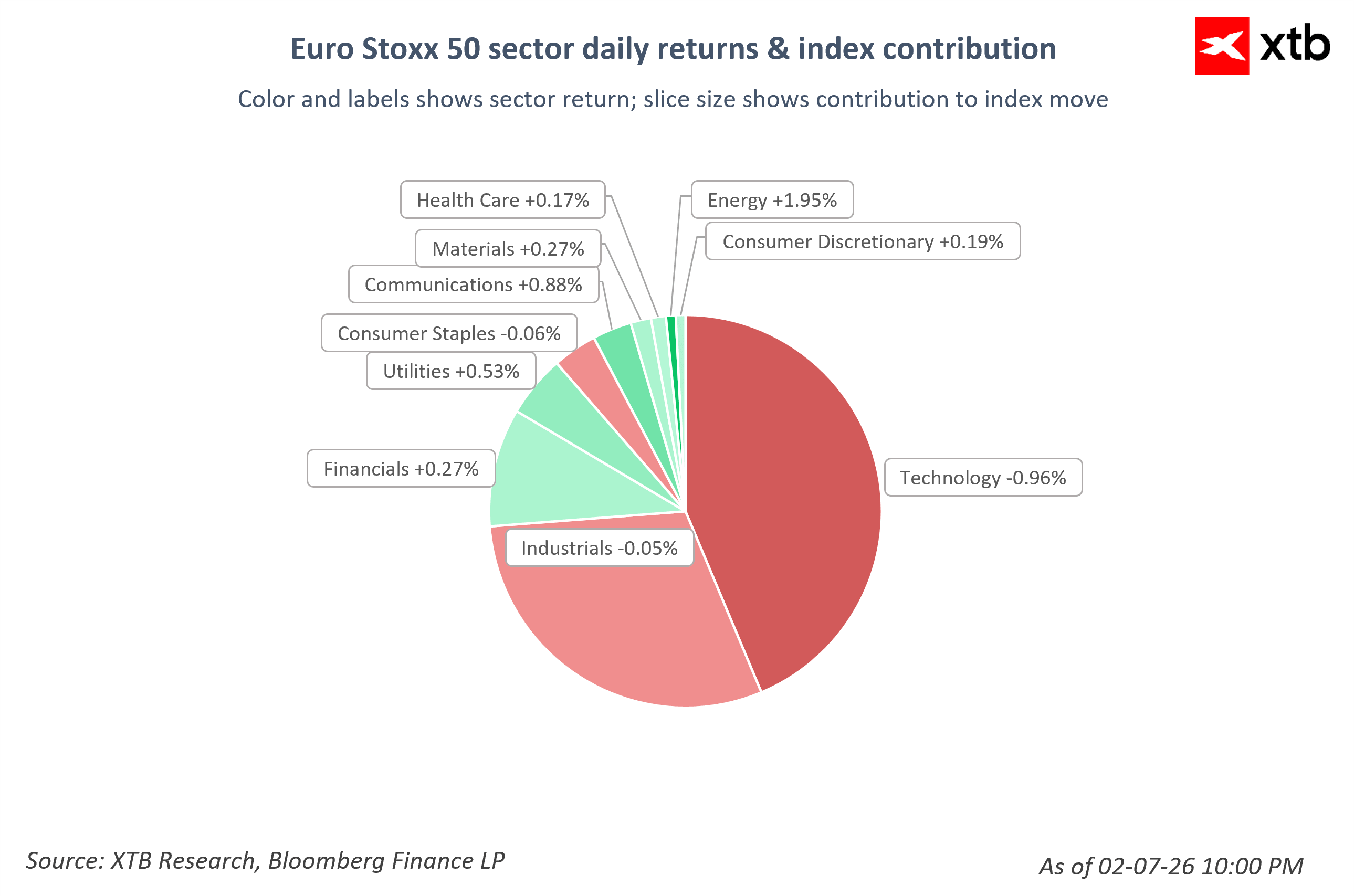
The deterioration in market sentiment translates into pressure on risky assets, including semiconductor equities, despite sustained strong interest in the artificial intelligence sector.
-
Investors remain focused on the further development of the Middle East conflict and the upcoming quarterly earnings of mega-cap tech companies, which will reveal the health of the AI sector and its growth prospects.
-
The session on European trading floors is progressing mostly in slight positive territory, demonstrating the relative resilience of investors despite ongoing geopolitical tensions and rising energy market concerns.
-
The strongest performance is seen in indices from Germany and Spain, where the DAX is gaining around 0.1% and the IBEX 35 is rising by about 0.2%, supported by positive sentiment surrounding certain industrial and financial companies.
-
France's CAC 40, similarly to the broad European Euro Stoxx 50, remains symbolically in the green.
-
The British FTSE 100 is holding close to its opening level with a minor loss.
-
Investors in Europe remain cautious, analyzing the impact of Middle East tensions, the situation around the Strait of Hormuz, and a potential rise in oil prices on the economic outlook and central bank policies.
-
Despite the uncertainty, equity markets remain stable, and investor attention outside of geopolitics is drawn to upcoming corporate quarterly results and the further growth prospects of the technology sector.
🏭 Sectors & Companies
-
Volkswagen is considering the reduction of another 50,000 jobs, as the current austerity program may not be sufficient to improve the company's competitiveness.
-
The German manufacturer is struggling with high production costs, pressure from Chinese automotive brands, and slower demand for electric vehicles in Europe.
-
Additional cutbacks would complement already planned layoffs, which could mean up to approximately 100,000 job reductions across the entire group.
-
The restructuring is intended to help Volkswagen lower costs, but it may spark strong opposition from trade unions and employees.
-
European airlines are under pressure following the rise in oil prices triggered by escalating Middle East tensions.
-
Higher fuel costs could compress the margins of carriers, who are already facing cost pressures and uncertainty regarding travel demand.
-
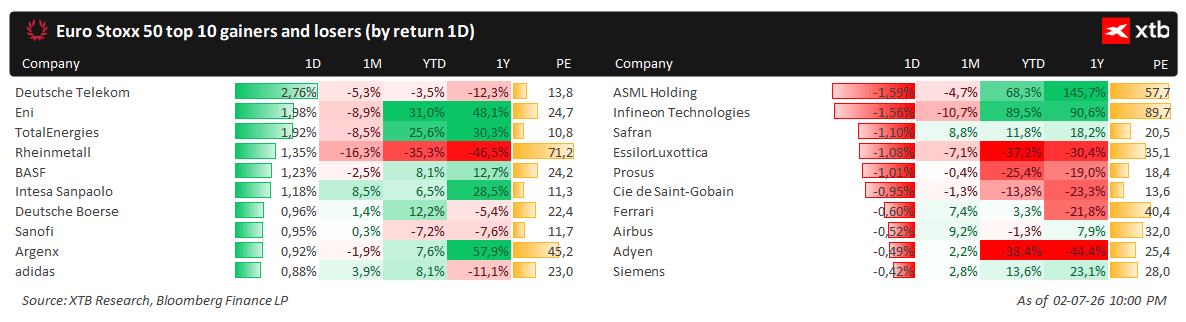
Shares of companies such as Lufthansa, Ryanair, and TUI are falling, as investors fear a further increase in operating expenses.
-
European oil companies are gaining on stock exchanges following the escalation of the US-Iran conflict, which is driving up oil prices.
-
Investors fear disruptions to commodity supplies from the Middle East, which increases the valuation of energy giants such as BP, Shell, and TotalEnergies.
-
Higher oil prices improve the revenue outlook for fuel producers, but simultaneously increase inflation risks and pressure on other economic sectors.
🪙 Precious Metals
-
The precious metals market is experiencing declines, the foundation of which lies in the escalation of the conflict in the Middle East.
-
Gold is retracing by about 0.1% and falling below $4,100 per ounce.
-
Silver is dropping by over 2% and pulling back below $59 per ounce.
💻 Cryptocurrencies
-
Cryptocurrencies also remain under pressure.
-
Bitcoin is falling by over 1.3% and testing the $63,000 level.
-
Ethereum is losing around 0.1% and sliding below $1,800.


Three markets to watch next week (23.10.2026)


Daily Summary: Oil at five-month highs, indices under pressure (23.10.2026)

US Open: Further declines on Wall Street, Brent above 111 USD, AI correction continues (14.10.2026)

Chart of the Day: Is USDJPY running out of road? Inflation forces the BoJ to act, but the Fed could spoil the Yen’s rally