
Reader wants the current figure for Elon Musk's net worth and to understand what it is made of, why it changes, and how an investor could get exposure to the companies behind it.
Reader wants the current figure for Elon Musk's net worth and to understand what it is made of, why it changes, and how an investor could get exposure to the companies behind it.


Elon Musk's net worth stands at approximately $1.2 trillion as of June 2026, positioning him firmly as the wealthiest person in the world. This valuation is derived primarily from his massive equity stakes in technology companies SpaceX and Tesla. Understanding how this historic fortune is structured offers critical insights into modern corporate valuation and asset growth. Read on to discover the breakdown of the first trillionaire's wealth and how market dynamics drive these figures daily.
Key Takeaways
-
Elon Musk's net worth is roughly $1.2 trillion according to leading financial trackers such as Bloomberg Billionaire Index and Forbes, making him the world's number one richest individual and the first trillionaire in history.
- His wealth is more than 80% concentrated in equity holdings within SpaceX (merged with xAI), where he has a 42% stake worth approximately $900 billion, and Tesla, where he has a 15% stake worth approximately $280 billion, as of June 2026.
- Because his fortune is heavily tied to publicly traded stock, his net worth fluctuates by billions of dollars daily.
How much is Elon Musk worth right now?
Elon Musk's net worth is approximately $1.2 trillion as of June 2026, according to the Bloomberg Billionaires Index, which secures his position as the wealthiest person on earth. Musk's net worth surged by almost $800 billion in a single trading session after the SpaceX stock debut on 12 June 2026, as Wall Street valued the company at almost $3 trillion versus the $1.75 trillion market cap from the IPO.
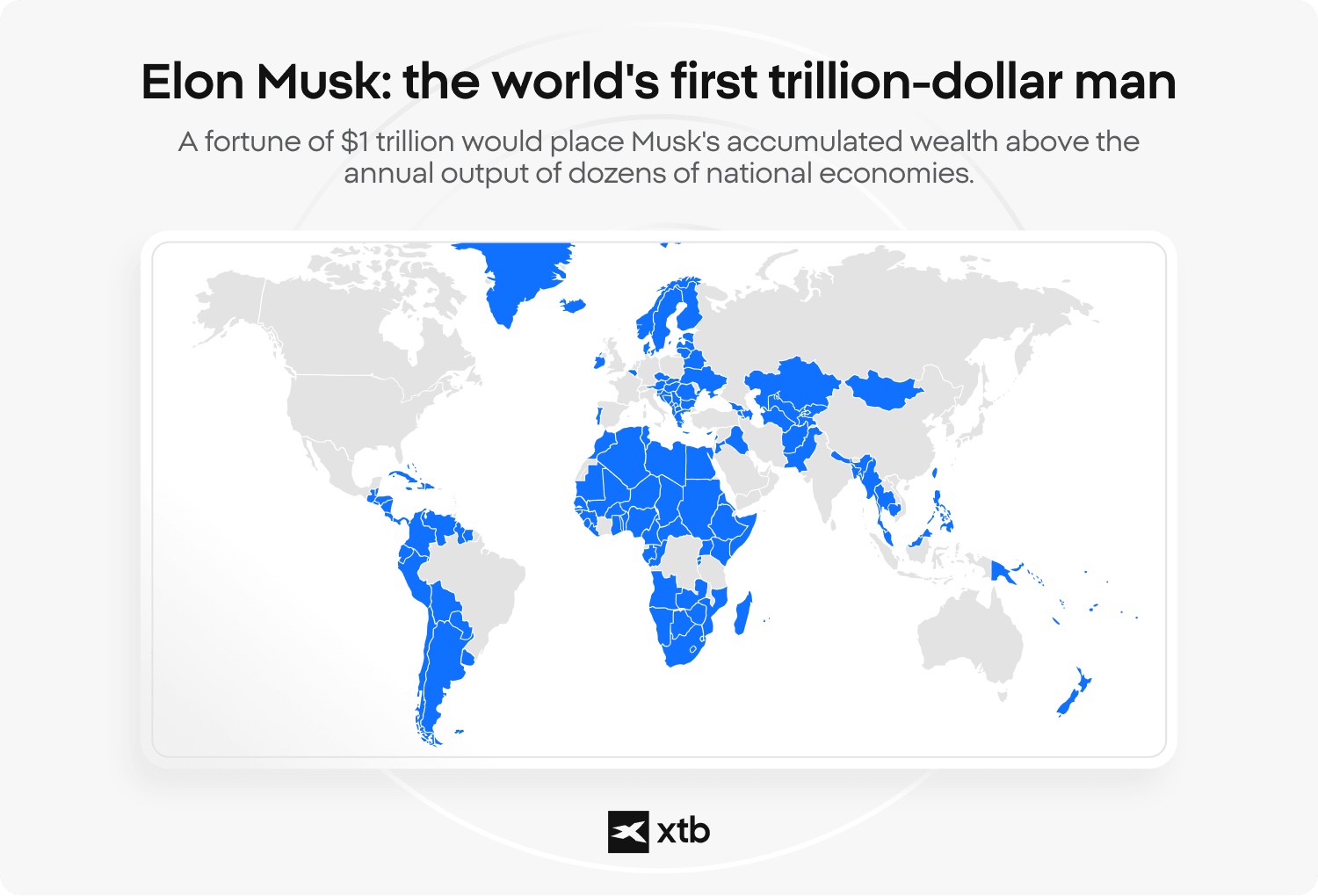
As of June 2026, Musk owns 4.76 billion SpaceX shares, based on the company's S-1 Filing. A $1 move in SPCX stock adds or subtracts about $4.8 billion from Musk's net worth. Even if you had earned $1 million every day since 1 AD, you would have accumulated about $740 billion by 2026 - still less than a $1.2 trillion fortune.
Musk’s fortune represents a historic milestone, solidifying his status as the world's first official trillionaire in US dollars and a leader of the new space economy. However, this number is a real-time estimate rather than a permanent bank balance. Financial trackers calculate this sum based on current market data, which shifts whenever global equity markets open for trading.
Because different tracking platforms use slightly different methodologies for evaluating private holdings, the final sum can vary between platforms. For instance, the Forbes Real-Time Billionaires List and the Bloomberg Billionaires Index often display distinct figures at any given moment. This variance highlights that any stated wealth figure is a snapshot in time rather than an absolute, unchangeable metric.
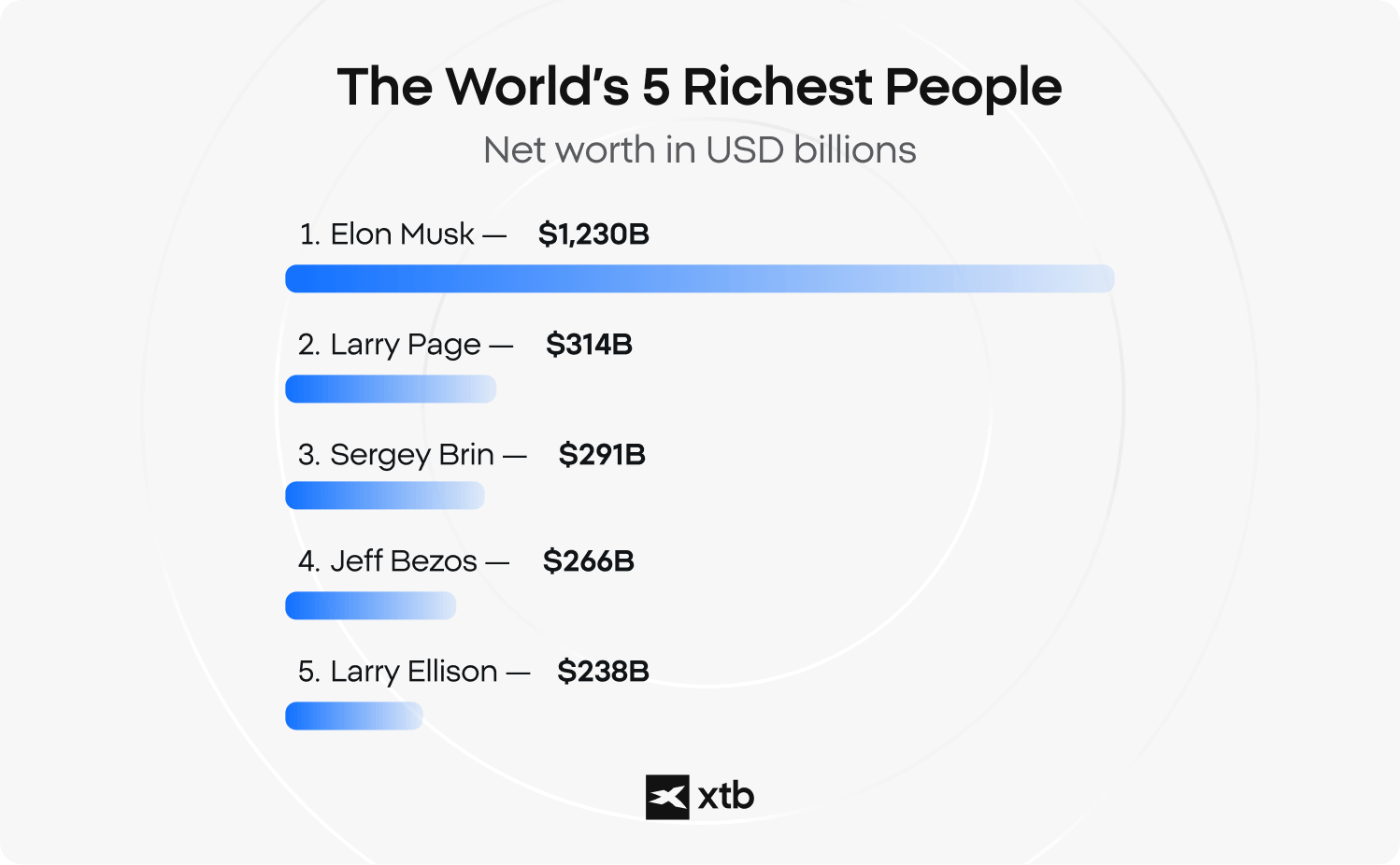
June 2026, Bloomberg Billionaire Index - TOP 5
- Elon Musk - 1,230 bln USD | Tesla, SpaceX
- Larry Page - 314 bln USD | Alphabet (Google)
- Sergey Brin - 291 bln USD Alphabet (Google)
- Jeff Bezos - 266 bln USD | Amazon
- Larry Ellison - 238 bln USD | Oracle
Source: Bloomberg Billionaire Index as of 22 June 2026
How is a billionaire's net worth actually calculated?
A billionaire's net worth is calculated by taking the total market value of all their assets, including public and private stock shares, and subtracting any outstanding personal liabilities or debts. The foundational concept of a balance sheet applies universally, whether evaluating a retail investor or the world's richest individual. To determine a billionaire's financial standing, analysts multiply the total number of corporate stock shares the individual owns by the current market price per share. This process is straightforward for publicly traded entities but requires complex estimation techniques for private enterprises.
When valuing large equity blocks or shares in private companies, financial institutions often apply a valuation discount. This discount accounts for the lack of liquidity and potential regulatory lock-up periods that prevent the immediate sale of those assets. Understanding how to calculate net worth helps clarify why billionaire wealth appears so massive yet remains largely unavailable for immediate spending.
This calculation method means that net worth serves as a measure of overall economic power rather than an indicator of available cash. Individuals can learn to read financial statements to understand how assets and liabilities interact on a smaller scale. For any investor, tracking the relationship between equity appreciation and debt is essential for long-term financial health.
What is Elon Musk's net worth made of?
The vast majority of Elon Musk's net worth consists of equity stakes in Tesla and SpaceX, meaning his wealth is tied up in corporate stock rather than liquid cash. Also, companies such as X, Neuralink, and The Boring Company represent smaller but potentially significant private-company holdings.
- SpaceX (NASDAQ: SPCX) – Musk's largest asset, with his 42% ownership stake estimated to be worth approximately $1 trillion, Musk also controls 82% of voting power in the company.
- Tesla (NASDAQ: TSLA) – Electric vehicle and energy company where Musk remains the largest individual shareholder, with his holdings estimated at $280 billion and 15% ownership stake.
- X (formerly Twitter) – Social media and digital platform acquired by Musk in 2022 and later integrated with xAI initiatives, with an estimated value of $20–40 billion attributable to his ownership.
- Neuralink – Neurotechnology company focused on brain-computer interface development, with Musk's stake estimated at $15–30 billion.
- The Boring Company – Infrastructure and tunnelling business specialising in transportation projects, with an estimated value of $5–10 billion attributable to Musk's ownership.
This structure creates a scenario in which an individual can hold a historic net worth. Unlike traditional corporate executives, Elon Musk does not receive a standard cash salary or regular performance bonuses. Instead, his compensation plans are structured around complex, performance-based stock options tied to specific market capitalisation and operational milestones. If the companies fail to meet these aggressive targets, his compensation drops to zero.
This structure creates a scenario in which an individual can hold a historic net worth while remaining relatively short on liquid capital. This phenomenon reflects a broader economic reality where immense paper wealth does not equal immediate purchasing power. Most of his capital remains actively deployed within his companies to fund ongoing operations and research.
Why does Elon Musk's net worth change so much?
Elon Musk's net worth fluctuates by billions of dollars daily because it is directly linked to his two volatile trillion-dollar companies: SpaceX and Tesla. Because his fortune is stock-based, any upward or downward movement in the equity markets immediately reshapes his financial standing.
If Tesla stock rises or falls by even a small percentage during a single trading session, Elon Musk's personal valuation adjusts by billions of dollars within minutes. For instance, if SpaceX shares drop 10% in a single session, his fortune can decline by almost $100 billion in a matter of hours. This extreme sensitivity to public market sentiment explains why his net worth is never a static figure.
Private equity valuations also introduce sudden, major adjustments to his overall fortune. Ventures like SpaceX and xAI are valued through periodic funding rounds or secondary share sales rather than continuous public trading. When these events occur, the updated baseline can cause his estimated wealth to jump overnight, creating discrepancies between major financial tracking indexes.
The following table illustrates how public stock performance and private funding rounds influence the tracking data across different financial index platforms:
|
|
|
|
|
|
|
|
|
|
|
|
|
|
|
|
How did Elon Musk become the world's first trillionaire?
Elon Musk reached the milestone of becoming the world's first trillionaire in 2026, driven primarily by the soaring valuations of SpaceX. His path to this unprecedented wealth level began with early entrepreneurial successes, including the sale of PayPal, which provided the initial capital to fund his modern ventures.
- 1971–1988: Early years in South Africa — Musk grew up in a relatively well-off family, with his father working as an engineer and property developer.
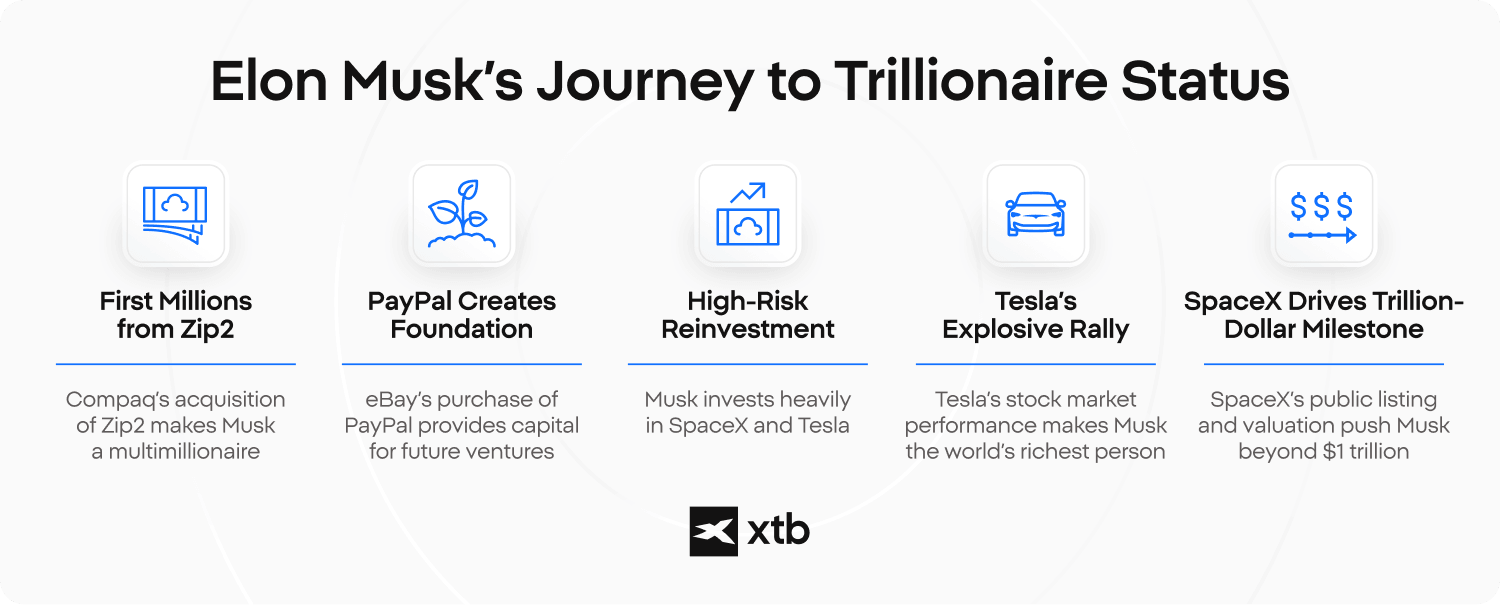
- 1999: First millions from Zip2 — Compaq acquired Zip2 for approximately $307 million, making Musk a multimillionaire at age 27.
- 2002: PayPal creates the foundation — After eBay purchased PayPal for $1.5 billion, Musk received roughly $180 million, providing the capital for his future ventures.
- 2002–2004: High-risk reinvestment strategy — Instead of moving into conservative investments, Musk invested heavily in SpaceX (2002) and Tesla (2004).
- 2020–2021: Tesla makes him the world's richest person — Tesla's explosive stock market rally transformed Musk from a billionaire into the richest individual on the planet.
- 2026: SpaceX drives the trillion-dollar milestone — Following its public listing and a valuation approaching $3 trillion, SpaceX became the largest contributor to Musk's fortune and pushed him beyond the $1 trillion mark.
- 2023–2026: Additional value from AI and private ventures — Holdings in xAI, X, Neuralink, and The Boring Company further expanded his wealth.
- 2026: From millionaire to trillionaire — Roughly 27 years after becoming a millionaire through Zip2, Musk became the first person in history to achieve a net worth exceeding $1 trillion.
Rather than diversifying into conservative assets, Musk reinvested his capital into high-risk industries like aerospace and electric vehicles. The exponential growth of these sectors eventually propelled him past other ultra-wealthy individuals on the global rich list. His total net worth has frequently surpassed Jeff Bezos' net worth and Bernard Arnault's net worth by substantial margins. This gap widened significantly as SpaceX surged throughout the mid-2026 period, making the company worth almost $3 trillion as of 18 June, surpassing the Amazon valuation only five sessions after its stock market debut.
How can investors get exposure to the companies behind Musk's wealth?
Retail investors can gain market exposure to SpaceX or Tesla through individual stock shares. Tesla and SpaceX (merged with xAI before the IPO) operate as publicly listed corporations, meaning anyone with an investment account can buy individual SpaceX / Tesla shares or invest in broad exchange-traded funds (ETFs) that hold those stocks.
This provides a direct path to participate in the space economy, AI, electric vehicle and clean energy sectors through standard public instruments. Learning how to invest in stocks is a practical step for individuals wanting to enter these markets. Investors should be aware that the valuations of Elon Musk's companies are considered very high, which may lead to significant volatility over time.

FAQ
FAQ
As of June 2026, Elon Musk's net worth is estimated at $1.2 trillion, making him the first person in history to surpass the trillion-dollar threshold. Most estimates place his fortune at around $1.23 trillion, although the exact figure fluctuates daily with the market value of his holdings.
Musk's wealth comes primarily from his ownership stakes in SpaceX, Tesla and his private equities. While Tesla was the main driver of his fortune for many years, SpaceX became the largest contributor after its public listing in 2026. According to several estimates, SpaceX now accounts for more than half of Musk's total net worth.
Yes. Following SpaceX's public debut in June 2026, Elon Musk became the first individual in recorded history to achieve a net worth exceeding $1 trillion. Previous wealth records held by modern billionaires were significantly below this level.
The largest sources of Musk's fortune are SpaceX, Tesla, and xAI. He also owns stakes in ventures such as Neuralink, The Boring Company, and X (formerly Twitter). However, SpaceX and Tesla remain the dominant contributors to his overall wealth.
Musk's fortune is several times larger than that of the world's second-richest individuals. While many of the wealthiest entrepreneurs have fortunes measured in the hundreds of billions of dollars, Musk's net worth has crossed the trillion-dollar mark, creating one of the largest wealth gaps ever recorded between the richest person and the rest of the billionaire ranking.
No. Like most ultra-high-net-worth individuals, Musk's wealth is primarily tied to equity ownership rather than cash. The vast majority of his fortune consists of shares in publicly traded and private companies, meaning his net worth can rise or fall significantly as company valuations change.
Not easily. Although his net worth exceeds $1 trillion, most of that wealth exists in company shares and ownership stakes rather than liquid cash. Selling a large portion of those holdings could affect company valuations and would likely require regulatory filings and substantial tax payments.
Musk's first major financial success came from Zip2, a software company he co-founded in the 1990s and later sold to Compaq. He then reinvested much of those proceeds into X.com, which eventually became PayPal and was acquired by eBay in 2002. Those early exits provided the capital used to build Tesla, SpaceX, and his later ventures.