
The reader wants to understand what the statement of changes in equity is, what moves a company's equity, and how to read it - leaving them able to tell dividends, share issues and retained earnings apart and see how the statement links the income statement to the balance sheet.
The reader wants to understand what the statement of changes in equity is, what moves a company's equity, and how to read it - leaving them able to tell dividends, share issues and retained earnings apart and see how the statement links the income statement to the balance sheet.


The statement of changes in equity is the only financial report that explains why a company's equity changed over a period - not just the opening and closing totals. It breaks the movement into four drivers: profit or loss, dividend payouts, share issues or buybacks, and reserve adjustments. Investors use it to track dividend policy, spot share dilution, and see how net income flows from the income statement into the balance sheet.
Key takeaways:
-
The statement tracks all movements in a company's equity over a defined reporting period.
- Key drivers that change equity include net income, dividends, and share issuances.
- The report is also known as the statement of stockholders' equity or the statement of owner's equity.
- Investors rely on it to evaluate payout policies and monitor for shareholder dilution.
What is a statement of changes in equity and what is it used for?
The statement of changes in equity is a financial statement showing how a company's equity changed between the beginning and the end of a reporting period. This financial statement highlights the specific movements in equity, effectively connecting the opening balance to the closing balance.
While a balance sheet shows the total amount of equity at a given moment, the statement of changes in equity provides transparency on exactly where those changes came from. Investors, shareholders, and corporate regulators use it to track wealth generation and distribution to determine if capital is being efficiently managed.
When asking what the statement of equity is, financial professionals refer to this exact tracking tool. It is sometimes called the statement of stockholders' equity, the statement of owner's equity, or—in a narrower format—the statement of retained earnings. Regardless of the name used, the core purpose remains the same: detailing the flow of capital and profits within a business over time.
What components make up the statement of changes in equity?
The changes in equity consist of the profit or loss for the period, dividends, share issues or buybacks, and changes in reserves. To understand the structure, investors can look at the main equity columns typically found in the report.
These columns break down the total equity into distinct financial categories:
- Share capital: The total funds raised by issuing shares to investors on the open market.
- Retained earnings: The accumulated net income kept within the company rather than distributed to shareholders.
- Reserves: Specific funds set aside by management to cover future obligations or anticipated projects.
- Accumulated other comprehensive income: Unrealised financial gains and losses, such as currency translation adjustments or asset revaluations.
The rows of the statement show the types of changes affecting these columns. Common line items include net income, dividends declared, share issues, share buybacks, and asset revaluations. Retained earnings typically show the most frequent movement in the statement, calculated by taking net profit and subtracting any dividends paid to shareholders.
What does a statement of changes in equity look like? (format and example)
The statement is formatted as a matrix where the columns represent equity components, the rows display the types of changes, and the bottom line shows the closing balance of each component.
A standard statement of changes in equity format follows a logical, step-by-step mathematical progression. The layout begins with the opening balance at the start of the year. From there, the matrix adds the net income, subtracts the dividends, and accounts for positive or negative share changes. The final calculation results in the closing equity
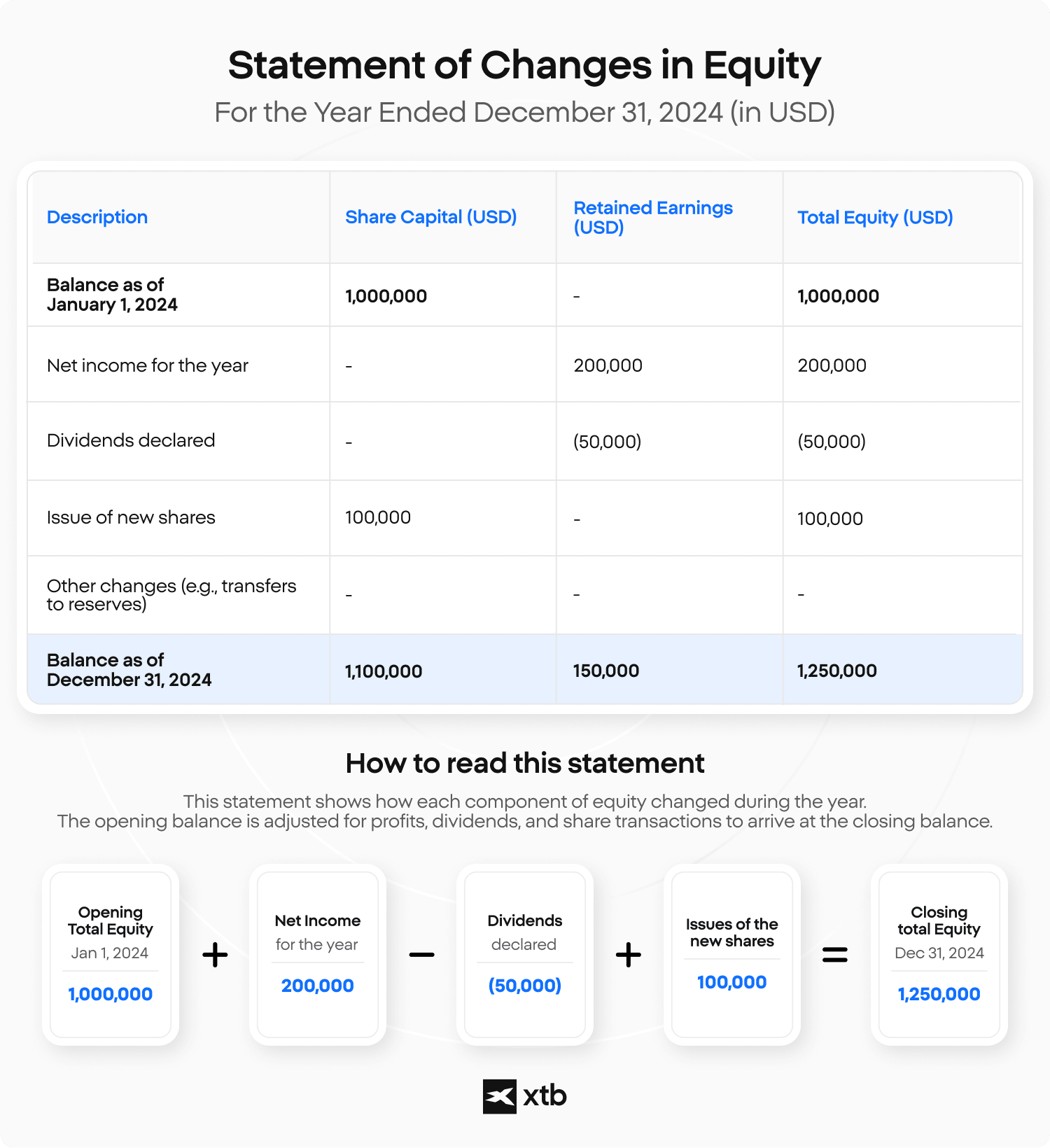
Finding a real-world statement of changes in equity example can help solidify this concept. Publicly traded companies include this matrix in their annual reports, clearly mapping out how starting capital evolved into the ending figures through operational success and financial decisions.
How do you read a statement of changes in equity as an investor?
By reading this statement, an investor can see a company's dividend policy and determine whether new share issues are causing dilution of their ownership.
- What dividend policy reveals. A consistent track record of dividend payments signals a stable payout policy - a key screen for investors seeking reliable dividend stocks.
- How to spot dilution. Frequent share issues increase the total shares outstanding and dilute existing stakes. For example, issuing new shares equal to 10% of the current count reduces an existing 5% holding to roughly 4.5% unless the investor buys into the new offering.
- What retained earnings trend shows. A rising retained earnings balance indicates the company is reinvesting profits to fund future growth rather than distributing them.
A positive movement in the equity statement generally indicates wealth creation for the shareholder, while a negative movement—outside of dividend payouts—might require closer scrutiny. The statement of equity serves as the vital financial bridge connecting other core financial documents. The net income figure is pulled directly from the income statement, which then adjusts the retained earnings. This final closing equity figure flows straight into the balance sheet.
Although it receives less attention than the cash flow statement or P/E ratio, the equity statement reconciles the income statement and the balance sheet into one view of how ownership value changed. All companies reporting under IFRS or U.S. GAAP must prepare it, giving investors a standardised tool to compare corporate financial structures.

FAQ
FAQ
Yes. Companies reporting under IFRS or U.S. GAAP are generally required to include a statement of changes in equity in their annual financial statements. This helps investors understand how shareholders' equity evolved during the reporting period rather than seeing only the opening and closing balances.
The balance sheet reports total shareholders' equity at a specific date, while the statement of changes in equity explains why that figure changed over time. It identifies the impact of profits, dividends, share issuances, share buybacks, and other equity adjustments.
Equity commonly increases due to:
Earning net income,
Issuing new shares to investors,
Recording positive movements in other comprehensive income.
Businesses that consistently generate profits without excessive share dilution often strengthen shareholders' equity over time.
Issuing new shares increases the total number of shares outstanding, reducing each existing shareholder's ownership percentage unless they participate in the new offering. Frequent dilution can also lower earnings per share (EPS), making it an important factor in fundamental analysis.
Yes. Negative equity can occur when accumulated losses and dividend distributions exceed the company's contributed capital and retained earnings. While some businesses recover from temporary negative equity, it may also indicate significant financial distress and should be investigated carefully.
Retained earnings represent only one component of shareholders' equity. Shareholders' equity also includes share capital, reserves, accumulated other comprehensive income, and other equity accounts. Together, these elements represent the owners' residual interest in the company.
Not necessarily. A growing equity balance is generally positive, but investors should understand what is driving the increase. Equity growth supported by sustainable profits is often more attractive than growth resulting primarily from issuing additional shares.
The statement is included in a company's audited annual report and, in many cases, its quarterly financial reports. Investors can access it through the company's investor relations website, the SEC's EDGAR database for U.S. companies, or the relevant stock exchange where the company is listed.
The statement clearly shows how much of the company's earnings were retained and how much was distributed as dividends. This helps investors evaluate whether dividend payments appear sustainable or whether they may be financed at the expense of future financial flexibility.
The statement acts as a bridge between the other financial reports. Net income flows from the income statement into retained earnings, while the ending equity balance appears on the balance sheet. Together with the cash flow statement, these reports provide a complete picture of a company's profitability, liquidity, and financial position.