



Lockheed Martin (LMT.US) has decided to raise its dividend to $3.30. The company pays a dividend every quarter, which implies an annualized dividend of $13.2. Thus, the annual dividend rate for the next 12 months is now 2.19%. For the company, this is the 22nd consecutive year of increasing the dividend paid.
Lockheed Martin's main gain this week came from the worsening conflict in the Middle East. As concerns about the stability of the geopolitical situation increased, the listings of defense companies recorded strong gains. In the case of Lockheed, the price jumped 3.2% during the week, thus setting a new ATH level.
Looking at historical levels of dividend growth, the 4.8% increase remains below the average annual increase for the last 3 and 5 years. At the same time, the dividend rate remains at its lowest level in 10 years.

The company has maintained steady dividend growth over the past 10 years, and recent increases in the company's price have pushed the dividend rate to its lowest levels in the past decade. Source: Bloomberg Finance L.P.
With rising geopolitical tensions, the company's stock price increasingly reflects investors' hopes that Lockheed Martin will benefit from the uncertain situation and increased demand for military equipment, which at the same time pushes the company away from a valuation based on dividends alone. Nevertheless, looking at the company's history and the maintenance of uninterrupted dividend payments and growth since the early 2000s, one can see that it continues to be an interesting proposition for investors looking for dividend companies.
Lockheed Martin (1D interval)
The company had been in an uptrend since February 2024, the upper limits of which it aggressively broke out after the end of July. Market geometry would indicate that a repeat of the breakout in October would reach the area of $665/share. It is worth remembering, however, that such a move would mean a drastic increase in current fundamental ratios, which, given the company's relatively inflexible business model, would be hard to justify over the next 12 months, thus pushing the company well above the average ratios for the past five years. In the case of Lockheed Martin, the current valuation indicates a forward P/E ratio of 22.5x with average values for the last 5 years at 16.2x. Additional upward momentum on the stock would create a risk of increased sensitivity of the stock along with higher valuations
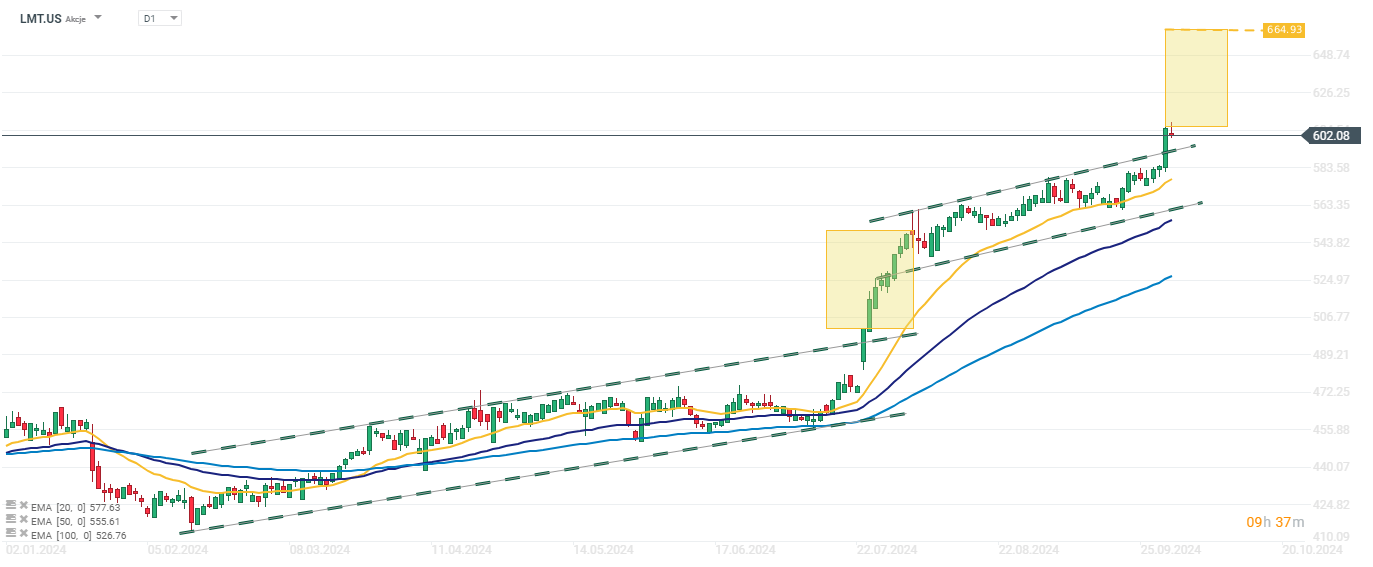
. Source: xStation




การประชุม Fed เดือนตุลาคม และประเด็นสำคัญที่ต้องจับตา



การยื่นเอกสาร IPO ของ Anthropic และความคืบหน้าการเจรจากับอิหร่านช่วยหนุนตลาดหุ้นสหรัฐฯ

Anthropic ยื่นเอกสารเตรียม IPO พร้อมใช้ตัวย่อ “ANT” บน Nasdaq แต่วันเปิดตัวและราคาเสนอขายยังเป็นปริศนา



Musk กู้เงิน 4 หมื่นล้านดอลลาร์ ลุย AI พร้อมเตือนคู่แข่งธุรกิจ Neocloud เสี่ยงเผชิญวิกฤตครั้งใหญ่